
Workplace stress is defined as the harmful physical and emotional response that occurs when job demands exceed coping ability, leaving employees depleted, unfocused, and at risk of burnout. The clinical term for this condition is occupational stress, and understanding how to manage workplace stress means working on two fronts simultaneously: reducing the demands placed on you and strengthening your capacity to cope with those that remain. Effective stress management techniques draw on tools like relaxation practices, workload prioritization, and peer support networks. The American Institute of Stress has developed a decision-style framework that categorizes stressors into five types, giving professionals a structured starting point rather than a vague directive to “just relax.”
How to manage workplace stress by identifying your stressors first
You cannot address what you have not named. The first step in any credible stress management plan is tracking exactly what triggers your stress response, when it happens, and how intense it feels. A simple journal, a notes app, or even a weekly calendar review can reveal patterns that feel invisible in the moment.

The American Institute of Stress recommends sorting every stressor through two questions: Does this matter to me? And do I have any control over it? This two-question filter separates productive worry from unproductive spinning. Stressors that matter and are within your control deserve a concrete action plan. Stressors that matter but are outside your control call for acceptance strategies and perspective shifts.
Once you have sorted your stressors, the American Institute of Stress groups them into five categories that make targeted action much easier:
- Schedule stress: Deadlines, back-to-back meetings, and time pressure. Address with calendar blocking and realistic scheduling.
- Suspense stress: Waiting for decisions, feedback, or outcomes you cannot control. Address with acceptance practices and clear communication timelines.
- Social stress: Conflict with colleagues, difficult managers, or isolation. Address with direct conversation, mediation, or peer support.
- Sudden stress: Unexpected crises, urgent requests, or last-minute changes. Address with pre-built response protocols and breathing techniques.
- System stress: Broken processes, unclear roles, or inadequate tools. Address with process clarification and escalation to leadership.
The key discipline here is taking one small, doable step per stressor rather than trying to solve everything at once. That single step prevents the overwhelm that turns stress awareness into anxiety.
Pro Tip: Use a free tool like Google Keep or Notion to log stressors in real time. After two weeks, review your entries and count which category appears most often. That category is where your energy belongs first.
What are the most effective ways to reduce your workload demands?
Reducing demands is the half of stress management that most professionals skip. They focus entirely on coping skills, which is like bailing water from a leaking boat without plugging the hole. Demand reduction paired with coping improvement consistently outperforms either approach alone.
The table below compares common demand-reduction tactics and their practical effectiveness for professionals dealing with work pressure.
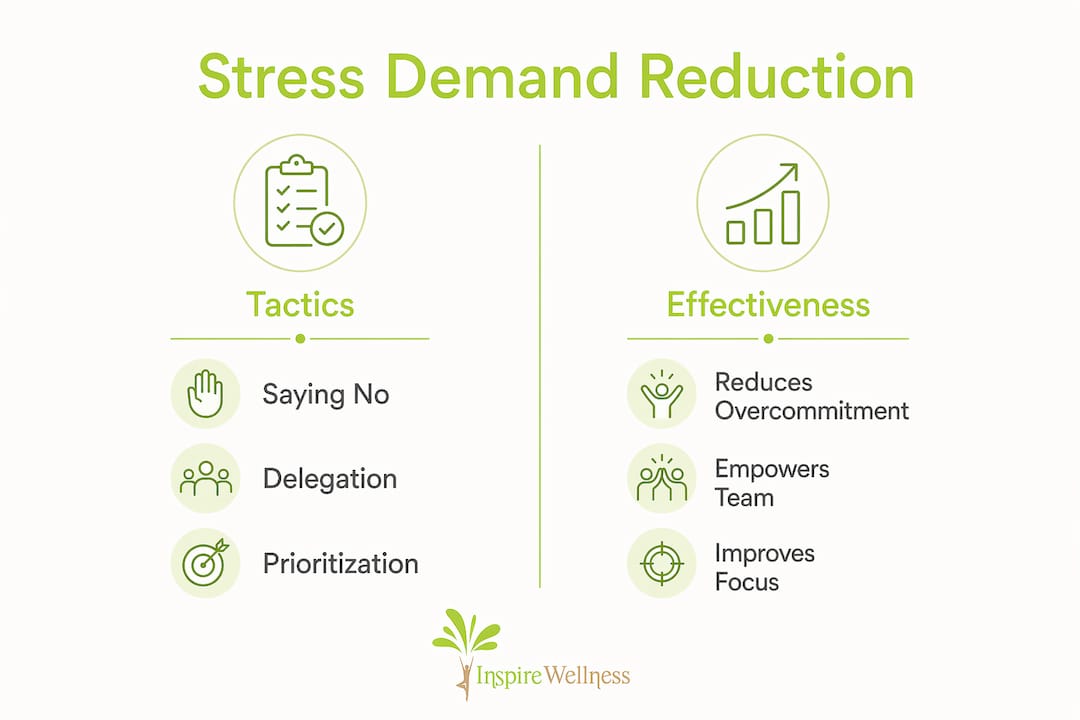
| Tactic | What it addresses | Effectiveness |
|---|---|---|
| Saying no to non-priority requests | Overcommitment and scope creep | High: directly reduces task volume |
| Delegating to capable colleagues | Bottlenecking and role overload | High: frees cognitive bandwidth |
| Batching similar tasks | Context-switching and mental fatigue | Moderate: improves focus and flow |
| Automating repetitive processes | Time-consuming low-value work | High: creates sustainable time savings |
| Using a prioritized daily task list | Decision fatigue and unclear focus | Moderate to high: structures effort |
Saying no is a skill, not a personality trait. Professionals who struggle with it often frame refusal as letting people down, when in reality, accepting every request reduces the quality of everything they deliver. A simple phrase like “I can take that on after I finish X, or I can hand it to someone with more capacity right now” protects your workload without damaging relationships.
Multitasking deserves special mention because it feels productive while actively increasing stress. Switching between tasks raises cortisol and reduces the quality of output on both tasks. Blocking focused time for one priority at a time, even in 45-minute windows, measurably reduces the cognitive load that feeds reducing office stress challenges.
Pro Tip: Try the Ivy Lee Method: at the end of each workday, write down the six most important tasks for tomorrow and rank them. Work through them in order the next day, moving nothing to the list until the first item is done. This single habit eliminates the morning decision fatigue that amplifies stress before 9 a.m.
How can you strengthen your coping skills to build real resilience?
Coping skills are the internal resources you draw on when demands cannot be reduced further. The Institute of Mental Health recommends three core practices: deep breathing, progressive muscle relaxation, and structured planning with calendars. These are not soft suggestions. They are evidence-backed interventions that regulate the nervous system and restore cognitive function.
Building emotional resilience in the workplace requires consistency more than intensity. A ten-minute daily practice outperforms an occasional hour-long session. The following habits, practiced daily, create a measurable buffer against occupational stress:
- Diaphragmatic breathing: Four counts in, hold for four, out for six. Three cycles before a stressful meeting resets your nervous system within minutes.
- Progressive muscle relaxation: Tense and release each muscle group from feet to shoulders. Ten minutes before sleep reduces cortisol and improves sleep quality.
- Mindfulness meditation: Apps like Headspace or Calm offer guided sessions from five minutes upward. Even brief daily practice reduces anxiety and improves focus over time.
- Consistent physical exercise: Three to five sessions per week of moderate activity, including walking, cycling, or strength training, directly lowers stress hormones and improves mood.
- Sleep protection: Seven to nine hours is not a luxury. Sleep deprivation amplifies every stress response and impairs the judgment needed to manage workload effectively.
- Social connection: Regular check-ins with trusted colleagues, mentors, or a professional counselor provide perspective and reduce the isolation that intensifies stress.
- Realistic expectation-setting: Accepting that some days will be harder than others, and that imperfect progress is still progress, prevents the perfectionism spiral that drives chronic stress.
Mindset is the least discussed but most powerful coping lever. Chronic stress causes persistent nervous system activation that reduces focus and creativity over time. Reframing a stressor as a challenge rather than a threat, a practice supported by cognitive behavioral research, measurably reduces the physiological stress response. This is not toxic positivity. It is a trained skill that improves with deliberate practice.
What role do leadership and workplace culture play in stress levels?
Individual coping skills have a ceiling. When workload is structurally excessive, roles are unclear, or communication is poor, personal resilience alone cannot prevent burnout. Employee stress is a business risk that requires leadership attention to systems and culture, not just individual wellness programs.
The organizational factors that most consistently drive occupational stress include:
- Excessive workload without adequate staffing: The CDC and NIOSH report that high workload and insufficient staffing are among the top workplace stressors, with supervisor support measurably reducing the severity of mental health symptoms.
- Poor communication and unclear expectations: Ambiguity about roles and priorities forces employees to make constant judgment calls under pressure, which is exhausting.
- Absence of psychological safety: When employees fear speaking up about unrealistic demands, stress accumulates silently until it surfaces as absenteeism or resignation.
- One-off wellness interventions: A 2026 systematic review found that organizational interventions preventing burnout are more effective than individual approaches, but their effects are short-term without ongoing commitment.
You can influence this environment even without a leadership title. Requesting regular one-on-ones with your manager to discuss workload, naming specific process inefficiencies in team meetings, and advocating for clear role boundaries are all forms of upward communication that shift culture incrementally. For managers, the evidence is clear: supportive supervisors buffer the mental health impact of high job demands. That makes leadership behavior one of the highest-leverage stress interventions available. You can explore what companies can do to reduce stress for a practical organizational perspective.
What are the common pitfalls in stress management and how do you fix them?
The most common mistake professionals make is waiting too long to act. Early stress signs, including irritability, low motivation, physical tension, and social withdrawal, are the body’s early warning system. Burnout is characterized by exhaustion, cynicism, and reduced efficacy, and it develops gradually from ignored early signals. Catching it at the irritability stage is far easier than recovering from full burnout.
A second frequent error is treating stress management as a one-time fix. Stressors change as roles evolve, teams shift, and organizational priorities move. Your plan needs the same flexibility. Review your stress journal monthly, reassess which category of stressor is dominant, and adjust your tactics accordingly.
The third pitfall is relying entirely on relaxation techniques while leaving demand overload unaddressed. Individual coping skills are insufficient when job demands remain overwhelming. Meditation helps, but it does not replace a conversation with your manager about an unsustainable workload.
Pro Tip: Set a monthly 20-minute calendar block called “Stress Audit.” Review your journal, check your energy levels, and ask yourself: Has anything changed that requires a new tactic? This habit keeps your plan current and prevents the slow drift back into reactive coping.
When symptoms persist despite consistent effort, seeking professional support is not a sign of weakness. It is the most direct path back to functioning well. A counselor, psychologist, or personalized stress management program can provide structured support that self-directed strategies cannot always replicate.
Key takeaways
Managing workplace stress requires combining demand reduction with consistent coping skill development, supported by leadership engagement and ongoing self-monitoring.
| Point | Details |
|---|---|
| Identify and categorize stressors | Use the American Institute of Stress two-question method to sort stressors by importance and control. |
| Reduce demands actively | Say no, delegate, and batch tasks to lower workload before relying on coping skills alone. |
| Build daily coping habits | Practice breathing, exercise, sleep protection, and social connection consistently, not occasionally. |
| Engage leadership and culture | Advocate for clear roles, realistic workloads, and ongoing wellness programs rather than one-off workshops. |
| Monitor and adjust your plan | Review your stress triggers monthly and update your tactics as your role and environment change. |
What I have learned about stress that most articles get wrong
When I work with professionals on occupational stress, the pattern I see most often is this: they have tried the relaxation techniques, they have downloaded the meditation apps, and they still feel overwhelmed. The reason is almost always the same. They are managing their response to an unreasonable situation rather than addressing the situation itself.
The demand side of the equation gets far less attention than it deserves. Telling a professional with 60 hours of work and 40 hours of capacity to breathe more deeply is not a solution. It is a delay. The real work is in the honest conversation with a manager, the boundary set with a client, or the process escalated to leadership. Those conversations feel harder than a breathing exercise, which is exactly why most people avoid them.
What I have also seen is that the professionals who recover most effectively from chronic work stress are not the ones with the most sophisticated coping toolkit. They are the ones who build a support network and use it consistently. A trusted colleague, a mentor outside your team, or a professional coach changes the experience of stress from something you endure alone to something you process and act on with support.
The encouragement I offer is this: progress does not require perfection. One honest conversation, one delegated task, one morning of protected focus time. These are not small steps. They are the actual work.
— Neelam
How Inspire-wellness supports your stress management journey
At Inspire-wellness, we work with professionals and organizations across Dubai and the UAE to build workplace wellbeing programs that address stress at both the individual and organizational level. Our approach combines behavioral science, resilience training, and personalized coaching to help employees reduce demands, strengthen coping capacity, and build the kind of workplace culture where people genuinely thrive. Whether you are an individual professional looking for structured support or an HR leader seeking a proven wellbeing program for your team, we offer tailored solutions that go beyond one-off workshops. Explore our full range of employee wellbeing programs and take the first step toward a healthier, more productive work experience.
FAQ
What is the most effective way to reduce workplace stress?
The most effective approach combines reducing job demands, through delegation, prioritization, and boundary-setting, with building coping skills like relaxation techniques and social support. Individual and organizational approaches together consistently outperform either strategy alone.
How do I know if I am experiencing burnout rather than normal stress?
Burnout presents as persistent exhaustion, cynicism toward your work, and a measurable drop in your sense of effectiveness. If these symptoms last more than two weeks despite rest, professional support is the recommended next step.
Why does stress management at work matter for productivity?
Chronic stress reduces focus, creativity, and decision-making capacity by keeping the nervous system in a persistent activation state. Managing stress directly restores the cognitive resources that drive performance.
Can my manager actually help reduce my stress levels?
Yes. Supervisor support measurably reduces the severity of mental health symptoms caused by high job demands. Requesting regular workload check-ins and naming specific pressure points gives your manager the information needed to intervene effectively.
How often should I review my stress management plan?
A monthly review is sufficient for most professionals. Reassess your dominant stressor category, check whether your current tactics are working, and adjust based on any changes in your role, team, or workload.