Stress doesn’t just wear individuals down. It quietly dismantles the systems that make teams work. When stress levels rise, communication falters, trust erodes, and the collective capacity to solve problems drops faster than most leaders realize. Research on teams across aviation, nuclear engineering, and construction confirms that team performance deteriorates under elevated stress, with coordination and accuracy declining in measurable ways. For managers and HR professionals, understanding why stress affects teams at a structural level is the first step toward protecting both people and performance.
Here is how stress typically shows up across a team:
- Communication breaks down. Members miss critical information, misread tone, and stop sharing updates proactively.
- Decision quality drops. Cognitive overload narrows thinking, leading to reactive choices rather than considered ones.
- Conflict increases. Emotional strain reduces patience and empathy, making disagreements more frequent and harder to resolve.
- Creativity stalls. Teams under pressure default to familiar routines and resist the experimentation that drives growth.
- Morale and motivation decline. Sustained pressure without support leads to disengagement, absenteeism, and eventually turnover.
- Collaboration weakens. Members retreat into siloed work, losing the shared awareness that makes coordinated effort possible.
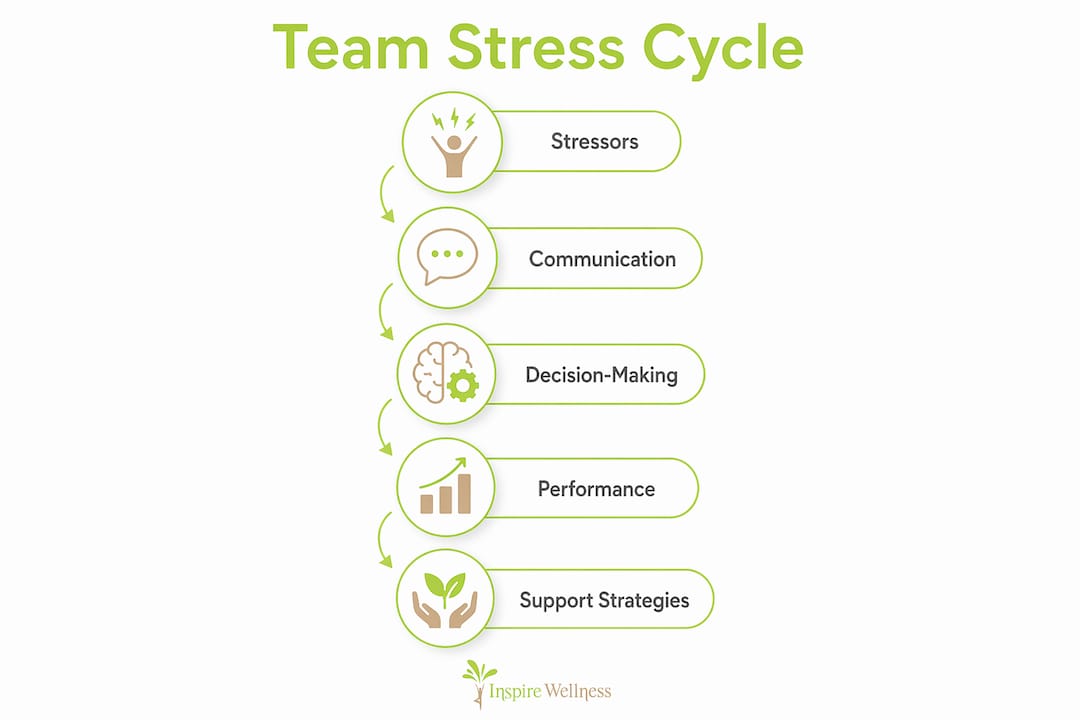
Each of these effects compounds the others. A team that communicates poorly will make worse decisions, which generates more conflict, which further erodes morale. Recognizing this cycle early is what separates leaders who manage stress well from those who inadvertently accelerate it.
How stress disrupts team collaboration and communication
Stress doesn’t just affect individuals in isolation. It spreads. Research on emotional contagion in teams shows that when one team member experiences high stress, colleagues with strong emotional attunement converge toward similar stress levels, creating a ripple effect that degrades collective wellbeing. This is why team-level interventions consistently outperform individually targeted support in high-stress environments.
The communication failures that follow are specific and predictable:
- Narrowed attentional focus. Under stress, team members concentrate almost entirely on their immediate task, pulling attention away from coordination, planning, and team learning. Nuclear plant crews and flight teams have both identified this narrowing as a direct cause of coordination breakdowns.
- Loss of situational awareness. When stress rises, members stop monitoring what colleagues need and fail to anticipate information gaps. Teams with lower situational awareness perform less efficiently, even when individual competence remains high.
- Reduced psychological safety. Emotional strain makes people less willing to speak up, ask questions, or flag errors, precisely the behaviors that keep teams aligned.
- Information hoarding. Stressed team members often revert to siloed work, sharing less and assuming more, which creates misalignment across the group.
- Tone misreads. Stress heightens threat sensitivity, so neutral messages get interpreted as criticism, and constructive feedback lands as an attack.
The practical consequence is that a team under sustained pressure gradually loses the shared understanding it needs to function. Members know their own tasks but lose track of the bigger picture, and that fragmentation is where performance really suffers.
Pro Tip: Schedule brief, structured check-ins during high-pressure periods, not to review tasks, but specifically to surface how the team is feeling. A five-minute pulse check can catch contagion effects before they spread.

How stress affects team decision-making and leadership functions
Stress impairs the cognitive and emotional resources that good decisions require. When the brain is in a threat response, working memory shrinks, risk assessment becomes skewed toward short-term relief, and the capacity for creative problem-solving contracts. For teams, this plays out as a collective shift toward rigid, familiar responses at exactly the moments when adaptive thinking matters most.
The effects on decision-making and leadership are layered:
- Cognitive overload reduces decision quality. Teams under elevated stress show rigid behavior, reduced adaptability, and poor coordination, losing the environmental monitoring that complex decisions require.
- Leaders amplify stress unintentionally. Research from MIT Sloan found that leaders often intensify the pressures employees already feel, triggering fight-or-flight responses rather than easing them. A controlling or confrontational leadership style under pressure is one of the fastest ways to accelerate team dysfunction.
- Decision fatigue sets in faster. Stressed teams exhaust their capacity for deliberate thinking more quickly, defaulting to shortcuts that feel safe but often aren’t.
- Creativity and problem-solving decline. Novel challenges require psychological bandwidth that stress consumes. Teams default to what worked before, even when the situation calls for something different.
- Emotional regulation weakens across the group. When leaders lose composure, it signals to the team that the situation is more threatening than it may actually be, compressing the space for calm, considered choices.
The MIT Sloan research offers a sobering illustration: a new unit director at a professional services firm introduced few procedural changes but brought a controlling, confrontational style. Within 18 months, 75% of the team had resigned, and many sought counseling to recover from the emotional toll. The director’s behavior, not the workload itself, was the primary driver of dysfunction.
What workplace stressors most commonly cause team dysfunction
Not all stress is created equal, and understanding its sources helps leaders target interventions precisely. Research across aviation, construction, and engineering teams identifies three primary stressor categories that consistently undermine team performance:
- Performance pressure. Tight deadlines, high-stakes outcomes, and constant evaluation create a threat state that narrows focus and reduces the collaborative behaviors teams need. When every deliverable feels critical, members stop investing in coordination and start protecting their own output.
- Role ambiguity. Unclear responsibilities create confusion about who owns what, leading to duplicated effort, dropped tasks, and interpersonal friction. Teams with poorly defined roles show measurable declines in situational awareness and coordination quality.
- Time pressure. When there is never enough time, teams cut the communication and planning steps that sustain performance. The irony is that skipping these steps usually costs more time in errors and rework than the shortcuts saved.
Each stressor operates at a cognitive level before it becomes a behavioral one. Performance pressure degrades working memory. Role ambiguity fragments the shared mental model that keeps a team aligned. Time pressure eliminates the reflection that allows teams to learn and adapt. Together, they create an environment where even capable, motivated people struggle to perform at their best.
Understanding these stressors also helps HR professionals design more targeted support. A team struggling with role ambiguity needs clarity and structure, not a mindfulness workshop. A team under time pressure may benefit more from workload redistribution than from resilience training alone.
Strategies leaders can use to support teams under stress
The most effective leaders don’t just absorb stress themselves. They actively reduce the conditions that generate it and build the team’s capacity to handle what remains. This requires both structural interventions and consistent behavioral choices.
- Model trust, not control. Leaders who respond to pressure by tightening control accelerate dysfunction. Shifting toward transparency, shared problem-solving, and genuine acknowledgment of difficulty builds the psychological safety that teams need to communicate honestly under pressure.
- Build shared mental models through cross-training. When team members understand each other’s roles and knowledge, they can anticipate needs and fill gaps without being asked. Cross-training is one of the most evidence-backed interventions for maintaining team performance under stress.
- Implement time management and conflict resolution training. Proactive organizational programs, including time management workshops and structured conflict resolution, are empirically shown to reduce burnout and improve team cohesion under sustained pressure.
- Detect stress signs early. Training managers to recognize early indicators of stress, such as withdrawal, irritability, declining output quality, and increased errors, correlates with higher team satisfaction and reduced turnover. The role of managers in wellbeing is most powerful when it is proactive rather than reactive.
- Prioritize team-level interventions over individual ones. Because stress spreads through emotional contagion, addressing it only at the individual level misses the group dynamics driving the problem. Team-wide approaches, including regular check-ins, shared goal-setting, and group reflection, interrupt the contagion cycle more effectively.
- Clarify roles and responsibilities during high-pressure periods. When workload spikes, role clarity often degrades. Explicitly reconfirming who owns what prevents the ambiguity that compounds stress and erodes coordination.
Pro Tip: When you notice a team member becoming increasingly withdrawn or reactive, address it privately and early. Managers who recognize stress signs before they escalate protect both the individual and the team’s collective performance.
Knowing your team members’ working styles and pressure points is also foundational. Leaders who understand senior manager dynamics can better calibrate when to step in and when to give space, a distinction that matters enormously during high-stress periods.

Building a resilient workforce through structured wellness programs
Individual resilience matters, but it develops within a system. When organizations invest in structured wellness programs, they create the conditions where teams can absorb pressure without fracturing. The evidence for this is consistent across corporate case studies: wellness programs improve emotional regulation, energy management, and resilience, reducing stress-related turnover and productivity loss in measurable ways.
What effective programs actually deliver for teams:
- Emotional resilience training builds the capacity to regulate responses under pressure, reducing the reactive behaviors that damage team relationships and decision quality.
- Energy management frameworks help team members sustain performance across long or demanding periods without burning through their reserves.
- Behavioral science-backed coaching addresses the cognitive patterns that make stress worse, including catastrophizing, avoidance, and perfectionism, at both the individual and team level.
- Structured mental health support reduces the stigma around seeking help and gives team members practical tools before stress becomes a crisis.
- Leadership development integrated with wellbeing equips managers to model healthy responses to pressure, which directly shapes team culture.
Research insight: Corporate case studies consistently demonstrate positive return on investment from sustained wellness initiatives, with gains in productivity, retention, and team cohesion that outpace the cost of program delivery.
The World Health Organization recognizes mental health at work as a global priority, noting that supportive work environments protect against the development of mental health conditions and improve overall performance. Organizations that treat wellness as a structural investment rather than a discretionary benefit tend to see stronger team outcomes, particularly during periods of organizational change or sustained pressure.
Building team situational awareness and transactive memory, knowing who knows what and who can do what, is itself a wellness outcome. Teams with these cognitive structures intact handle stress more effectively because they don’t lose coordination when pressure rises.
Long-term consequences of unmanaged stress on team retention and productivity
Chronic, unmanaged stress doesn’t plateau. It compounds. What begins as reduced communication quality and occasional conflict gradually becomes a pattern of disengagement, absenteeism, and attrition that is far more costly to reverse than it would have been to prevent.
The long-term picture for teams that don’t receive adequate support is consistent and concerning. Turnover accelerates as high performers, who typically have the most options, leave first. The institutional knowledge they carry leaves with them, weakening the transactive memory that helps remaining members coordinate. New hires enter a team already depleted, making onboarding harder and extending the performance gap.
Productivity losses compound in parallel. Teams operating under chronic stress default to reactive, task-focused work and lose the capacity for the planning, learning, and adaptation that drive long-term output. Creativity, which requires psychological safety and cognitive bandwidth, is often the first casualty and the last to return.
The risk of workplace burnout escalates significantly when stress goes unaddressed for extended periods. Burnout is not simply exhaustion. It involves a fundamental disconnection from work and colleagues that takes months to recover from, even with intervention. For teams, one burned-out member can pull others toward the same state through emotional contagion, creating a cycle that leadership changes alone cannot break.
The financial dimension is real too. The CDC’s National Institute for Occupational Safety and Health identifies workplace stress as a significant driver of healthcare costs, absenteeism, and reduced productivity across American organizations. Addressing stress proactively, through leadership development, wellness programs, and structural role clarity, consistently costs less than managing the downstream consequences of burnout and turnover.
Key Takeaways
Unmanaged team stress consistently degrades communication, decision-making, and morale, making proactive leadership and structured wellness investment the most effective path to sustained team performance.
| Point | Details |
|---|---|
| Stress spreads through teams | Emotional contagion means one stressed member can lower wellbeing across the whole group, making team-level interventions more effective than individual support alone. |
| Three stressors drive most dysfunction | Performance pressure, role ambiguity, and time pressure are the primary sources of team cognitive and emotional strain, each requiring targeted responses. |
| Leaders can amplify or reduce stress | Controlling leadership behaviors escalate team dysfunction; modeling trust and psychological safety actively reduces it. |
| Cross-training builds stress resilience | Developing shared mental models and situational awareness through cross-training helps teams maintain coordination when pressure rises. |
| Early detection protects retention | Managers trained to recognize stress signs early correlate with higher team satisfaction and lower turnover rates. |
Ready to build a team that performs under pressure?

At Inspire-wellness, we work with managers, HR leaders, and organizations to design wellness programs that address stress at the team level, not just the individual one. From emotional resilience coaching to corporate wellness programs built around behavioral science, our approach is grounded in the same research that informs this guide.
If you’re ready to move from reactive stress management to a proactive culture of wellbeing, explore how Inspire-wellness can support your team’s long-term performance and resilience.