
Coaching is defined as a structured, goal-directed process that improves employee performance by developing behavioral skills, cognitive self-regulation, and work engagement. The role of coaching in performance is no longer a soft-skills conversation. It is a measurable, evidence-backed driver of organizational results. Research from the International Coaching Federation (ICF), Google, and Cleveland Clinic confirms that when coaching is applied consistently and aligned with leadership direction, it produces gains in goal attainment, self-awareness, and sustained productivity. For HR professionals and business leaders, understanding how to deploy coaching effectively is one of the highest-return investments available.
What does the evidence say about coaching’s impact on performance?
The most rigorous data available comes from a 2026 meta-review of 11 RCTs involving 15,278 participants, which found coaching produces a moderate to strong positive effect on professional performance, emotional competence, self-awareness, and goal attainment, with a Hedges’ g of approximately 0.58. An effect size at that level places coaching alongside other well-validated organizational interventions. This is not marginal improvement. It is the kind of shift that shows up in performance reviews, retention data, and team output.
The same meta-review found that long-term, individually tailored coaching formats and cognitive-behavioral approaches produced the strongest results. External assessments, rather than self-reports, showed even higher effect sizes, which means the gains are visible to others, not just felt internally. That distinction matters enormously when you are building a business case for a coaching program.

A 2026 Springer Nature study of 9,341 employees found that leader coaching behavior positively moderates the relationship between goal-focused leadership and employee person-job fit, which in turn increases work engagement. In plain terms: when managers coach with purpose and direction, employees feel better matched to their roles and more motivated to perform. This finding positions coaching not as a remedial tool but as a proactive performance driver.
The behavioral and cognitive mechanisms behind these gains are also well understood. Goal setting and reflective thinking explain coaching’s performance improvements more than attitude shifts or personality changes. Coaching works because it changes what people do and think, not just how they feel about their work.
| Study | Sample | Key Outcome | Effect / Scale |
|---|---|---|---|
| 2026 Meta-Review (RCTs) | 15,278 participants | Performance, goal attainment, emotional competence | Hedges’ g ≈ 0.58 |
| Springer Nature (2026) | 9,341 employees | Work engagement, person-job fit | Positive moderation |
| Cleveland Clinic (2024) | Global leaders and caregivers | Self-awareness, accountability, leadership alignment | 826 coaching hours |
| CCL Team Coaching Research | Executive teams | Collaboration, collective leadership | Measurable gains at 1 year |
How do different coaching approaches enhance performance?
Not all coaching methods produce equal results, and HR professionals who treat coaching as a single uniform practice will consistently underperform those who match the approach to the context. The GROW model, developed by Sir John Whitmore and now championed by Google’s re:Work program, remains one of the most widely adopted frameworks. GROW stands for Goal, Reality, Options, and Will. It structures conversations around where an employee wants to go, where they currently are, what paths exist, and what they will commit to doing. Google’s research shows that top-performing managers use GROW not as a rigid script but as a flexible guide that adapts to each employee’s readiness and receptiveness.
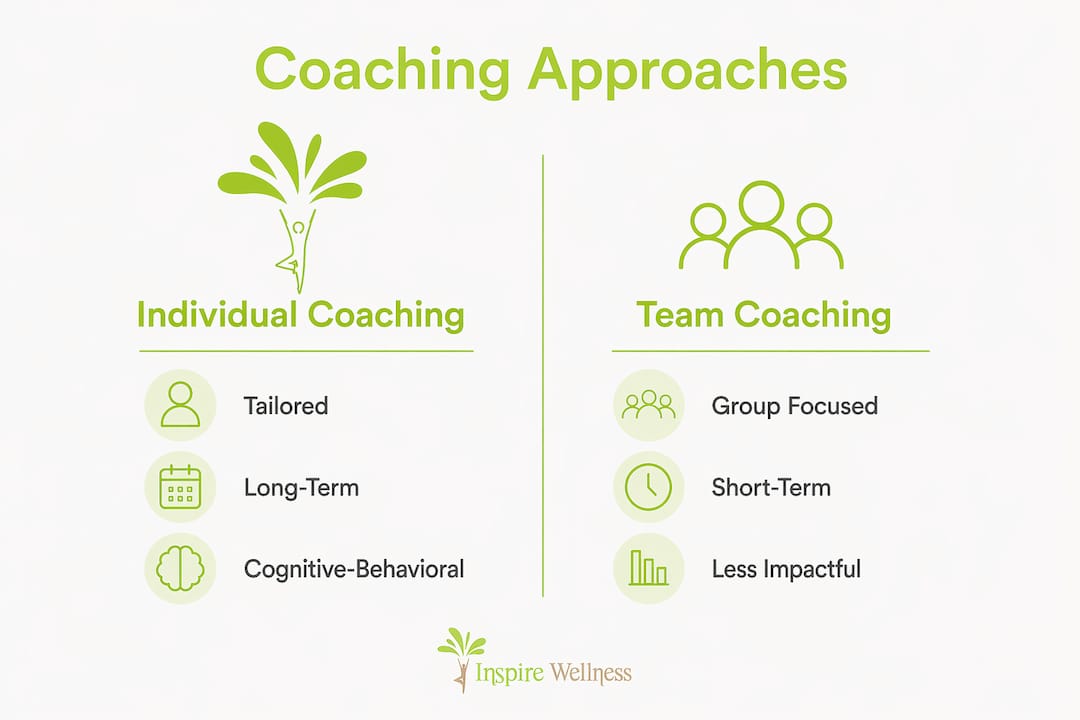
Cognitive-behavioral coaching (CBC) takes a more structured approach, targeting the thought patterns and beliefs that drive behavior. CBC is particularly effective for employees who are stuck in unproductive habits or who struggle with self-limiting assumptions about their capabilities. The 2026 meta-review specifically identified cognitive-behavioral approaches as producing stronger performance outcomes than general coaching conversations, which makes CBC a strong choice for high-stakes development work.
Team coaching, as documented by the Center for Creative Leadership (CCL), addresses collective performance rather than individual skill gaps. One year of executive team coaching produces measurable gains in alignment, collaboration, and shared leadership effectiveness. This is especially relevant for HR leaders managing cross-functional teams or newly formed leadership groups that need to build trust and direction quickly.
The core techniques that underpin effective coaching across all models include:
- Active listening: Giving full attention to what the employee says and what they leave unsaid, then reflecting it back to surface assumptions
- Powerful questioning: Asking open questions that prompt reflection rather than leading the employee toward a predetermined answer
- Goal-setting: Translating broad aspirations into specific, time-bound commitments that can be tracked and reviewed
- Structured feedback: Delivering observations on behavior and outcomes in a way that is specific, timely, and forward-looking
- Accountability check-ins: Following up on commitments made in coaching sessions to reinforce behavior change over time
Pro Tip: Avoid coaching by formula. Google’s research confirms that the managers who produce the strongest results flex their style to each individual rather than following a scripted sequence. The GROW model is a compass, not a checklist.
What role does a coaching culture play in sustaining performance?
Individual coaching sessions produce real gains, but those gains erode quickly when the surrounding organizational culture does not reinforce them. A coaching culture is defined by the ICF and the Human Capital Institute (HCI) as an environment where leadership actively values coaching, dedicates budget to it, and treats it as a systemic capability rather than an occasional intervention. The ICF/HCI research reveals a striking gap: 85% of surveyed professionals report that their managers use coaching skills, yet only 27% of employees have access to a professional coach practitioner. That gap represents enormous untapped potential.
Organizations that close this gap see measurable benefits beyond performance scores. The same ICF/HCI data shows that strong coaching cultures reduce burnout and stress, which directly supports retention and reduces the hidden costs of disengagement. For HR professionals managing emotional resilience in the workplace, this connection between coaching culture and burnout reduction is a compelling argument for leadership investment.
| Dimension | Individual coaching | Coaching culture |
|---|---|---|
| Reach | One person at a time | Entire workforce |
| Sustainability | Fades without reinforcement | Self-reinforcing through norms |
| Burnout reduction | Moderate, context-dependent | Consistent, systemic |
| Leadership alignment | Depends on the coach | Built into management practice |
| ROI visibility | Session-level outcomes | Organizational performance trends |
Cleveland Clinic’s approach illustrates what a mature coaching culture looks like in practice. In 2024, 60 coaches delivered 826 coaching hours globally, using a proprietary ICF-derived model that combines quantitative and qualitative measurement to track sustained behavior change. The focus areas were self-awareness, accountability, and alignment of leadership behavior with organizational values. That combination of scale, structure, and measurement is what separates a coaching culture from a coaching program.
Pro Tip: Integrate coaching conversations directly into your existing goal-setting and performance review cycles. When coaching is a standalone event, it competes for attention. When it is woven into the rhythms of how your organization already operates, it becomes the default way leaders develop their people.
How can HR leaders implement coaching for lasting performance gains?
Knowing that coaching works is not the same as knowing how to build it into your organization at scale. The implementation gap is real. Only 1 in 5 managers provide effective coaching and feedback, and WorldatWork’s 2025 research links this directly to poor goal-setting and inconsistent performance management. The problem is not that managers are unwilling. It is that most organizations have never built the infrastructure to make good coaching possible.
Here is a practical sequence for HR professionals and business leaders ready to change that:
- Assess manager coaching capability first. Use 360-degree feedback or structured observation to identify where coaching skills are strong and where they break down. This baseline prevents you from designing programs that miss the actual gaps.
- Build manager enablement before scaling. Train managers in core coaching skills, including active listening, questioning, and feedback delivery, before expecting them to coach their teams. Credentialing through ICF-recognized programs adds rigor and accountability.
- Align coaching objectives with business priorities. Coaching that is disconnected from organizational goals loses credibility quickly. Work with senior leaders to identify the two or three performance behaviors the organization most needs to develop, then design coaching conversations around those.
- Measure with both numbers and narratives. Cleveland Clinic’s model combines quantitative tracking with qualitative follow-up to determine whether behavior change persists beyond the coaching window. Sentiment surveys alone will not tell you whether coaching is working. Observable behavior change will.
- Address inconsistency as a systemic issue. Disconnected or episodic coaching fails to sustain improvements. Build regular coaching touchpoints into team rhythms, not just annual development conversations.
- Expand access progressively. Start with senior leaders and high-potential employees, then use peer coaching and manager-as-coach models to extend reach without proportionally increasing cost.
Managerial coaching quality is a systemic capability, not an individual talent. HR’s role is to build the infrastructure, the training, the measurement systems, and the cultural norms that make good coaching the expected standard rather than the exception.
Key takeaways
Coaching improves employee performance by changing behaviors and cognitive habits, and sustaining those gains requires embedding coaching into leadership culture, manager capability, and organizational measurement systems.
| Point | Details |
|---|---|
| Evidence is strong | A 2026 meta-review found a Hedges’ g of 0.58, placing coaching among the most effective organizational interventions. |
| Approach matters | Cognitive-behavioral and individually tailored formats produce stronger results than generic coaching conversations. |
| Culture amplifies impact | ICF/HCI research shows coaching cultures reduce burnout and extend performance gains across the entire workforce. |
| Manager capability is the bottleneck | Only 1 in 5 managers coach effectively; HR must treat this as a systemic infrastructure problem, not an individual one. |
| Measurement must go beyond sentiment | Tracking observable behavior change and using qualitative follow-up, as Cleveland Clinic does, reveals whether coaching is truly working. |
What I’ve learned about coaching that most guides won’t tell you
By Neelam
After working with HR leaders and business teams across the region, the pattern I see most often is this: organizations invest in coaching programs and then measure success by participation rates and satisfaction scores. Both metrics are nearly useless for predicting performance outcomes. What actually predicts sustained improvement is whether the coaching conversation changed a specific behavior that the employee then repeated in their daily work.
The research backs this up. Goal setting and reflective thinking are the mechanisms that drive performance gains, not general feelings of being supported. That means your measurement framework needs to track whether employees are setting clearer goals, reflecting on their progress, and adjusting their approach. If your current coaching program cannot answer those questions, it is measuring the wrong things.
The other pattern I see is what I call episodic coaching: a workshop here, a one-off session there, with no connection to the manager’s daily leadership behavior or the organization’s performance expectations. This approach produces temporary enthusiasm and very little lasting change. The organizations that get real results treat coaching as a leadership capability that is built, practiced, and reinforced continuously. They also connect coaching directly to how leaders manage stress and model resilience, because a leader who cannot regulate their own pressure cannot coach others through theirs.
My honest recommendation: start smaller than you think you need to, measure more rigorously than feels comfortable, and build from demonstrated results rather than assumed ones.
— Neelam
How Inspire-wellness can support your coaching strategy
At Inspire-wellness, we work with HR professionals and business leaders across the UAE to design coaching and wellbeing programs that connect directly to performance outcomes. Our approach combines behavioral science, wellbeing coaching, and structured measurement frameworks to help organizations move from episodic coaching to a genuine coaching culture.
Whether you are building your first manager coaching capability program or scaling an existing initiative, our team can help you design something that fits your organizational context and produces results you can measure. Explore our workplace wellbeing improvement guide for a practical, step-by-step process built specifically for HR professionals. You can also review our corporate wellness programs to see how we integrate coaching with broader employee health and resilience strategies. We would welcome the conversation.
FAQ
What is the role of coaching in employee performance?
Coaching improves employee performance by developing behavioral skills, cognitive self-regulation, and goal attainment. A 2026 meta-review of 15,278 participants found a moderate to strong effect size (Hedges’ g ≈ 0.58) across professional performance, emotional competence, and self-awareness.
How does coaching effectiveness differ across team and individual formats?
Individual coaching with long-term, tailored formats produces the strongest performance gains, while team coaching, as documented by CCL, improves collective alignment, collaboration, and shared leadership effectiveness within approximately one year.
Why do so many coaching programs fail to sustain results?
Episodic or disconnected coaching fails because it lacks integration with leadership direction and accountability systems. WorldatWork’s 2025 research shows only 1 in 5 managers coach effectively, pointing to a systemic infrastructure gap rather than individual unwillingness.
How should HR measure the impact of a coaching program?
Effective measurement combines quantitative performance tracking with qualitative follow-up to assess whether behavior change persists beyond the coaching window. Cleveland Clinic’s model, which tracked 826 coaching hours in 2024, demonstrates how this mixed approach reveals sustained impact.
What is a coaching culture and why does it matter?
A coaching culture is an organizational environment where leadership values coaching, dedicates budget to it, and integrates it into management practice at every level. ICF/HCI research shows that strong coaching cultures reduce burnout, extend performance gains across the workforce, and produce results that individual coaching alone cannot sustain.