Step by step wellness initiatives are structured, evidence-based programs designed to systematically improve employee health, engagement, and organizational performance across every level of a company. In corporate wellness practice, these are also called worksite health programs or employee wellbeing frameworks. The most effective versions combine leadership commitment, behavioral science, and continuous measurement to create lasting culture change rather than short-lived perks. Organizations that follow a deliberate, phased approach consistently outperform those that launch ad hoc wellness activities, seeing measurable reductions in absenteeism, burnout, and turnover. This guide walks HR professionals and corporate leaders through each phase of building a program that actually works.
What are the critical first steps to plan effective wellness initiatives?
Sustainable wellness programs begin with a clear strategic foundation, not a list of activities. Defining your ‘why’ before selecting any program elements is the single most important planning decision you will make. Without a defined purpose tied to business priorities, such as reducing absenteeism, improving retention, or lowering healthcare costs, wellness efforts tend to drift and lose funding within two years.
Follow these four foundational steps before designing a single program element:
-
Set strategic goals aligned to business outcomes. Identify two or three measurable targets that connect directly to organizational priorities. If your company is managing high turnover in a specific department, frame your wellness goal around engagement and stress reduction for that group specifically.
-
Secure leadership commitment and name wellness champions. Leadership active involvement raises participation rates and drives genuine behavior change across teams. Appoint visible champions at the senior and middle management levels who model healthy behaviors publicly, whether that means attending a lunchtime walk or sharing their experience with a mental health resource.
-
Assess employee needs through multiple data sources. Use anonymous surveys, HR data on sick days and turnover, and optional focus groups to understand what employees actually need versus what leadership assumes they need. A manufacturing team in Dubai may prioritize physical recovery and hydration, while a remote tech team may need mental health support and social connection tools.
-
Define measurable, realistic objectives. Translate your goals into specific KPIs before launch. Participation rate targets, absenteeism reduction percentages, and engagement survey scores all give you a baseline to measure against at 90 days, six months, and one year.
Pro Tip: Run a short pulse survey of 5 to 8 questions before any planning meeting with leadership. Real employee data in the room changes the conversation from opinion to evidence, and it dramatically shortens the time needed to reach alignment on priorities.
How to design a multi-component wellness program that engages employees

Program design is where most organizations either build something meaningful or create a wellness catalog that nobody uses. The most effective programs address physical, mental, social, and financial wellbeing together, because these dimensions are deeply interconnected in how employees experience work.
Consider building your program around these core components:
- Physical wellbeing: Subsidized gym memberships combined with organized fitness classes on-site or virtually produce better outcomes than either option alone. Walking challenges, ergonomic assessments, and nutrition workshops round out physical support.
- Mental health resources: Employee Assistance Programs (EAPs), access to licensed counselors, and structured resilience training address the growing burden of workplace stress. Normalize these resources through leadership storytelling, not just policy documents.
- Social connection: Team-based wellness challenges, peer recognition programs, and community volunteer days build the relational fabric that makes work feel meaningful. Isolation is a significant health risk, particularly in hybrid and remote environments.
- Financial wellbeing: Workshops on budgeting, retirement planning, and debt management reduce the cognitive load that financial stress places on employees during work hours.
- Work-life balance: Flexible scheduling, protected lunch breaks, and clear boundaries around after-hours communication are structural supports, not optional perks.
Integrating wellbeing into daily workflows through low-friction digital nudges, such as timed break reminders or a two-minute mindfulness prompt before a recurring meeting, significantly improves adoption and sustainability. McKinsey’s 2026 research confirms that accessibility and workflow integration are the primary drivers of long-term program uptake.
| Program element | Low-friction integration example |
|---|---|
| Physical activity | 10-minute stretch break built into team meeting agendas |
| Mental health | Weekly mindfulness prompt sent via Slack or Microsoft Teams |
| Social connection | Monthly peer recognition channel with leadership participation |
| Financial wellbeing | Quarterly 30-minute financial literacy webinar during work hours |
| Nutrition | Healthy snack options in office kitchens alongside vending machines |
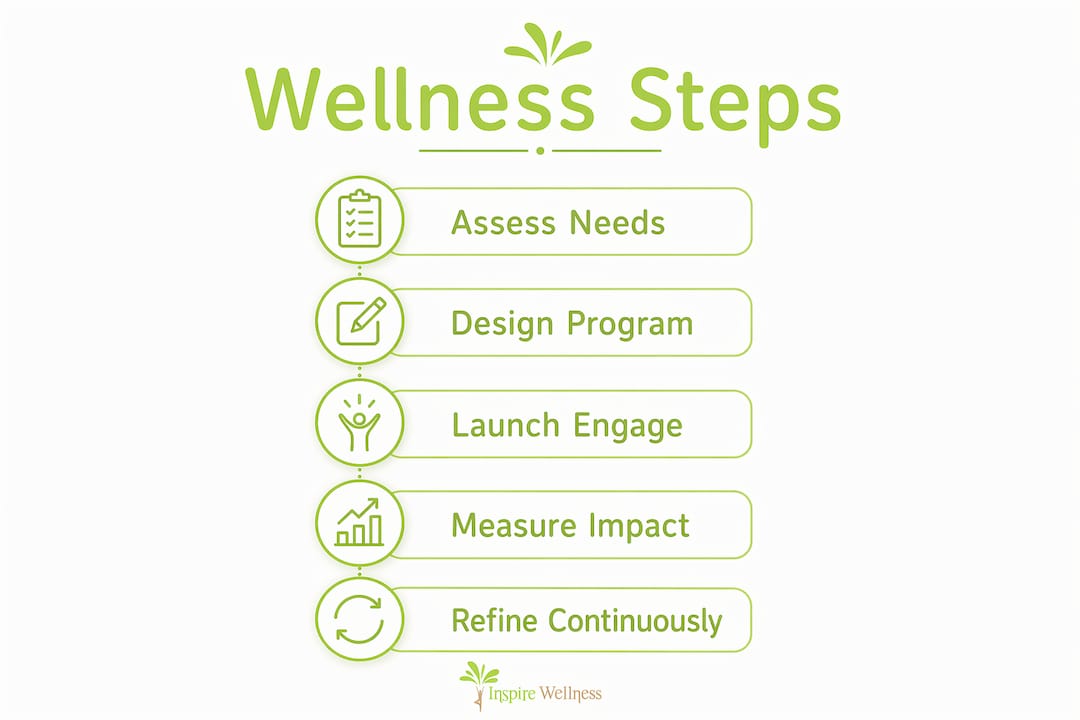
The CDC Worksite Health ScoreCard provides a validated framework for assessing which program elements your organization currently offers and where the gaps are. Using it during the design phase gives your program a credible, evidence-based structure that leadership and employees can trust.
Pro Tip: Avoid designing a program that only appeals to employees who are already health-conscious. The biggest wellbeing gains come from reaching the middle 60% of your workforce, those who are neither highly engaged nor actively disengaged. Design for them first.
What are best practices for program launch, communication, and engagement?
A well-designed program that nobody knows about produces zero results. Multi-channel communication strategies including meetings, emails, intranet posts, and physical posters yield measurably better awareness and participation than single-channel announcements.
Use this launch sequence to build momentum without overwhelming employees:
-
Pre-launch awareness campaign (4 to 6 weeks before). Share the “why” behind the program through a message from senior leadership. Use email, team meetings, and your intranet to build anticipation. Avoid leading with features; lead with the benefit to the individual employee.
-
Pilot with a volunteer group. Select a cross-functional group of 15 to 30 employees to test your program before full rollout. Gather structured feedback after 30 days using a short survey and one or two focus groups. This step catches friction points before they affect your entire workforce.
-
Full launch with visible leadership participation. When the CEO or CHRO participates in the launch event, attendance and early sign-ups increase significantly. Incentives and leadership modeling increase uptake, but programs must balance positive reinforcement with respect for employee autonomy to avoid backlash.
-
Sustain engagement through regular communication. Share success stories, participation milestones, and program updates monthly. Celebrate team achievements publicly. Recognize participation without singling out individuals in ways that feel invasive or pressuring.
-
Create feedback loops from day one. Build a standing mechanism for employees to share what is working and what is not, whether through a dedicated email address, a quarterly survey, or a wellness committee with rotating membership. Employees who feel heard stay engaged longer.
For HR professionals managing wellness recognition programs, the key is making recognition feel genuine rather than performative. A handwritten note from a manager carries more weight than a generic digital badge in many workplace cultures.
How to measure, evaluate, and refine wellness initiatives for sustained success
Measurement is the mechanism that separates a wellness program from a wellness culture. Combining quantitative KPIs with qualitative feedback gives you the full picture of what is changing and why.
| KPI category | What to track | Review frequency |
|---|---|---|
| Participation | Sign-up and attendance rates by program | Monthly |
| Health outcomes | Absenteeism, sick day frequency, EAP utilization | Quarterly |
| Engagement | Pulse survey scores, eNPS, manager feedback | Quarterly |
| Behavior change | Self-reported habit changes, biometric screening trends | Bi-annually |
| Culture indicators | Voluntary participation rates, peer referrals to programs | Annually |
Measuring only participation numbers without tracking behavior change or environmental supports misses the most critical aspects of program effectiveness. An organization can report 80% participation in a wellness challenge while absenteeism and burnout remain unchanged, which means the program is generating activity but not impact.
Adjust your program at each review cycle based on what the data tells you. If a mental health webinar series has high registration but low completion, the format may be the barrier rather than the topic. Shift to shorter, on-demand recordings and measure again. Sustainable implementation requires treating wellness program planning as an ongoing cycle of evaluation and adaptation, not a one-time design project.
Pro Tip: Present your wellness KPIs alongside business metrics in leadership reviews, not in a separate wellness report. When HR connects reduced absenteeism to productivity gains or lower recruitment costs, wellness investment becomes a business conversation, not a benefits conversation.
What common barriers and pitfalls can arise and how to overcome them?
Even well-planned programs encounter resistance. Knowing the most common failure points in advance allows you to build mitigation strategies into your design from the start.
- Resource constraints: Limited budgets force difficult trade-offs. Prioritize high-impact, low-cost interventions first, such as mental health awareness campaigns, walking groups, and manager training on psychological safety. Scale up as you demonstrate ROI.
- Low initial participation: Early low uptake is normal and not a signal to abandon the program. Revisit your communication strategy, check whether the timing or format of activities creates barriers for certain employee groups, and ask your pilot group what held colleagues back.
- Employee skepticism: Some employees will view wellness programs as surveillance or as pressure to perform health behaviors. Protect privacy rigorously, make all participation voluntary, and communicate clearly that no individual health data is shared with management.
- Inconsistent leadership support: Employer determination and resources are the primary predictors of long-term program success. If leadership engagement fades after launch, the program loses credibility quickly. Build wellness into leadership performance conversations and quarterly business reviews.
- Measuring the wrong things: Tracking headcount in a yoga class tells you nothing about whether stress levels are improving. Build behavior change metrics and culture indicators into your measurement framework from the beginning.
“The organizations that sustain wellness programs over years are those that treat wellbeing as a business discipline, with the same rigor applied to goal-setting, measurement, and accountability that they apply to financial performance.”
Maintaining flexibility as your organization changes is equally important. A program designed for a 200-person office in 2024 may need significant restructuring for a hybrid workforce of 500 in 2026. Build annual program reviews into your calendar and give your wellness committee the authority to recommend meaningful changes.
Key takeaways
Effective step by step wellness initiatives succeed when they combine strategic planning, leadership visibility, multi-component program design, and continuous measurement into a single, evolving system.
| Point | Details |
|---|---|
| Start with strategy, not activities | Define business-aligned goals and secure leadership commitment before selecting any program elements. |
| Design for the whole person | Address physical, mental, social, and financial wellbeing together to drive meaningful behavior change. |
| Integrate into daily workflows | Low-friction digital nudges and routine-embedded activities drive adoption far better than standalone events. |
| Measure behavior change, not just participation | Track absenteeism, engagement scores, and self-reported habit changes alongside attendance numbers. |
| Treat wellness as an ongoing cycle | Annual reviews and continuous feedback loops keep programs relevant as your organization evolves. |
Why most wellness programs plateau and what actually changes that
I have worked with organizations across industries, and the pattern I see most consistently is this: companies launch wellness programs with genuine enthusiasm, hit a participation peak in the first three months, and then watch engagement quietly erode. The reason is almost never the quality of the activities. It is almost always the absence of cultural infrastructure.
The programs that sustain themselves over years share one characteristic that is rarely discussed in wellness guides. They treat wellbeing as a management practice, not an HR benefit. When a line manager checks in on a team member’s stress levels in a one-on-one meeting, that is a wellness intervention. When a leadership team protects Friday afternoons from meeting bookings, that is a structural wellness support. These behaviors do not appear in a wellness program brochure, but they determine whether your formal program has any real traction.
I also want to be direct about measurement. Most organizations measure what is easy to count, which is attendance. The harder and more important question is whether employees are actually changing how they work and recover. Sustainable employee wellness requires that you build the discipline to ask that harder question, even when the answer is uncomfortable.
The organizations I have seen build genuinely healthy cultures are patient. They do not expect a 90-day program to undo years of high-pressure norms. They invest in corporate wellbeing initiatives with a three-year mindset, adjust based on what employees tell them, and keep leadership visibly engaged throughout. That combination is not complicated. It is just uncommon.
— Neelam
How Inspire-wellness helps you build programs that last
At Inspire-wellness, we work with HR leaders and corporate decision-makers across the UAE and beyond to design wellness programs that are grounded in behavioral science and built for real organizational contexts. We do not offer off-the-shelf activity packages. We build structured frameworks tailored to your workforce, your culture, and your business goals.
Our approach combines wellbeing coaching, resilience training, mental health support, and the systematic Wellness Pyramid framework to address every dimension of employee health. Whether you are launching your first program or restructuring an existing one, our team provides the strategic guidance and hands-on support to move from planning to measurable impact. Explore our employee wellbeing programs or review our corporate wellness implementation guide to see how we support organizations at every stage of the wellness journey.
FAQ
What is a step by step wellness initiative?
A step by step wellness initiative is a structured, phased approach to building workplace health programs that begins with strategic goal-setting and progresses through needs assessment, program design, launch, and continuous measurement. It is the recognized industry method for creating sustainable employee wellbeing programs rather than one-off wellness events.
How long does it take to implement a corporate wellness program?
Most organizations require three to six months to move from initial planning through a pilot launch, with full program rollout and early measurement completed within the first year. Sustainable culture change typically becomes visible at the 18-month to two-year mark.
What KPIs should HR track for wellness program success?
Track participation rates, absenteeism frequency, engagement survey scores, EAP utilization, and self-reported behavior change at regular intervals. Combining quantitative and qualitative data gives the most accurate picture of program impact.
Why do wellness programs fail to sustain engagement over time?
Programs lose momentum when leadership support fades, when activities are not integrated into daily workflows, or when measurement focuses only on attendance rather than behavior change. Employer determination and resources are the primary predictors of long-term success.
How do you get leadership buy-in for a wellness program?
Present wellness goals alongside business metrics such as absenteeism costs, turnover rates, and productivity data. Securing leadership commitment early and naming visible champions at senior and middle management levels is the most reliable path to sustained organizational support.