Managers shape employee wellbeing more directly than most organizations recognize. Research now confirms that the role of managers in wellbeing extends well beyond team performance reviews and project deadlines. Your decisions about how you communicate, how you develop your people, and how you structure work itself are among the strongest predictors of whether employees thrive or quietly disengage. This article walks through what the latest evidence tells us about managerial influence on workplace health, where boundaries matter, and how you can lead in ways that genuinely sustain your team.
Table of Contents
- Key takeaways
- The role of managers in wellbeing
- Balancing support with professional boundaries
- Supporting specific health challenges at work
- Why manager wellbeing shapes team wellbeing
- Best practices for embedding wellbeing into leadership
- My honest take on where managers get this wrong
- How Inspire-wellness supports managers and HR leaders
- FAQ
Key takeaways
| Point | Details |
|---|---|
| Manager behaviors drive wellbeing | Development, open communication, and work efficiency practices measurably improve employee wellbeing outcomes. |
| Boundaries protect trust | Supporting employees without probing personal details or applying pressure preserves autonomy and psychological safety. |
| Manager health affects team health | When managers experience burnout or low wellbeing, their capacity to support their teams deteriorates significantly. |
| Sensitive topics need confidence | Managers trained to handle issues like menopause-related adjustments reduce attrition risk and strengthen inclusion. |
| Feedback loops matter | Wellbeing improvement requires adaptive, responsive leadership, not a fixed set of one-time behaviors. |
The role of managers in wellbeing
The formal term in organizational psychology for this area is psychosocial work environment, and it sits at the heart of how leadership and employee wellbeing interact. Three clusters of behavior consistently show the strongest positive relationship with team health: employee development, open and honest communication, and what researchers call sustainable work efficiency, meaning how managers help employees accomplish meaningful work without burning through their energy reserves.
A longitudinal company-wide study in Japan found that these specific manager behaviors correlated with branch-level employee wellbeing, while a different cluster, clarifying organizational strategy and goals, related more strongly to financial outcomes. That distinction matters. Wellbeing and performance are connected, but they respond to different managerial inputs. Knowing which lever you are pulling changes how you invest your effort.
There is another layer here that most manager training ignores. The same research identified that wellbeing predicts leader ratings, not just the other way around. When employees feel well, they rate their managers more positively, which in turn reinforces those leaders’ confidence and behavior. The relationship is genuinely bidirectional. This means that even a modest investment in employee wellbeing creates a feedback loop that strengthens your own leadership over time.
- Prioritize development conversations: Regular one-on-ones that focus on growth signals, not just task status, directly tie to employee mental health.
- Communicate with transparency: Employees who understand the “why” behind decisions experience lower anxiety and higher trust.
- Design sustainable workloads: Protecting recovery time and discouraging chronic overwork builds longer-term performance capacity.
Pro Tip: Review your last five team conversations. If they were all task-focused, schedule a dedicated development conversation with each team member this month. That single shift in meeting purpose can meaningfully change how supported your team feels.
Balancing support with professional boundaries
There is a persistent misconception that caring for employee wellbeing means knowing everything about your people. It does not. In fact, overstepping into personal territory is one of the fastest ways to erode the trust you are trying to build.
Yale Insights highlights that managers who probe for personal, unrelated details or apply subtle pressure under the guise of wellbeing interest actually undermine autonomy and damage psychological safety. The employees most at risk are those who feel they cannot say no to their manager’s curiosity without consequences.
The most effective approach frames wellbeing within the context of work. You can ask how someone is managing their workload. You can check in on whether they have what they need to do their job well. These questions stay inside your professional relationship without feeling clinical or invasive. They also signal care in ways employees can actually receive.
Here is what healthy boundary-setting looks like in practice:
- Keep wellbeing conversations anchored to work performance and support, not personal circumstances.
- Maintain confidentiality rigorously. If an employee shares something sensitive, it stays between you and them unless they explicitly consent otherwise.
- Offer resources (counseling access, flexible scheduling, adjusted workloads) rather than direct mandates or personal advice.
- Be transparent about the limits of your role. You are a manager, not a therapist, and your team benefits from knowing that distinction.
Pro Tip: When opening a wellbeing check-in, try framing it as: “Is there anything about your work right now that I can help make easier?” This question shows genuine interest while keeping the conversation clearly within your professional role.
Explore these practical communication techniques to refine how you approach wellbeing conversations with your team.
Supporting specific health challenges at work
One of the clearest tests of managerial competence in wellbeing is how confidently you handle sensitive health topics. Menopause is a useful case study because it affects a significant portion of the workforce and remains chronically underaddressed in most management training programs.

CIPD’s 2026 guidance reports that 17% of employees considered leaving their jobs due to inadequate managerial support around menopause symptoms. That is a retention crisis hiding in plain sight, and it is almost entirely preventable with the right manager behaviors.
The guidance is clear: managers play a vital enabling role not by becoming medical experts, but by being confident enough to open the conversation and follow through on practical adjustments. Structured risk assessments and clear adjustment protocols, whether adjusting temperature control, flexible scheduling, or modified uniform policies, create psychological safety for employees navigating significant health changes.
What this looks like in real terms:
- Normalize the topic by referencing organizational policies and available support before an employee reaches a crisis point.
- Conduct a workplace adjustment review collaboratively, focusing on what practical changes would help the employee perform at their best.
- Document agreed adjustments and follow up regularly so the employee knows the support is ongoing, not a one-time accommodation.
- Connect employees to occupational health resources or external wellbeing programs where internal support is limited.
The same principles apply to mental health disclosures, chronic illness, or any sensitive health challenge. Managers trained to handle these topics reduce turnover and build genuine inclusivity into the team culture.
Pro Tip: Do not wait for an employee to raise a health-related issue before preparing. Review your organization’s adjustment and support policies now, so you are ready to respond with clarity and confidence when the conversation arises.
Why manager wellbeing shapes team wellbeing
Here is a truth that organizational strategy often overlooks. Managers cannot pour from an empty cup, and when manager wellbeing is neglected, the entire team pays the price.
A study of Danish frontline managers found that manager wellbeing correlates strongly with organizational climate, task autonomy, and psychosocial work demands, and that manager wellbeing scores fell below population averages. These are not outliers. They are structural patterns that organizations continue to reproduce when they invest in employee wellness programs without addressing the conditions that managers work in.
| Factor | Impact on managers | Impact on teams |
|---|---|---|
| High emotional demands | Burnout, reduced empathy | Less psychological safety |
| Limited task autonomy | Decreased motivation | Reduced team initiative |
| Positive organizational climate | Higher wellbeing scores | Greater engagement and trust |
| Workload overload | Impaired decision-making | Higher error rates, attrition risk |
High emotional and quantitative demands significantly degrade manager wellbeing and, by extension, their leadership effectiveness. When managers are stretched too thin, they become reactive rather than supportive. They stop noticing early warning signs of distress in their teams because they are managing their own stress. This is not a personal failing. It is a predictable outcome of unsustainable working conditions.
Organizations that want healthier teams need to invest in the psychosocial health of their managers with the same rigor they apply to frontline employees. Best practices for manager wellbeing include regular supervision, peer support structures, realistic workload planning, and senior leadership that models the behaviors it expects.
Pro Tip: If you are a manager reading this, schedule a personal wellbeing audit. Identify two or three specific stressors in your own role and bring them to your supervisor as concrete issues to solve, not as personal complaints. Your capacity to support your team depends on it.
Best practices for embedding wellbeing into leadership
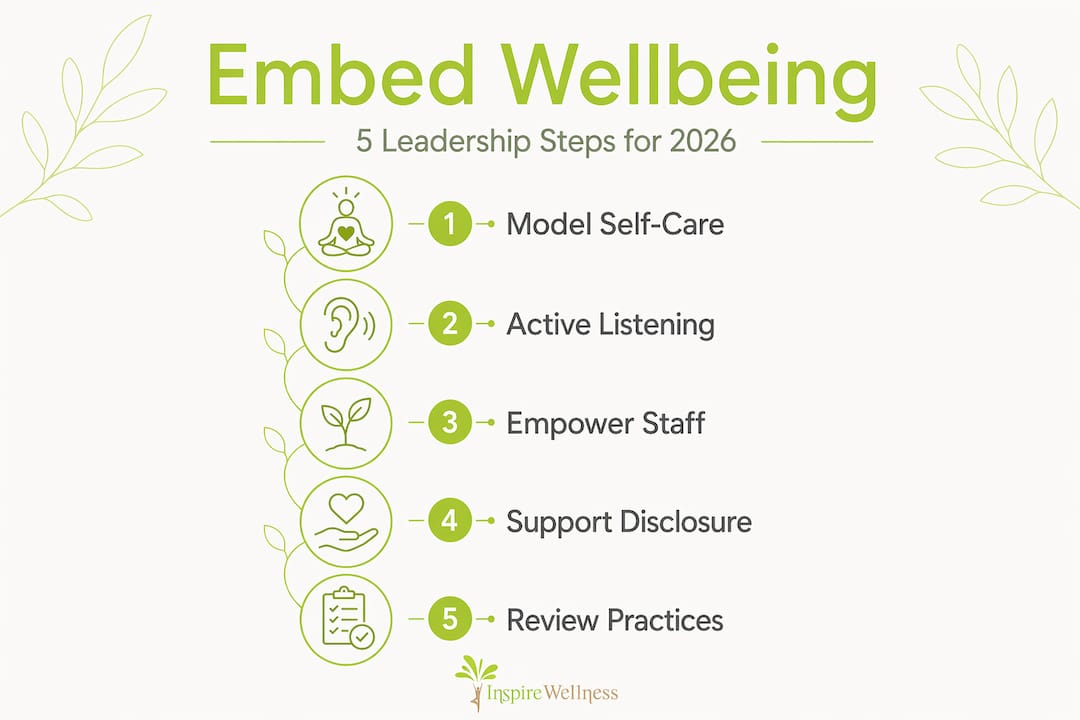
Treating wellbeing as a checklist that managers complete once and move on from is one of the most common and costly mistakes organizations make. Research is direct on this point: one-way manager training alone is insufficient to create lasting wellbeing improvements. What works is adaptive leadership that reads and responds to team signals over time.
| Approach | What it looks like in practice | Why it works |
|---|---|---|
| Reactive wellbeing | Addressing issues only after they escalate | Low effort but misses early intervention windows |
| Scripted check-ins | Following a fixed script for wellbeing conversations | Provides structure but feels impersonal over time |
| Adaptive leadership | Adjusting support based on real-time team feedback | Builds genuine trust and catches issues early |
| Embedded wellbeing metrics | Including team health data in performance reviews | Signals organizational commitment, not surveillance |
Embedding wellbeing into performance management works best when it is framed as support, not monitoring. Linking wellbeing topics to work outcomes and offering resources rather than mandates is the approach that retains trust. Practically, this means checking in on energy levels, workload balance, and team morale in the same review conversations where you discuss outputs and goals.
You can review how to build a credible wellbeing strategy that integrates these principles into your organizational framework.
The ILO estimates approximately 840,000 deaths annually are linked to psychosocial risks at work. That statistic should change how organizations classify manager behavior. Supporting wellbeing is not a soft skill. It is a risk management function.
My honest take on where managers get this wrong
I have spent years working alongside organizations genuinely trying to improve employee health, and the pattern I keep seeing is this: managers are handed wellbeing frameworks and expected to apply them like a recipe. Show empathy. Check in weekly. Offer support. Tick the boxes. And then nothing really changes.
What I have learned is that the managers who genuinely move the needle are the ones who have done their own inner work first. They know what it feels like to be unsupported, or overloaded, or afraid to speak up. That experience makes them attuned to their team in ways no training module can replicate.
The other thing I have observed is how easily wellbeing conversations become surveillance in disguise. A manager who checks in frequently but uses that information to manage performance, rather than to genuinely support the person, destroys trust faster than no check-in at all. Employees are perceptive. They know the difference between a manager who cares and a manager who is collecting data.
My practical advice: invest in your own wellbeing with the same seriousness you bring to your team’s. Get support, build recovery into your schedule, and model the behavior you want your team to feel safe practicing. The managers I have seen create truly healthy teams are not the ones who follow the most frameworks. They are the ones who show up as genuinely grounded human beings.
— Neelam
How Inspire-wellness supports managers and HR leaders
Building the capability for managers to positively impact team wellbeing does not happen through a single training session. It requires sustained, evidence-based support that integrates with how your organization actually works.
At Inspire-wellness, we work with managers and HR leaders across the UAE to design wellbeing programs grounded in behavioral science and real organizational context. Our corporate wellbeing coaching equips managers with the confidence, tools, and frameworks to handle sensitive conversations, build psychologically safe teams, and embed wellbeing into everyday leadership. Whether you are building from scratch or looking to strengthen what you already have, our leadership wellbeing programs provide a structured, practical path forward. If you are ready to make manager capability a genuine organizational asset, we are here to help you get there.
FAQ
How do managers directly impact employee mental health?
Managers influence mental health through their communication style, workload decisions, and the psychological safety they create. Research shows that development-focused and communication-forward behaviors correlate directly with improved employee wellbeing outcomes.
What boundaries should managers keep in wellbeing conversations?
Managers should anchor wellbeing conversations to work performance and support rather than personal details. Maintaining confidentiality, offering resources instead of advice, and staying within the professional relationship are all critical practices.
Why does manager wellbeing matter for team health?
When managers experience high demands and low autonomy, their capacity to support their teams decreases. Studies of frontline managers show wellbeing scores below population averages, with direct consequences for leadership quality and team engagement.
How can managers support sensitive health issues like menopause?
Managers can open conversations proactively, conduct workplace adjustment reviews, and implement practical accommodations such as flexible scheduling. Confidence in handling these topics reduces attrition risk and promotes inclusion across the team.
What makes a wellbeing strategy sustainable long-term?
Sustainable wellbeing strategies rely on adaptive leadership and feedback loops rather than fixed scripts. Embedding wellbeing into regular performance conversations, offering resources consistently, and adjusting to real team signals are the practices that create lasting change.