
Workplace wellbeing programs are structured organizational initiatives designed to improve employee health across physical, mental, nutritional, and social domains. In Abu Dhabi, these programs carry added weight because the government has formally declared wellbeing core infrastructure, integrating public health goals directly into the private sector through the Abu Dhabi Healthy Living Strategy. For HR professionals and business leaders, this means wellbeing is no longer a discretionary benefit. It is a strategic priority with measurable returns, government backing, and a clear framework for implementation.
Why wellbeing programs in Abu Dhabi matter now
Abu Dhabi’s Healthy Living Strategy is the most direct reason why corporate wellbeing has moved from nice-to-have to non-negotiable. The strategy encompasses 25 targeted initiatives covering physical activity, nutrition, sleep, and mental wellbeing, all designed to reduce the burden of non-communicable diseases like obesity and diabetes. That scope signals a government that expects businesses to participate, not just observe.
The Abu Dhabi Public Health Centre and the Department of Health are the primary bodies coordinating this effort. Their approach is not punitive. The strategy focuses on nudges, gradual improvements, and informed choice rather than forced compliance, which makes it easier for employers to align their own programs with public health goals without alienating their workforce.

The transition from reactive care to proactive prevention is the defining shift here. Organizations that wait until employees are sick or burned out pay far more in healthcare costs, lost productivity, and turnover than those that invest upstream. Abu Dhabi’s policy environment now actively supports that upstream investment, giving businesses both the framework and the community infrastructure to build on.
What are the key components of wellbeing programs in Abu Dhabi?
Effective workplace wellbeing programs in Abu Dhabi address four interconnected pillars, each of which maps directly to the Healthy Living Strategy’s priorities:
- Physical activity: Structured movement programs, standing desk policies, on-site fitness facilities, or subsidized gym memberships. Abu Dhabi’s Degayeg initiative has held 500+ community fitness events with over 7,700 participants, demonstrating that demand for physical activity support is real and growing.
- Nutrition: Workplace cafeteria standards, healthy snack programs, and alignment with the Nutri Mark labeling system, which grades food from A to E. Employers who adopt Nutri Mark-aligned food policies signal credibility and reinforce government health messaging.
- Mental wellbeing: Access to counseling, stress management workshops, and mental health support in Abu Dhabi through employee assistance programs. This pillar requires the most cultural sensitivity, particularly in a diverse, multinational workforce.
- Sleep: Education on sleep hygiene, flexible scheduling where operationally possible, and workload management to reduce chronic fatigue. Sleep is the most underinvested pillar in most corporate programs, yet it directly affects cognitive performance and emotional regulation.
The most effective programs do not treat these pillars as separate modules. They embed healthy behaviors into the daily work routine through what McKinsey describes as wellness nudges, such as timely break reminders, walking meetings, and activity prompts. This approach increases participation rates significantly compared to standalone wellness events.
Pro Tip: When designing your program, map each pillar to a specific, measurable outcome. For example, link your nutrition initiative to a 10% reduction in cafeteria purchases of high-sugar items over six months. Concrete targets make it easier to demonstrate ROI to leadership and sustain budget approval.
How do wellbeing programs benefit organizations and employees?
The business case for wellbeing initiatives in the UAE is grounded in data, not aspiration. Research consistently shows that employees with better health report higher performance and innovation, along with stronger work-life balance. For Abu Dhabi organizations competing for skilled talent in a high-cost market, that performance differential is a genuine competitive advantage.
The organizational benefits compound across several dimensions:
- Reduced absenteeism: Employees who participate in structured health programs take fewer sick days. Lower absenteeism directly reduces operational disruption and the hidden costs of presenteeism, where employees show up but perform below capacity.
- Lower healthcare expenditure: Proactive prevention costs less than treatment. Organizations that partner with providers like Inspire-wellness to implement evidence-based programs can track reductions in healthcare claims over time, which strengthens the financial case for continued investment.
- Improved employee engagement: Wellbeing programs signal that leadership values people as whole human beings, not just productive units. That signal builds loyalty, reduces voluntary turnover, and creates the psychological safety needed for high-performance teams.
- Reduced burnout: Job autonomy, leadership commitment, and coworker support are foundational enablers that must accompany wellbeing interventions. Organizations that address these organizational conditions alongside individual health programs see the greatest reduction in burnout rates.
- Alignment with national health goals: Businesses that visibly support Abu Dhabi’s public health agenda build stronger relationships with government stakeholders, which matters for licensing, procurement, and long-term operating conditions in the emirate.
“Wellbeing is core infrastructure. It requires coordinated efforts at scale across government and the private sector to reshape the environments that support healthy behavior.” — Department of Health, Abu Dhabi
That statement reframes the entire conversation for HR leaders. Wellbeing programs are not a cost center. They are an infrastructure investment with returns measured in workforce capability, organizational resilience, and reduced healthcare liability. Understanding how to reduce employee healthcare costs through prevention is increasingly central to CFO-level discussions in Abu Dhabi organizations.
What makes a wellbeing program successful in Abu Dhabi?
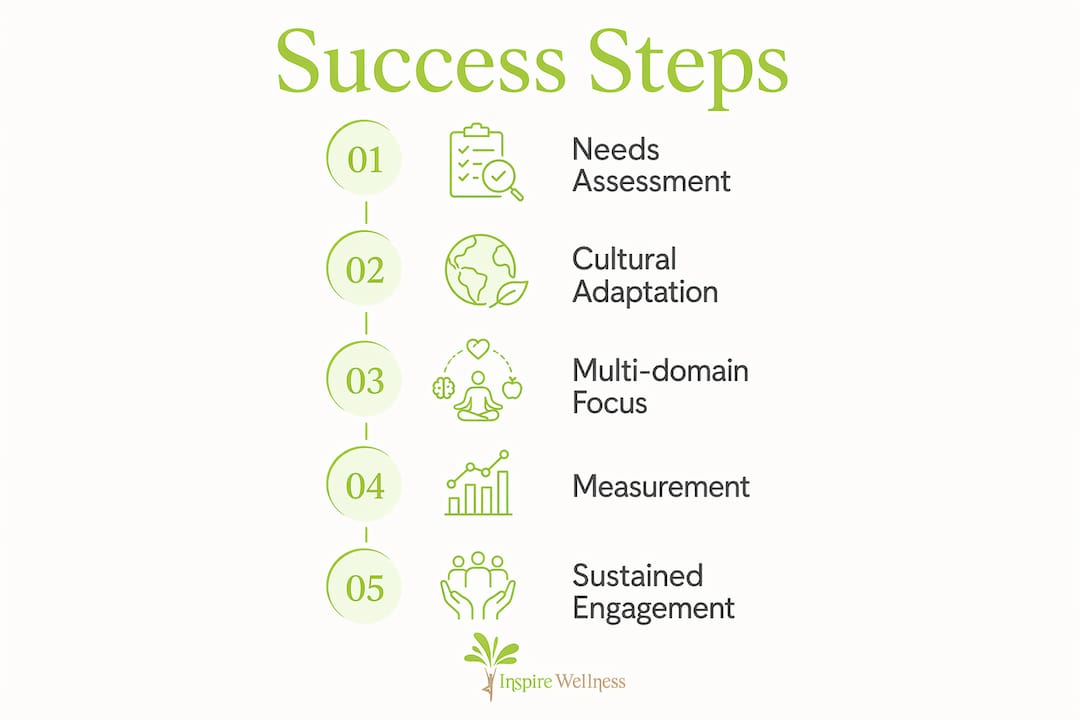
The difference between a wellbeing program that delivers results and one that fades after the launch event comes down to design quality and organizational commitment. The following comparison illustrates the gap between common program approaches and what the evidence actually supports.
| Common approach | Evidence-based approach |
|---|---|
| Annual health fair or one-off workshop | Multi-domain program sustained over 12+ weeks |
| Sentiment surveys as the primary metric | Clinical outcome measures: blood pressure, BMI, sleep quality |
| Voluntary participation with no structural support | Wellness nudges embedded in daily work routines |
| Generic content for all employees | Needs assessment tailored to workforce demographics |
| Leadership endorsement without personal participation | Visible leadership engagement and modeling |
Multi-domain programs targeting clinical outcomes yield higher ROI and sustained behavioral change over 12 or more weeks. That finding has direct implications for how Abu Dhabi HR teams should structure their annual wellbeing budgets. Spreading resources across a series of disconnected events produces far weaker results than concentrating investment in a sustained, integrated program.
Cultural adaptation is equally non-negotiable in Abu Dhabi’s diverse workforce. A program designed for a homogeneous Western corporate environment will not resonate with a team that includes Emirati nationals, South Asian professionals, Arab expatriates, and Western executives. Needs assessments must account for dietary preferences, religious observance, language, and varying attitudes toward mental health disclosure.
Mental health programs alone have limited impact when organizational conditions like excessive workload and poor management quality remain unaddressed. This is the most common failure mode we see in corporate wellbeing. You can offer all the mindfulness apps and counseling sessions you want, but if managers are creating toxic conditions, the program cannot compensate.
Pro Tip: Before launching any wellbeing initiative, conduct a structured needs assessment that includes both quantitative data (absenteeism rates, healthcare claims, engagement scores) and qualitative input (focus groups, anonymous surveys). This gives you a baseline and ensures the program addresses real needs rather than assumed ones. Explore wellbeing strategy best practices for UAE multinationals to see how this process works in practice.
How are Abu Dhabi government policies shaping corporate wellbeing?
Abu Dhabi’s public health policies are creating a framework that private sector organizations cannot afford to ignore. The Healthy Living Strategy’s collaboration with the private sector is deliberate and structured, not incidental. Here is what that means in practice for businesses operating in the emirate:
- Nutri Mark food labeling: The A-to-E grading system for packaged food is now visible in Abu Dhabi retail environments. Employers who align their workplace food offerings with Nutri Mark standards reinforce the same health messaging employees encounter outside work, creating behavioral consistency.
- Advertising restrictions: Restrictions on unhealthy food advertising reduce the environmental cues that trigger poor dietary choices. Workplaces that mirror this approach by removing vending machine junk food or limiting unhealthy options in cafeterias amplify the policy’s effect.
- Community fitness programs: The Degayeg Fitness Festival and similar events give employers a ready-made platform to engage employees in physical activity outside the office. Subsidizing or organizing group participation in these events costs relatively little and builds team cohesion alongside physical health.
- Autonomy-centered design: The Healthy Living Strategy explicitly avoids forced measures, focusing instead on making healthier choices easier and more appealing. Corporate programs that adopt the same philosophy, offering incentives rather than mandates, tend to achieve higher and more sustained participation.
The practical implication for HR leaders is that government programs provide both legitimacy and infrastructure. Partnering with or referencing Abu Dhabi Public Health Centre initiatives in your internal communications strengthens employee trust in your wellbeing program. It positions the organization as a participant in a broader community effort rather than a company simply managing its healthcare liability. Building a credible wellbeing strategy means understanding and leveraging these policy frameworks from the start.
Key takeaways
Wellbeing programs in Abu Dhabi succeed when they align with the Healthy Living Strategy’s four pillars, embed health behaviors into daily routines, and address organizational conditions alongside individual health interventions.
| Point | Details |
|---|---|
| Government alignment is a strategic asset | Abu Dhabi’s 25-initiative Healthy Living Strategy gives businesses a ready-made framework for program design. |
| Multi-domain programs outperform single-focus ones | Programs addressing physical activity, nutrition, mental health, and sleep together deliver higher ROI over 12+ weeks. |
| Clinical outcomes beat sentiment metrics | Measure blood pressure, BMI, and sleep quality rather than satisfaction scores to prove real program value. |
| Organizational conditions determine program success | Excessive workload and poor management undermine even well-designed wellbeing initiatives. |
| Cultural adaptation is non-negotiable | Abu Dhabi’s diverse workforce requires needs assessments that account for dietary, religious, and language differences. |
What I’ve learned about wellbeing programs in Abu Dhabi that most guides miss
After working with organizations across the UAE, the pattern I see most often is this: companies invest in the visible parts of wellbeing (the yoga class, the fruit bowl, the mental health awareness week) and neglect the invisible architecture that determines whether any of it sticks. Leadership behavior is that architecture. When a senior leader leaves the office at 10 p.m. every night and sends emails at midnight, no amount of stress management workshops will move the needle on burnout.
The Abu Dhabi context adds a layer that outside consultants often underestimate. The workforce here is genuinely diverse in ways that affect health behavior at a fundamental level. Ramadan, for example, changes sleep patterns, eating schedules, and energy levels for a significant portion of your team for an entire month. A wellbeing program that ignores this is not just culturally tone-deaf. It is operationally ineffective.
What I advocate for is treating the government’s Healthy Living Strategy as a partner, not a compliance checklist. The Degayeg events, the Nutri Mark system, the community fitness infrastructure: these are assets your organization can plug into rather than build from scratch. The businesses that do this well spend less on program development and achieve higher employee participation because they are reinforcing behaviors employees already encounter in their daily lives.
Start with a real needs assessment. Not a survey that asks employees if they want a gym subsidy (everyone says yes). A structured analysis of your absenteeism data, healthcare claims, and engagement scores that tells you where the actual health burden sits in your organization. That is where your investment will generate the highest return.
— Neelam
How Inspire-wellness helps Abu Dhabi businesses build programs that work
At Inspire-wellness, we work directly with HR professionals and business leaders across the UAE to design workplace wellbeing programs that align with Abu Dhabi’s Healthy Living Strategy and deliver measurable outcomes. Our approach combines behavioral science, mental health support, and resilience training into a structured framework that fits your organization’s size, culture, and workforce demographics. We do not offer off-the-shelf solutions. Every program begins with a needs assessment and ends with clinical outcome tracking that proves the investment was worth making. If you are ready to move from intention to impact, our workplace wellbeing improvement guide gives HR teams a proven, step-by-step process to get started. For managers looking for practical day-to-day strategies, our wellbeing tips for managers resource offers concrete tools you can apply immediately.
FAQ
What are wellbeing programs in Abu Dhabi?
Wellbeing programs in Abu Dhabi are structured workplace initiatives that address physical activity, nutrition, mental health, and sleep to improve employee health and organizational performance. They are increasingly aligned with the Abu Dhabi Healthy Living Strategy’s 25 government-led initiatives.
How do wellbeing programs improve employee productivity?
Employees with better health report higher performance, stronger work-life balance, and more innovative behavior, according to McKinsey research on proven workplace health interventions. Reduced absenteeism and lower burnout rates compound these gains over time.
What role does the Abu Dhabi government play in workplace wellbeing?
The Department of Health and the Abu Dhabi Public Health Centre coordinate the Healthy Living Strategy, which includes Nutri Mark food labeling, advertising restrictions, and community fitness programs that directly support private sector wellbeing efforts.
How long does it take for a wellbeing program to show results?
Multi-domain programs sustained over 12 or more weeks consistently show higher ROI and sustained behavioral change compared to shorter interventions, based on research from The Human Capital Hub on what workplace wellness science actually supports.
What is the biggest mistake companies make with wellbeing programs?
The most common failure is investing in individual health interventions while leaving poor organizational conditions, such as excessive workload and weak management quality, unaddressed. Mental health support and fitness programs cannot compensate for a structurally unhealthy work environment.