
Most organizations know they should invest in employee wellbeing, yet when it comes time to actually implement corporate wellbeing initiatives, the effort stalls somewhere between a company-wide email and a wellness challenge nobody participates in. The gap between good intentions and operational reality is where programs fail. This article walks you through a structured, step-by-step approach covering preparation, execution, and measurement, so your wellbeing program becomes part of how work actually gets done, not just something HR promotes on World Mental Health Day.
Table of Contents
- Key Takeaways
- Planning before you implement corporate wellbeing initiatives
- A step-by-step approach to executing your initiatives
- Common challenges to anticipate
- Measuring and verifying what you build
- My honest take on why wellbeing programs fail
- How Inspire-wellness can support your implementation
- FAQ
Key Takeaways
| Point | Details |
|---|---|
| Start with a needs assessment | Identify workforce-specific risks before designing any program to avoid mismatched initiatives. |
| Secure leadership buy-in early | Programs without visible executive support rarely sustain past the first quarter. |
| Use a structured execution roadmap | Follow a step-by-step process including risk assessment, workplace adjustments, and manager training. |
| Treat wellbeing as an operational system | Apply PDCA cycles to continuously improve rather than launching isolated one-off programs. |
| Measure with defined KPIs | Track absence rates, retention, and satisfaction scores to prove impact and maintain momentum. |
Planning before you implement corporate wellbeing initiatives
Getting this phase right determines everything that follows. Many organizations skip straight to solutions, launching fitness challenges or mental health webinars, without first understanding the specific pressures their workforce faces. That is the equivalent of prescribing medication before running a diagnosis.
Assess your workforce’s actual needs
Start with a structured needs assessment. Survey employees anonymously, review absence data, analyze turnover patterns by department, and examine any existing occupational health records. Different workforce demographics carry different risk profiles. A manufacturing site faces physical strain and fatigue. A financial services firm faces chronic stress and long hours. A workforce with a significant proportion of women aged 40 to 55 may benefit from specific support, given that workplace temperature and ergonomics are workplace factors that directly affect this group’s productivity and retention.

Pro Tip: Run a cross-functional diagnostic team including HR, occupational health, line managers, and an employee representative before finalizing your wellbeing plan. Each function sees a different slice of the real picture.
Align with business goals and secure leadership
Wellbeing programs that live solely within HR rarely reach their potential. To get real traction, you need executive sponsorship and cross-functional accountability. Frame the conversation in business terms. Investing in occupational health demonstrably improves retention, reduces sickness absence, and increases productivity. Those are metrics every CFO and CEO already care about.
Consider framing your wellbeing work within the Total Worker Health model from NIOSH, which integrates health protection and promotion across both work-related and personal health factors. This approach connects safety, productivity, and wellness into one system rather than treating them as separate programs competing for budget.
The planning phase should produce a clear document that includes your priority risk areas, proposed initiatives, a responsible owner for each, a realistic timeline, and the budget allocated. Without this governance structure, even the best intentions dissolve when competing priorities arrive.
| Planning element | What to define |
|---|---|
| Needs assessment findings | Top 3 to 5 workforce risk areas with supporting data |
| Initiative priorities | Programs matched to specific identified risks |
| Leadership sponsors | Named executive or senior manager per initiative |
| Success metrics | Baseline measurements and target outcomes |
| Review cadence | Quarterly check-ins with a defined annual review |
A step-by-step approach to executing your initiatives
Once your foundation is set, execution needs to be systematic. Ad hoc rollouts create inconsistent employee experiences and make it nearly impossible to attribute outcomes to specific interventions. Here is a practical roadmap for step-by-step corporate wellbeing execution.
-
Conduct structured risk assessments. Do not limit this to physical safety. A workplace risk assessment for wellbeing should cover psychosocial hazards, workload distribution, management practices, and specific population needs. Menopause workplace risk assessments, for example, provide a structured model for identifying how workplace conditions affect a specific employee group, and the same framework can be adapted for other health concerns.
-
Implement tailored workplace adjustments. Generic wellness benefits have low uptake because they rarely match actual needs. Specific adjustments such as flexible working hours, ergonomic furniture, private rest spaces, and modified task allocation improve retention and reduce sick days far more than a monthly yoga email. Build a formal accommodation intake process with confidential consultations, written agreements, and scheduled reviews.
-
Build a psychological health and safety program. Mental health cannot be addressed through awareness campaigns alone. A 10-step structured approach covering psychosocial risk assessment, prioritized control implementation, training, communication, and continuous improvement provides the operational backbone your mental health strategy needs.
-
Create confidential communication channels. Employees need a way to raise concerns without fear of judgment. This could be an anonymous survey tool, a confidential HR helpline, or an employee assistance program. Confidential consultations with clear response timelines and written agreements convert wellbeing messaging into tangible employee experience.
-
Train your managers. A policy nobody knows how to use is not a policy. Equip managers with specific skills in recognizing stress signals, having supportive conversations, and knowing when to refer employees to occupational health or counseling resources. This is the delivery layer that brings every initiative to life. For practical guidance on this, the manager wellbeing tips from Inspire-wellness offer a strong reference point.
-
Communicate consistently and transparently. Tell employees what is available, how to access it, and that participation is confidential. Repeat this message through multiple channels. One launch email is never enough.
Pro Tip: Start with two or three high-impact, targeted controls before scaling broadly. Psychosocial risk frameworks that prioritize a small number of manageable levers outperform sprawling programs that try to address everything at once.
Common challenges to anticipate
Even well-designed programs hit friction. Knowing what to expect helps you respond without losing momentum.
-
Stigma and reluctance. Mental health and personal health conversations still carry stigma in many workplaces. Framing wellbeing as a professional performance support tool rather than a personal problem reduces resistance. Normalize the language at every level, starting with senior leaders modeling their own engagement.
-
Resource constraints. Not every organization can fund a full wellness suite. Prioritize based on your risk assessment findings. High-impact, low-cost adjustments like flexible scheduling, designated quiet spaces, or peer support networks often deliver stronger results than expensive off-site events.
-
Wellbeing fatigue. Constant wellness campaigns with no visible follow-through erode trust faster than doing nothing. Employees need to see that their feedback leads to actual changes. When surveys disappear into a black hole, participation drops permanently.
-
Gaps between planned and delivered adjustments. An accommodation agreed in writing but never operationally supported creates resentment. Build a formal review process so that every written agreement is checked at 30, 90, and 180 days to confirm it is working as intended.
-
Maintaining confidentiality. Anonymous surveys and data tracking are only effective when employees genuinely trust the process is confidential. Clearly communicate who sees what data and under what circumstances. Trust, once broken, is hard to rebuild.
Staying aware of these friction points means you can address them proactively rather than discovering them after participation rates drop. Reviewing your wellbeing improvement process regularly keeps the entire system from drifting into autopilot.
Measuring and verifying what you build
This is where most programs fall short. Without defined metrics and a review process, you are managing perception instead of outcomes. Structured wellbeing programs reduce absenteeism, turnover, and conflict while improving trust and safety culture. But you only see those results if you track them.
Pro Tip: Set your KPIs before you launch, not after. Baseline data collected at the start makes it possible to demonstrate genuine change rather than simply reporting activity.
| KPI | What it measures | How to track it |
|---|---|---|
| Absence rate | Program impact on sick days | Monthly HR data by department |
| Employee satisfaction score | Overall wellbeing perception | Biannual pulse surveys |
| Retention rate | Turnover reduction linked to wellbeing | Quarterly HR analytics |
| Program utilization | Uptake of specific initiatives | EAP access logs, session records |
| Manager capability score | Wellbeing conversation confidence | Post-training assessments |
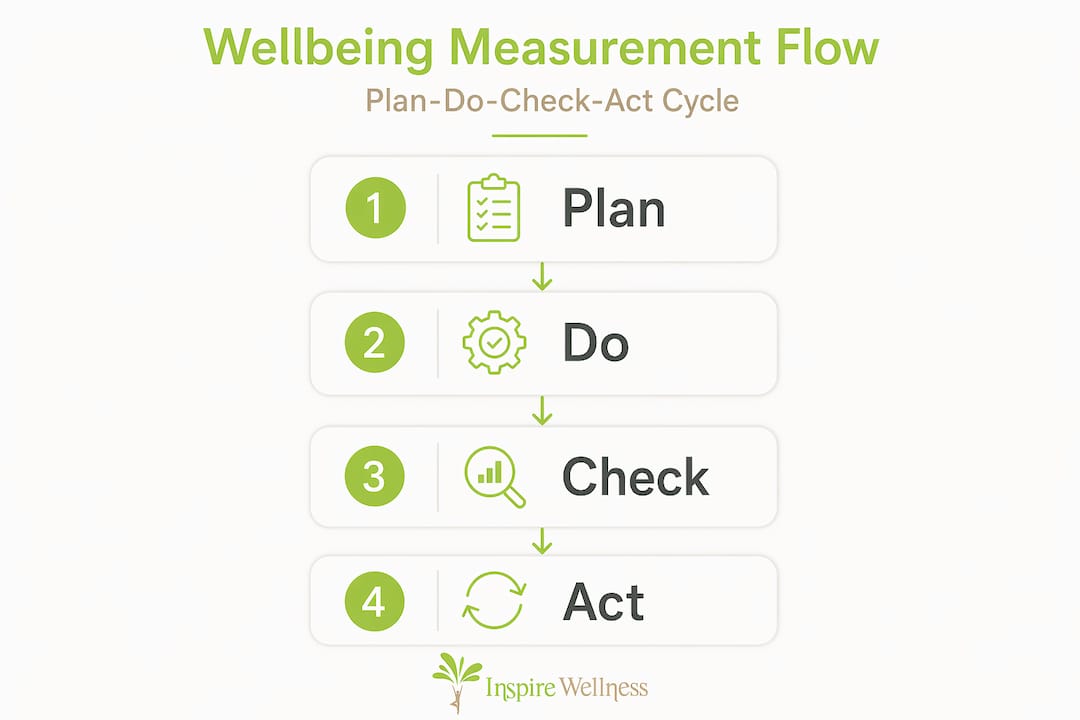
Apply the Plan-Do-Check-Act (PDCA) cycle as your governance rhythm. Plan your interventions based on risk data, implement them with defined owners, check the results against your KPIs at regular intervals, and act by adjusting controls that are not performing. This cycle, drawn from PDCA-based psychological safety frameworks, treats wellbeing as a living operational system rather than a program with a launch date and a quiet death.
Report outcomes to leadership quarterly. Visible executive engagement reinforces the message that wellbeing is a permanent organizational priority, not a project with an end date.
My honest take on why wellbeing programs fail
I’ve worked alongside enough HR teams to see the same pattern repeat itself. The organization announces a wellbeing program with genuine enthusiasm. A digital platform is purchased, a few workshops are delivered, and leadership sends a supportive message. Six months later, utilization is low, nobody quite knows what happened, and the program quietly fades.
In my experience, the failure is almost never about lack of care. It is about lack of operational rigor. Wellbeing needs to be managed the way you manage any other business-critical process, with risk assessments, named accountability, governance cycles, and progress reporting. The moment you treat it as a softer side project, it loses funding, loses attention, and loses credibility with employees.
What I’ve found actually works is starting with two or three well-targeted changes that employees can feel immediately. A manager who has a real conversation. A flexible arrangement that gets honored consistently. An anonymous channel that visibly leads to action. Those small wins build the trust that makes larger programs possible.
I’ve also seen organizations underestimate the power of integrating wellbeing with safety and productivity goals rather than keeping it in a separate lane. When the CFO sees the connection between a wellbeing investment and a measurable drop in absence costs, the conversation about budget changes entirely.
— Neelam
How Inspire-wellness can support your implementation
At Inspire-wellness, we’ve built our entire approach around the principle that wellbeing should be embedded into how an organization operates, not bolted on as an afterthought. Our corporate wellness programs are designed with the kind of operational structure this article describes, combining behavioral science, psychosocial risk frameworks, mental health support, and resilience training into one cohesive system. We work with HR leaders and business executives across Dubai and the UAE to assess workforce needs, design tailored initiatives, train managers, and build the measurement infrastructure that keeps programs accountable. Whether you are starting from scratch or strengthening an existing effort, our corporate wellbeing coaches provide the expert guidance and hands-on support to turn your wellbeing strategy into a program your employees actually experience every day.
FAQ
What is the first step to implement corporate wellbeing initiatives?
Start with a workforce needs assessment. Review absence data, conduct anonymous surveys, and identify your top psychosocial and physical risk areas before designing any programs.
What are examples of wellbeing initiatives for the workplace?
Examples include flexible working arrangements, ergonomic workplace adjustments, employee assistance programs, manager wellbeing training, psychological safety programs, and confidential health support channels.
Why does employee wellbeing matter for business performance?
Investing in employee wellbeing reduces sickness absence, improves retention, and increases productivity, all of which directly affect business profitability and culture.
How do you measure the success of corporate wellbeing programs?
Track KPIs including absence rates, employee satisfaction scores, retention figures, and program utilization data. Apply PDCA cycles to review and adjust based on those results.
How long does it take to see benefits from wellbeing initiatives?
Early structural changes like workplace adjustments and manager training can show measurable impact within three to six months. Broader culture shifts typically take 12 to 18 months of consistent implementation.