
Stress reduction in business is the practice of implementing proactive strategies to minimize employee stress, protect wellbeing, and sustain organizational productivity. Workplace stress costs U.S. employers $190 billion in annual healthcare costs alone, with the total economic impact nearing $300 billion when absenteeism and lost productivity are included. The American Medical Association recognizes that chronic stress activates cortisol and adrenaline continuously, raising the risk of cardiovascular disease, diabetes, and cognitive decline. For business leaders, this is not a wellness trend. It is a material risk that demands the same governance attention as financial or operational exposure.
How does workplace stress affect productivity and business outcomes?
Stress does not stay in the body. It shows up in your quarterly numbers. 70% of workers lose 1–5 hours weekly to stress-related distraction, and more than 20% spend over five hours per week ruminating during work hours. That is a significant portion of your paid workforce operating well below capacity every single week.
The costs compound through two mechanisms: absenteeism and presenteeism. Absenteeism is the direct loss of working days. Presenteeism is subtler and more expensive. It describes employees who show up physically but cannot perform at full capacity because of stress, anxiety, or burnout. Most organizations track sick days. Very few measure presenteeism, which means they are systematically underestimating the true cost of workplace stress.

The absence multiplier effect makes this worse. When one employee is absent, the disruption ripples outward. Colleagues absorb extra workload, morale drops, deadlines shift, and team continuity breaks down. The cost of a single absence is never just the salary of the person who stayed home. It includes the productivity drag on everyone around them.
Depression and anxiety alone cause productivity losses exceeding $1 trillion globally. That figure reframes the conversation entirely. Stress management is not a benefit you offer employees out of goodwill. It is a financial lever with measurable return.
Pro Tip: Track presenteeism alongside absenteeism in your quarterly workforce reviews. Use pulse surveys or manager check-ins to surface performance dips that sick-day data will never reveal.
What are effective stress reduction strategies, and why do some fail?
The most common mistake organizations make is treating stress as an individual problem. They roll out a meditation app, schedule a yoga session, and consider the box checked. Individual-level interventions without systemic organizational change yield no significant wellbeing improvement and no positive ROI. Apps and yoga classes do not fix unmanageable workloads or poor leadership behavior.
Effective stress reduction strategies operate at the organizational level. They address the root causes of stress rather than the symptoms. The most impactful approaches include:
- Workload management: Audit task distribution regularly. Chronic overload is the single most common driver of burnout. Redistribute work before people break, not after.
- Role clarity: Ambiguity about responsibilities creates constant low-grade stress. Clear job descriptions, defined decision rights, and regular goal alignment reduce this significantly.
- Flexible scheduling: Giving employees control over when and where they work reduces stress without requiring any budget. Autonomy is one of the most powerful stress buffers available to leaders.
- Psychosocial risk management: Identify and address interpersonal stressors such as conflict, exclusion, and poor management practices. These are as damaging as physical workplace hazards.
- Culture of openness: Normalize conversations about mental health and workload. Employees who feel safe raising concerns before they reach crisis point are far less likely to burn out.
Fragmentation of wellness efforts across HR, operations, and compliance is the biggest structural barrier to success. When stress management sits in HR as a perk rather than in the boardroom as a risk, it never gets the resources or accountability it needs. You can read more about overcoming siloed wellness initiatives and building programs that actually move the needle.
Pro Tip: Add a stress risk indicator to your existing business performance dashboard. When stress sits alongside revenue, retention, and customer satisfaction, leaders treat it with the same urgency.
How can business leaders build resilience in their teams?
Resilience is not a personality trait. It is a capacity that can be deliberately developed. Harvard Health research confirms that resilience grows through decisive action, calm problem-solving, and interpersonal connectivity under pressure. High-performance operators like Navy SEALs train this capacity systematically. Your teams can do the same.
Building resilience starts with individual behavioral practices and scales through organizational support structures. Leaders who model healthy behavior create permission for their teams to do the same. When a senior leader takes a lunch break, leaves on time, or openly discusses managing pressure, it signals that wellbeing is not just tolerated but expected.
Practical behavioral techniques that build resilience include:
- Deep breathing and mindfulness: Brief, consistent practices reduce cortisol levels and improve focus. Even five minutes of structured breathing before high-stakes meetings produces measurable calm.
- Gratitude practices: Regular reflection on positive outcomes rewires stress response patterns over time. This is not soft science. It is behavioral psychology with a strong evidence base.
- Regular manager check-ins: Structured one-on-ones give employees a consistent outlet for concerns before they escalate. The cadence matters more than the duration.
- Mental health resources: Access to counseling, employee assistance programs, and emotional resilience training gives employees tools to manage stress before it becomes a clinical issue.
- Flexible benefits: Allowing employees to direct wellness benefits toward what actually helps them, whether that is therapy, fitness, or childcare support, increases both uptake and impact.
The AMA frames stress management as preventive medicine, comparable to diet and exercise. Leaders who adopt this framing stop asking whether to invest in resilience and start asking how to build it systematically. For a practical framework, the Inspire-wellness guide on resilience at work outlines exactly how to do this at scale.
What is the business case for stress reduction in ESG and governance?
Workplace stress is now a material ESG issue. That is not a framing choice. It is a governance reality. Organizations that integrate psychosocial risk management into ESG frameworks demonstrate better accountability across prevention, health outcomes, and business continuity. Investors, regulators, and boards increasingly expect it.
The Stress-ESG Business Impact Framework connects four elements: organizational determinants of stress, prevention processes, health outcomes, and governance mechanisms. When these four elements operate together, stress management stops being a wellness program and becomes a risk management function. That shift changes how it is funded, measured, and reported.
Data from 5,420 UK firms collected between 2020 and 2024 shows a strong correlation between firm size, productivity investment, and employee-centered wellbeing practices. Larger firms are more likely to treat wellbeing as a strategic response to productivity risk rather than a cost to contain. That distinction matters because it determines whether wellbeing programs get sustained investment or get cut at the first budget review.
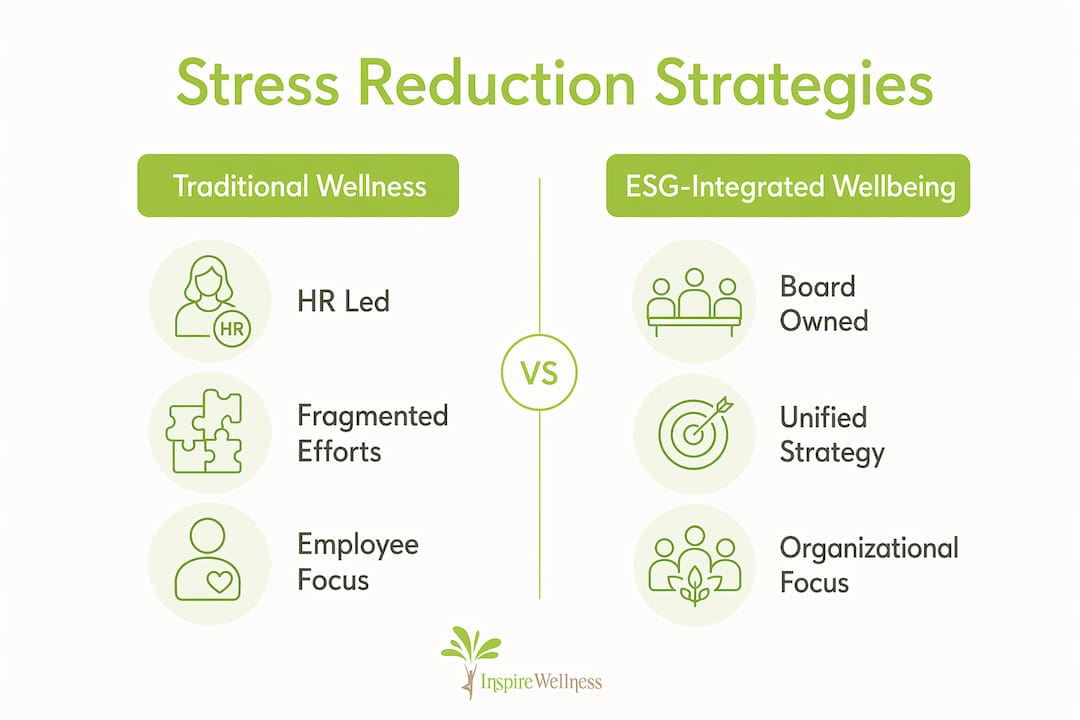
| Approach | Traditional wellness | ESG-integrated wellbeing |
|---|---|---|
| Ownership | HR department | Board and executive team |
| Measurement | Participation rates | Business continuity, productivity, retention |
| Scope | Individual programs | Systemic risk management |
| Reporting | Internal only | ESG disclosures and stakeholder reports |
| Investment logic | Cost to contain | Risk to manage and return to capture |
The shift from traditional wellness to ESG-integrated wellbeing is not cosmetic. It changes who owns the problem, how success is measured, and how much resource the function receives. Leaders who make this shift position their organizations for both regulatory compliance and competitive advantage in talent markets where wellbeing is a hiring differentiator. Building a corporate wellness program with this governance lens is the most durable investment you can make in your workforce.
Key Takeaways
Stress reduction in business is a governance and productivity issue, not a wellness perk, and organizations that treat it as a material risk consistently outperform those that do not.
| Point | Details |
|---|---|
| Economic cost is measurable | Workplace stress costs U.S. employers nearly $300 billion annually in healthcare, absenteeism, and lost productivity. |
| Individual programs alone fail | Apps and yoga without systemic workload and management changes produce no meaningful ROI. |
| Resilience is trainable | Leaders can build team resilience through structured behavioral practices and consistent organizational support. |
| ESG integration raises accountability | Embedding psychosocial risk in ESG frameworks moves stress management from HR perk to board-level priority. |
| Fragmentation is the core barrier | Wellness efforts split across HR, compliance, and operations lose impact without unified governance. |
Why I think most leaders are still solving the wrong problem
After working with organizations across industries, I keep seeing the same pattern. A leader notices burnout on their team and responds by adding a benefit. A new app. A wellness day. A mindfulness workshop. The intention is genuine. The diagnosis is wrong.
The stress is almost never about the individual employee’s coping skills. It is about workload, unclear expectations, poor management behavior, or a culture that quietly punishes people for having limits. Treating the symptom while leaving the cause untouched does not reduce stress. It signals to employees that the organization sees their distress but has chosen a cheap fix over a real one.
The leaders I have seen make the most lasting difference are the ones who ask a different question. Not “what can we offer employees to help them cope?” but “what are we doing organizationally that is creating this stress in the first place?” That question is harder. It implicates leadership decisions, resource allocation, and culture. It also produces real change.
Stress reduction works when it is built into how you manage, not bolted on as a program. The organizations that get this right do not have the best wellness apps. They have managers who check in regularly, workloads that are actively monitored, and a culture where raising a concern is safe. That is not a wellness strategy. That is good leadership. And it is entirely within your control to build it.
— Neelam
How Inspire-wellness helps businesses reduce stress and build performance
Inspire-wellness works with organizations across the UAE and beyond to build corporate wellness programs that address stress at its source, not just its surface. Our programs combine behavioral science, resilience training, and mental health support into frameworks that integrate with your existing management structure.
We design programs for businesses of all sizes, from leadership coaching and team resilience workshops to organization-wide wellbeing strategies that connect directly to productivity and retention outcomes. If you are ready to move beyond wellness as a perk and build it into your performance culture, Inspire-wellness is the partner to do it with. Explore our wellness program benefits to see what a structured investment in employee wellbeing actually delivers.
FAQ
Why is stress reduction in business a financial priority?
Workplace stress costs U.S. employers nearly $300 billion annually through healthcare, absenteeism, and lost productivity. Reducing stress is one of the highest-return investments a business can make in its workforce.
What makes individual stress programs fail?
Individual-level interventions like apps or yoga classes fail when they do not address systemic causes such as unmanageable workloads or poor management practices. Without organizational change, these programs produce no measurable wellbeing improvement or ROI.
How does the absence multiplier affect business costs?
The absence multiplier effect means that when one employee is absent, the productivity and morale of surrounding team members also drops. This makes the true cost of absenteeism far higher than a single employee’s salary.
Can resilience actually be taught in a workplace setting?
Yes. Harvard Health research confirms that resilience is a trainable capacity built through decisive action, calm problem-solving, and interpersonal connection. Structured programs, regular check-ins, and leadership modeling all accelerate its development.
How does stress management connect to ESG reporting?
Psychosocial risk is now recognized as a material ESG issue. Organizations that embed stress management into ESG governance frameworks improve accountability, business continuity, and stakeholder reporting, making wellbeing a board-level concern rather than an HR function.