Low morale spreads quietly. It shows up in missed deadlines, shorter lunch conversations, and resignation letters that no one saw coming. Understanding how to enhance workplace morale is one of the most pressing responsibilities HR professionals and managers carry, because when morale slips, productivity, retention, and culture all follow. The research is unambiguous: employees in positive cultures are 83% motivated compared to just 45% in poor ones. This guide gives you the foundation, the steps, and the honest perspective you need to turn that around.
Table of Contents
- Key Takeaways
- How to enhance workplace morale: the foundation first
- Practical steps to boost employee morale
- Common mistakes that undermine morale initiatives
- Measuring and sustaining positive morale over time
- My honest take on what actually moves the needle
- How Inspire-wellness can support your morale strategy
- FAQ
Key Takeaways
| Point | Details |
|---|---|
| Culture drives motivation | Employees in positive cultures are nearly twice as motivated as those in poor ones, making culture a measurable business asset. |
| Recognition matters most | 34% of U.S. workers cite lack of recognition as a key morale issue, making appreciation programs a high-priority fix. |
| Psychological safety is non-negotiable | Teams with higher psychological safety report better job satisfaction and stronger manager relationships. |
| Measurement sustains progress | Tracking engagement scores, turnover rates, and survey feedback turns morale efforts from guesswork into a repeatable system. |
| Burnout is a warning sign | Roughly 30% of workers report burnout, and burned-out employees are among the highest turnover risks you face. |
How to enhance workplace morale: the foundation first
Before any recognition program or team event lands well, the underlying conditions of your workplace need to be sound. Think of it like soil quality before planting. No initiative takes root in a culture where employees feel invisible, unsafe, or unfairly treated.
SHRM’s 2024 Global Culture Report identifies five elements that underpin a positive workplace culture:
- Honest and unbiased management: Managers who give consistent, fair feedback without favoritism create the credibility teams need to trust direction from above.
- Civil behavior: Respect as a daily standard, not a reaction to conflict, shapes how people treat one another and how safe they feel speaking up.
- Meaningful work: Employees who understand how their role connects to a larger purpose stay engaged longer and contribute with more energy.
- Open communication: Transparency from leadership, especially during uncertain periods, reduces anxiety and prevents the rumor-driven speculation that erodes morale fast.
- Empathy in leadership: Managers who actively listen and respond to personal context, not just performance metrics, build the kind of relationships that retain people.
Psychological safety sits at the intersection of all five. Employees with higher psychological safety report higher job satisfaction and stronger relationships with both managers and coworkers. Improving team spirit starts by creating an environment where people are not afraid to contribute, question, or ask for help.
Pro Tip: Before launching any morale initiative, run a quick pulse survey that asks one question: “Do you feel comfortable sharing concerns with your manager?” The answer tells you whether the foundation is solid enough to build on.

Practical steps to boost employee morale
Once the foundation is in place, you can build deliberately. These steps are sequenced to address the most common morale gaps first, then extend into longer-term systems.
-
Build a recognition culture, not a recognition event. Lack of recognition is one of the top drivers of disengagement. Recognition should be frequent, specific, and visible. Peer-to-peer recognition platforms, manager shout-outs in team meetings, and milestone acknowledgments all work, but only when they are tied to genuine contributions rather than rotation schedules.
-
Redesign flexibility around real life. Work-life balance is not a perk anymore. It is a retention mechanism. Teams that have autonomy over start times, remote days, or project pacing report significantly better mood and sustained output. Flexible arrangements signal that the organization trusts its people, and that trust compounds over time.
-
Invest in career development visibly. One of the most direct ways to lift workplace mood is to show employees that their growth matters to the company. Learning stipends, internal mentoring programs, and promotion transparency give people a reason to stay and a direction to move toward.
-
Open communication channels in both directions. Monthly town halls where only leadership speaks are not enough. Create structured opportunities for employees to provide upward feedback, whether through anonymous surveys, skip-level meetings, or dedicated office hours. People who feel heard are less likely to disengage quietly.
-
Address burnout before it becomes attrition. Burnout affects around 30% of workers and carries a measurable morale cost: exhaustion, lost trust in managers, and reduced perception of career opportunity. Building workload check-ins into your regular one-on-one structure is a simple, low-cost intervention that managers can start this week.
Alongside these steps, several supporting practices significantly amplify results:
- Structured team building activities that focus on communication and shared problem-solving, not just socializing
- Mental health resources that are accessible, destigmatized, and actively promoted by leadership (not buried in an employee handbook)
- Manager training on emotional intelligence and managing workplace stress, so line managers are equipped to recognize and respond to early warning signs
Pro Tip: When introducing a new recognition program, pilot it with one team for 60 days and gather specific feedback before scaling. Rollouts that skip piloting often create inconsistency that feels worse than no program at all.
Common mistakes that undermine morale initiatives
Even well-resourced morale programs fail when execution misses a few critical points. The mistakes below are more common than most organizations want to admit.
- Treating symptoms without addressing root causes. A pizza party after a difficult quarter might generate short-term goodwill, but it does nothing for the manager whose communication style is driving people out. 54% of employees cite unfair treatment and poor management as top reasons for leaving. If leadership behavior is the problem, social events are not the solution.
- Rolling out programs without employee input. Morale initiatives that are designed in boardrooms and announced without consultation often feel performative to the people they are meant to serve. Employees read top-down “culture fixes” with healthy skepticism, especially in organizations with a history of unaddressed issues.
- Applying one-size-fits-all solutions. A 25-year-old on a hybrid schedule and a 50-year-old approaching retirement have very different morale drivers. Flexibility, recognition, and career development all look different depending on life stage, role, and personality. Segmenting your approach meaningfully is not extra work. It is what separates programs that work from programs that sit in a slide deck.
- Skipping the mental health conversation entirely. 39% of employees fear negative consequences from disclosing mental health conditions at work. If your wellbeing program does not actively normalize mental health conversations and provide genuine support, you are missing one of the largest drivers of sustained morale problems. Resources on mental health at work show that this gap has direct performance implications.
- Measuring nothing. Without data, you cannot know if your efforts are working. Without knowing what works, you are likely to repeat what does not.
Measuring and sustaining positive morale over time
Knowing how to motivate staff is only half the equation. Knowing whether it is working requires deliberate measurement and a willingness to iterate.
The table below outlines the key indicators you should track and the tools most commonly used to measure them:
| Indicator | What it tells you | Measurement tool |
|---|---|---|
| Employee engagement score | Overall sentiment and commitment levels | Quarterly pulse surveys |
| Voluntary turnover rate | Whether people are choosing to leave | HRIS tracking and exit interviews |
| Absenteeism rate | Disengagement and burnout signals | Attendance records |
| Manager effectiveness rating | Quality of the most direct morale driver | 360 feedback tools |
| eNPS (employee Net Promoter Score) | Likelihood to recommend the organization | Annual or biannual survey |
Fair treatment and management quality consistently rank above compensation as the top reasons engaged employees stay. That means your measurement system should pay as much attention to how people experience their managers as it does to financial satisfaction.
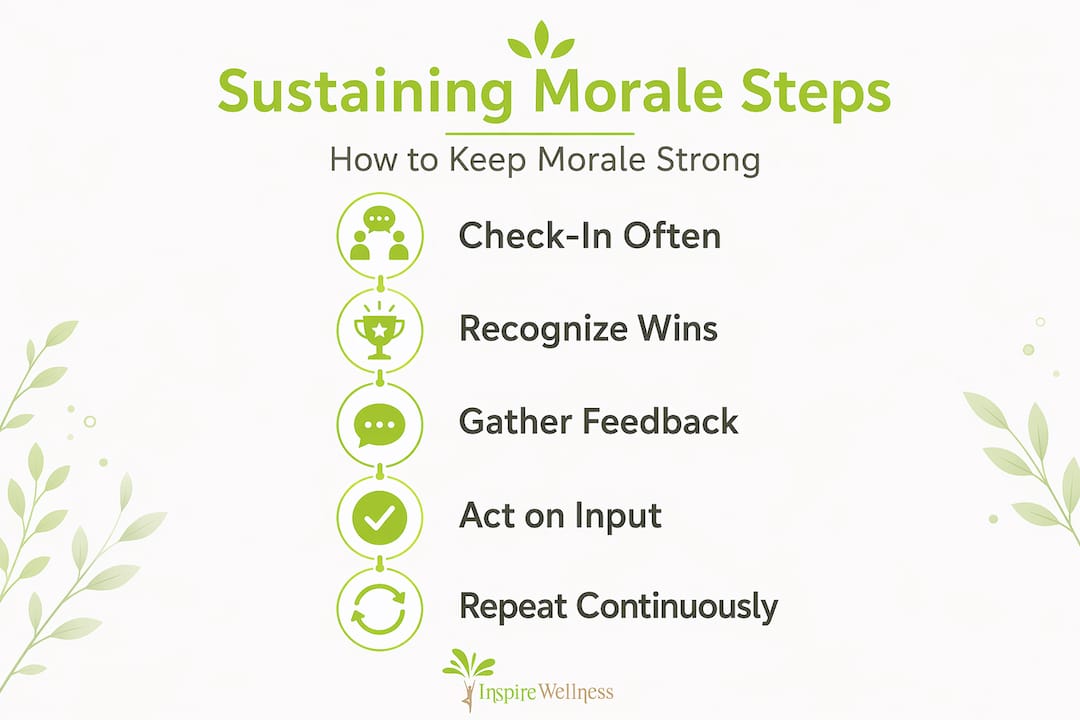
The most sustainable morale programs are not annual initiatives. They are woven into the rhythm of how the organization operates: regular feedback cycles, visible recognition, open communication, and leadership behaviors that reinforce the culture your wellbeing strategy is trying to build. When enhancing workplace culture becomes a shared leadership habit rather than an HR project, you stop chasing morale and start sustaining it.
My honest take on what actually moves the needle
I’ve spent years working alongside HR leaders and senior managers who genuinely want to improve how their teams feel at work. And the pattern I keep seeing is this: organizations invest in the visible parts of morale improvement and underinvest in the invisible ones.
The visible parts are recognition boards, wellness apps, and team lunches. Those things are fine. But what I’ve found actually builds durable morale is far quieter. It’s the manager who tells a team member their idea influenced a strategic decision. It’s the HR leader who follows up two weeks after a difficult performance conversation to check how someone is doing. It’s the executive who shares a genuine challenge with their team instead of projecting constant confidence.
What surprises most people I work with is how much morale is shaped by micro-interactions rather than formal programs. You cannot schedule trust. You cannot automate psychological safety. And you cannot substitute a company retreat for a leader who models the behavior they expect from their people.
My experience has also taught me to be skeptical of morale programs that exist primarily to reduce HR liability rather than to genuinely serve employees. People feel the difference. And in organizations where positive workplace culture is real rather than cosmetic, the morale data speaks for itself: lower turnover, higher output, and teams that weather difficult periods without falling apart.
The most honest advice I can offer is this: fix the manager before you launch the program. Almost every morale problem I’ve traced back to its source has had a leadership behavior at its center.
— Neelam
How Inspire-wellness can support your morale strategy
At Inspire-wellness, we work directly with HR teams and business leaders who are ready to move from reactive morale management to a structured, sustainable approach. Our corporate wellness programs integrate behavioral science, mental health coaching, and resilience training into frameworks that fit your organization’s size, culture, and goals. Whether you are addressing burnout risk, building psychological safety, or redesigning your wellbeing strategy from the ground up, we bring the expertise and the tools to make that work.
You can explore our full range of workplace solutions at Inspire-wellness, or read our corporate wellness guide built specifically for HR leaders who want a proven roadmap for lasting impact.
FAQ
What are the fastest steps to boost employee morale?
Recognition, transparent communication, and workload check-ins are the fastest-impact steps, because they address the most common morale gaps without requiring budget approval or long implementation timelines.
How does psychological safety affect workplace morale?
Employees who feel psychologically safe report higher job satisfaction and stronger working relationships, which directly supports sustained morale and lower turnover risk.
Why do morale improvement programs often fail?
Most programs fail because they treat surface symptoms rather than underlying causes, particularly poor management behavior and lack of fair treatment, which research identifies as the primary reasons employees leave.
How should HR measure the success of morale initiatives?
Track voluntary turnover rate, engagement scores, absenteeism, manager effectiveness ratings, and employee Net Promoter Score through a combination of pulse surveys, exit interviews, and 360 feedback tools.
How does burnout connect to low workplace morale?
Burnout reduces trust in managers, diminishes energy, and increases turnover intention. Addressing it through workload management and mental health support is one of the most direct ways to protect morale over time.