Mental health at work is no longer a soft concern. 76% of U.S. workers report at least one symptom of a mental health condition affecting their work, and Gallup’s latest data shows global employee engagement has dropped to just 20%. These numbers translate directly into lost productivity, higher turnover, and a workforce that is present in body but disconnected in mind. The workplace wellbeing tips in this article give managers and professionals a clear, evidence-backed path to change that. You will find ten specific strategies built for 2026 priorities, from strengthening support programs to measuring outcomes that actually move the needle.
Table of Contents
- Key takeaways
- 1. Strengthen your EAP and make sure employees actually use it
- 2. Train leaders to recognize distress and build psychological safety
- 3. Implement stress management programs with real organizational backing
- 4. Reduce mental health stigma through language, training, and parity
- 5. Measure wellbeing outcomes and close the feedback loop
- 6. Adopt a whole-person approach that integrates mental, physical, and cultural wellbeing
- My perspective on why most wellbeing programs fall short
- How Inspire-wellness can help you put these tips into practice
- FAQ
Key takeaways
| Point | Details |
|---|---|
| EAPs need active promotion | Offering an EAP is not enough; managers must actively reduce stigma and train supervisors to encourage use. |
| Psychological safety drives performance | Leaders who model vulnerability create environments where employees speak up, reducing risk and improving collaboration. |
| Stress programs require policy backing | Mindfulness workshops only work when supported by real organizational changes like flexible hours and workload reviews. |
| Measuring outcomes sustains trust | Closing feedback loops within 30 days and sharing results transparently keeps employees engaged in wellbeing programs. |
| Holistic programs outperform single initiatives | Combining mental health, physical wellbeing, and cultural policies produces measurable gains in retention and productivity. |
1. Strengthen your EAP and make sure employees actually use it
Employee Assistance Programs are among the most underutilized resources in corporate wellness, and the gap between what organizations offer and what employees access is telling. Effective EAPs include confidential counseling, crisis intervention, financial guidance, and referral networks. Yet many employees never use them, either because they do not know the full scope of services or because accessing them feels professionally risky.
Closing that gap requires more than a benefits brochure. Consider these promotion strategies:
- Share EAP details during onboarding, performance reviews, and all-hands meetings, not just open enrollment.
- Train every manager to reference the EAP without pressure, in conversations about workload or stress.
- Use anonymous testimonials or leadership endorsements to normalize usage.
- Make access frictionless: a direct phone number, an app, and a clear assurance of confidentiality.
When supervisors actively encourage EAP engagement, utilization rates rise. That translates directly to fewer crisis situations, lower absenteeism, and measurable cost savings on healthcare claims.
Pro Tip: Schedule a 10-minute EAP awareness segment in your next team meeting. Simply naming the resource, explaining what it covers, and confirming confidentiality can triple the number of employees who feel comfortable reaching out.

2. Train leaders to recognize distress and build psychological safety
Most managers never receive formal training on mental health awareness, yet they are often the first person an employee interacts with when something is wrong. This is one of the most consequential gaps in any corporate wellness workflow.
Psychological safety is the belief that you will not be punished or humiliated for speaking up with ideas, questions, or concerns. When leaders build that environment, employees surface problems earlier, ask for support more readily, and stay more engaged over time. Leadership training should cover:
- How to recognize early behavioral signs of burnout or anxiety, such as withdrawal, irritability, or missed deadlines.
- How to open a non-judgmental conversation without diagnosing or overstepping.
- How to respond compassionately and direct employees to appropriate support.
- How to model vulnerability themselves, sharing openly when they are feeling stretched.
“Leaders modeling vulnerability is key to psychological safety.” This insight from the World Wellbeing Movement reflects what the research consistently shows: when a senior leader speaks openly about their own stress or mental health experience, it reduces stigma across the entire organization far more effectively than any company-wide campaign.
The connection between leadership transparency and reduced stigma is direct. Employees take their cues from what leaders do, not what policies say.
3. Implement stress management programs with real organizational backing
Stress reduction is one of the 2026 workplace wellness priorities that gets the most attention but is often handled incorrectly. Organizations roll out mindfulness sessions or resilience workshops while leaving the structural causes of stress completely unchanged. That approach does not hold.
Effective stress management programs address both the individual and the system. At the individual level, your program should include:
- Mindfulness and breathing techniques, delivered in short, accessible formats (10 to 15 minutes).
- Resilience training that builds emotional regulation and problem-solving under pressure.
- Time management workshops that teach prioritization and boundary-setting, not just efficiency.
At the organizational level, policies must reinforce what programs teach. Flexible scheduling, dedicated no-meeting days, and regular workload reviews are not perks. Flexible schedules and no-meeting days are proven contributors to work-life balance and stress reduction. When employees see their organization changing how it operates, not just offering a new app, the impact of wellness programs multiplies.
Companies offering flexible work arrangements report 21% higher engagement scores, and that advantage grows when flexibility is supported by a culture that respects boundaries rather than treating remote access as an invitation to be available constantly.
Pro Tip: Before launching a stress management program, survey your team on their top three sources of workplace stress. The answers will almost always point to workload, communication gaps, or unclear expectations. Addressing those root causes will do more than any workshop alone.
4. Reduce mental health stigma through language, training, and parity
Stigma is the silent ceiling on any mental health initiative. An employee who fears judgment will not use a counseling benefit, will not flag burnout early, and will not be honest on a wellbeing survey. Reducing that stigma is one of the most direct employee engagement tips for 2026 available to any manager.
Mental health literacy training for all staff, not just managers, creates a shared language and shared understanding. Person-first language matters here. Saying “an employee experiencing depression” rather than “a depressed employee” shifts the framing and signals respect. That shift affects how colleagues interact, how managers respond, and how HR communicates about benefits.
| Stigma-reinforcing approach | Stigma-reducing approach |
|---|---|
| “He’s been acting strange lately.” | “He seems to be having a difficult time. Let’s check in.” |
| Mental health days treated as suspicious | Mental health days treated the same as sick days |
| Wellness benefits buried in HR portal | Benefits actively communicated and normalized by leadership |
| Generic “stress is normal” messaging | Specific support resources shared by name |
Health benefits parity, treating mental health coverage as equivalent to physical health coverage, removes a financial barrier that discourages treatment. When leaders communicate that distinction clearly and consistently, it signals that the organization views the whole person, not just the productive employee.
5. Measure wellbeing outcomes and close the feedback loop
Understanding why you should measure employee wellbeing is fundamental before investing in any program. Without data, you are guessing at what works, what to change, and whether your resources are going to the right places.
The metrics that matter most include:
- Productivity rates and absenteeism trends, tracked before and after program launches.
- Employee engagement scores at the team level, not just organization-wide averages.
- Retention rates, especially voluntary turnover among high performers.
- Utilization rates for specific wellbeing resources, such as EAP sessions or mental health days.
Tracking business outcomes alongside sentiment data builds the strongest case for program refinement. Pulse surveys are powerful, but only if you act on them. Closing feedback loops within 30 days and communicating what changed as a result, using a “you said, we did” format, is an essential practice for maintaining the trust that keeps employees participating honestly.
Gamification, team-based challenges, and scheduling programs at convenient times all increase engagement with wellbeing initiatives. But the single most effective engagement driver is showing employees that their input produces visible change.
6. Adopt a whole-person approach that integrates mental, physical, and cultural wellbeing
The most forward-looking organizations no longer treat wellbeing as a menu of separate services. They treat it as a core part of how work is designed. This whole-person approach is the direction that employee wellness trends in 2026 are clearly pointing.
A genuinely holistic program combines:
- Mental health benefits including counseling access, digital mental health tools, and manager training.
- Physical wellbeing support such as fitness incentives, ergonomic assessments, and sleep health resources.
- Stress management embedded into daily work rhythms, not delivered as an annual retreat.
- Diversity, equity, and inclusion policies that acknowledge the specific stressors experienced by different employee groups.
- A sustained commitment from senior leadership that shows up in resource allocation, not just messaging.
Corporate wellness programs improve productivity by up to 10% through measurable changes in health behaviors. Those gains come specifically from improvements in diet, exercise, and stress management, areas that are connected to how work is structured and supported every day. One-off wellness events do not produce that kind of result. Integrated wellbeing pillars that are consistent, accessible, and culturally embedded do.
Leadership commitment is the variable that separates programs that last from programs that fade. When executives visibly participate in wellbeing initiatives, allocate budget for mental health resources, and hold managers accountable for team wellbeing, the culture shifts at a fundamental level.
My perspective on why most wellbeing programs fall short
I have worked alongside enough organizations to see a consistent pattern. The programs exist. The EAP link is buried in the benefits portal. The mindfulness app subscription is paid for. The annual wellness week is planned. And still, the team is burned out, disengaged, and too exhausted to participate in any of it.
What I have found, time and again, is that the gap is not in resources. It is in psychological safety. Employees do not use wellbeing programs when they believe doing so signals weakness or invites scrutiny. No amount of app subscriptions closes that gap. Only leadership behavior does.
The executives I have seen create genuine wellbeing cultures share one thing in common: they talk openly about their own stress, their own limits, and the support they seek. That transparency does more for a healthy team culture than any initiative launched from HR.
My advice to managers reading this: start with yourself. Not as a performance. As a practice. When your team watches you take a mental health day without apology or set a meeting boundary without explanation, they learn what is actually permitted. That permission travels faster than any policy update.
The organizations that will lead on wellbeing in 2026 are not the ones with the biggest wellness budgets. They are the ones with the most honest leaders.
— Neelam
How Inspire-wellness can help you put these tips into practice
Building a wellbeing strategy that actually holds requires more than good intentions. It requires a structured approach, the right expertise, and programs designed to fit your organization’s specific culture and challenges.
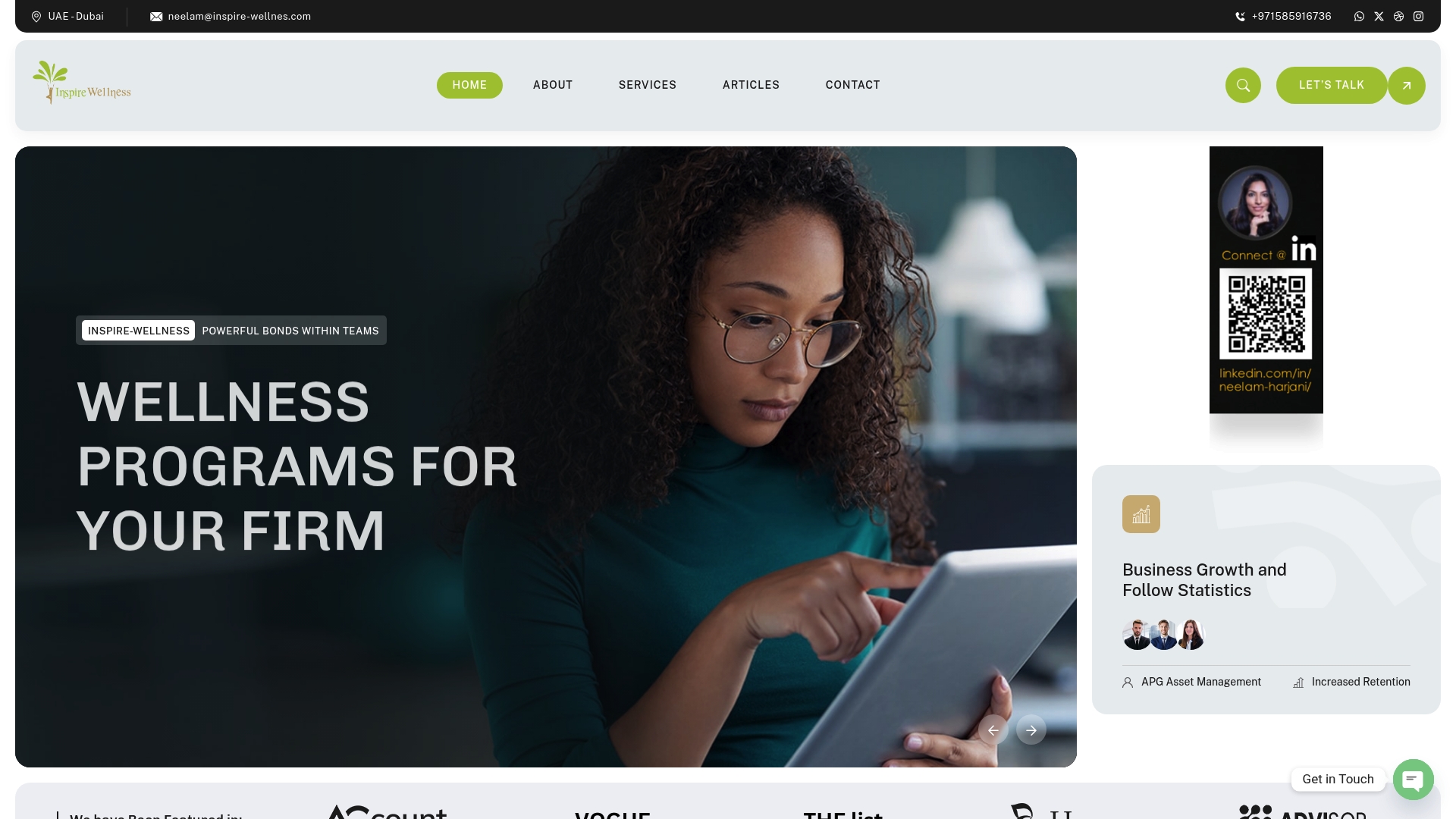
At Inspire-wellness, we work with organizations across Dubai and the wider UAE to design corporate wellness programs that integrate mental health support, resilience training, and leadership development into a single, measurable framework. Our employee wellbeing coaching translates the strategies in this article into programs your team will actually use, supported by behavioral science and built for long-term results. Whether you are starting from scratch or refining what you already have, we are here to help you build a workforce that is genuinely well.
FAQ
What are the most impactful workplace wellbeing tips for managers?
The highest-impact strategies combine EAP promotion, leadership mental health training, and flexible work policies. Managers who model psychological safety and close feedback loops consistently see stronger employee engagement and lower burnout rates.
Why should organizations measure employee wellbeing?
Measuring wellbeing links program investment to business outcomes like productivity, retention, and absenteeism. Without tracking data at the team level and sharing results with employees, organizations cannot identify what is working or build the trust needed for sustained participation.
How does psychological safety relate to employee wellbeing?
Psychological safety allows employees to raise concerns, ask for help, and use mental health resources without fear of judgment. Leaders who model vulnerability and transparency are the most effective drivers of this culture.
What is a whole-person approach to workplace wellness?
A whole-person approach integrates mental health benefits, physical wellbeing support, stress management programs, and inclusive cultural policies into a cohesive strategy. Research shows this approach produces up to 10% productivity gains through lasting health behavior changes.
How can companies reduce mental health stigma at work?
Mental health literacy training for all staff, person-first language, leadership endorsement of mental health resources, and parity between mental and physical health benefits are the most evidence-supported methods for reducing stigma across an organization.