
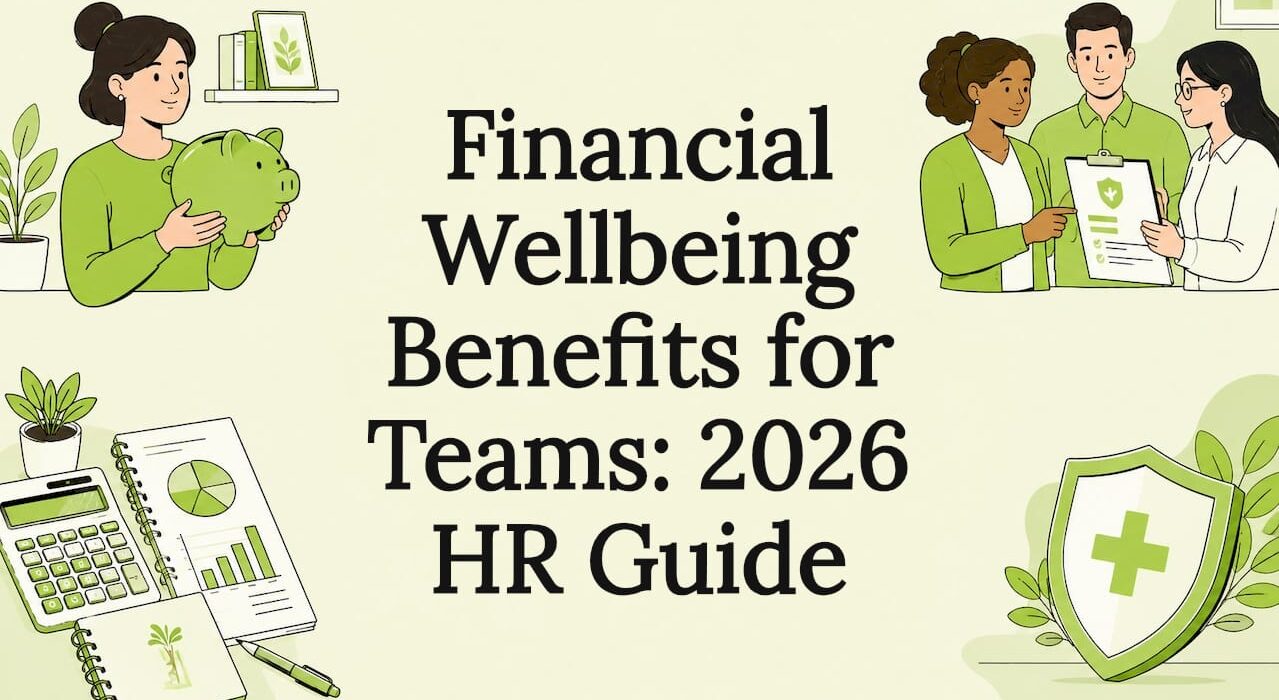
Financial wellbeing benefits for teams are employer-driven programs that reduce financial stress and improve productivity, engagement, and retention through continuous education, coaching, and personalized support. The industry term for this field is “employee financial wellness,” and it covers everything from budgeting tools and debt management to retirement readiness coaching. 33% of working-age adults feel overwhelmed by financial stress, and that pressure shows up directly in your team’s focus, attendance, and output. HR leaders who treat financial health as a core benefit, not an afterthought, see measurable gains across every performance metric that matters.
What are the key components of financial wellbeing benefits for teams?
Effective financial wellness programs share one defining feature: they run continuously, not as a single event. A one-time seminar on budgeting does not change behavior. Continuous, personalized programs supported by both technology and human coaches consistently outperform one-off education events in engagement and lasting behavior change.
The core components of a well-built program include:
- Financial education: Ongoing workshops, digital modules, and resources covering budgeting, debt reduction, emergency savings, and tax basics. Content must be updated regularly, not recycled from last year’s enrollment period.
- Personalized coaching: Access to a human financial advisor, not just a chatbot. Employees with complex situations, such as managing student debt alongside retirement contributions, need real guidance.
- Technology-enabled tools: Apps and platforms that help employees track spending, model debt payoff scenarios, and project retirement income. These tools extend the program’s reach between coaching sessions.
- Debt and emergency savings support: Targeted resources for the most common financial pain points. Many employees carry high-interest debt that directly competes with their ability to save.
- Retirement readiness beyond enrollment: Helping employees understand their retirement plan, not just sign up for it. This distinction drives participation quality, not just participation rates.
- Integration with existing benefits: A financial wellness program that sits in isolation gets ignored. Programs embedded into onboarding, open enrollment, and manager communications see far higher utilization.
Pro Tip: When selecting a program vendor, ask whether their coaches are commission-free. Commission-free coaching builds significantly more employee trust than models where advisors earn fees from product recommendations.
How do financial wellbeing benefits improve team performance and engagement?

Financial stress is a direct productivity drain. Financial stress causes absenteeism, reduced focus, and measurable declines in mental health. When employees spend work hours worrying about bills or loan payments, their cognitive bandwidth shrinks and their output suffers.
The performance benefits of addressing this are concrete:
- Reduced absenteeism: Employees under financial stress take more unplanned days off. Programs that relieve that pressure reduce absence rates.
- Higher engagement scores: Financially secure employees show up more present and more motivated. They are less likely to be passively job-searching while on the clock.
- Improved mental health and sleep: Financial anxiety is one of the leading causes of poor sleep. Better sleep translates directly into sharper decision-making and lower error rates at work.
- Stronger retirement plan participation: Retirement plan participation rates increase when financial wellness initiatives support education and planning beyond the enrollment window. Higher participation signals that employees feel financially stable enough to invest in their future.
- Lower turnover intent: Employees who feel their employer supports their financial health are more likely to stay. Retention savings alone often justify the cost of a program.
Stat callout: 33% of working-age adults report that financial stress negatively affects their sleep, mental health, and productivity. That means roughly one in three people on your team is operating below their potential right now.
The ROI indicators HR teams should watch include absenteeism rates, voluntary turnover, engagement survey scores, and retirement plan participation. Employers with financial wellness programs report improvements across all four. These are not soft metrics. They connect directly to labor costs, productivity output, and your ability to retain top talent.
What are practical strategies for implementing financial wellbeing benefits?
Implementation determines whether a program delivers results or collects dust in an employee portal. The following steps give HR leaders a clear path forward.
-
Conduct a needs assessment survey. Before selecting any program, survey your team. Needs assessment surveys help organizations align benefit offerings with real employee priorities, whether that is debt reduction, emergency savings, or retirement readiness. A program built around actual needs drives far higher utilization than one built around assumptions.
-
Choose continuous programs over one-time events. A single financial literacy workshop produces minimal lasting change. Select programs that deliver ongoing touchpoints through coaching, digital tools, and regular content updates.
-
Prioritize commission-free, coaching-led platforms. Programs perceived as unbiased build greater trust and employee adoption than sales-driven models. Employees disengage quickly when they sense a financial advisor is selling them something.
-
Embed the program into existing workflows. Introduce financial wellness resources during onboarding. Revisit them at open enrollment. Include them in manager communications. Programs that live inside the employee experience get used. Programs that require employees to seek them out do not.
-
Explore zero-cost or low-cost entry models. Some platforms offer zero-cost employer models with a limited number of free coaching sessions per employee, generating revenue only if employees choose premium services. These models reduce the barrier to launching a program while still delivering real value.
-
Track both immediate and long-term outcomes. HR leaders should measure short-term metrics like utilization and satisfaction alongside long-term indicators like retention rates and retirement participation. This dual view gives you the full ROI picture. For a structured approach to this, Inspire-wellness’s guide on wellness program ROI offers a practical framework.
Pro Tip: Announce your financial wellness program through managers, not just HR emails. Employees trust their direct managers. A brief team meeting mention drives more sign-ups than three company-wide email blasts.
Comparing financial wellbeing program types for different teams
Not every organization needs the same program. The right fit depends on team size, workforce diversity, and budget. The table below compares four common program categories.
| Program Type | Best For | Key Strengths | Limitations |
|---|---|---|---|
| Educational-only | Small teams, limited budgets | Low cost, easy to deploy | Minimal behavior change, no personalization |
| Coaching-intensive | Mid-size to large teams | High trust, personalized guidance | Higher cost, requires advisor availability |
| Digital tools-focused | Tech-comfortable workforces | Scalable, always accessible | Low engagement without human support |
| Hybrid (coaching + digital) | Diverse, distributed teams | Balances scale with personalization | Requires thoughtful integration to work well |
Educational-only programs work as a starting point but rarely move the needle on financial behavior. Coaching-intensive models produce the strongest outcomes but require investment in qualified advisors. Digital tools extend reach but lose effectiveness when employees have no human to turn to with complex questions. The hybrid model, combining digital tools with access to real coaches, delivers the best balance of scale and impact for most organizations. Team size and workforce diversity should guide your final choice.
How can HR leaders measure the success of financial wellbeing benefits?
Measurement is what separates a program that feels good from one that proves its value. HR leaders should track a defined set of metrics from day one.
- Utilization rates: What percentage of eligible employees are actively using the program? Low utilization signals a communication or trust problem, not necessarily a program quality problem.
- Absenteeism changes: Compare unplanned absence rates before and after program launch. A meaningful reduction is one of the clearest signs that financial stress is declining.
- Retirement plan participation: Track both enrollment rates and contribution levels. Rising contributions indicate that employees feel financially stable enough to save, which is a strong proxy for overall financial health.
- Hardship withdrawal rates: A drop in retirement account hardship withdrawals signals that employees are building emergency savings and relying less on retirement funds for short-term crises.
- Employee satisfaction surveys: Include two or three financial wellness-specific questions in your regular engagement surveys. Ask whether employees feel their employer supports their financial health.
- Retention and recruitment data: Link financial wellness program participation to turnover rates. Employees who engage with the program should show lower voluntary turnover over a 12-month window.
Financial wellness is a retention lever that requires ongoing, personalized support integrated with total rewards. Measuring it with the same rigor you apply to health benefits makes the business case undeniable. For a deeper look at boosting productivity through wellness investment, Inspire-wellness has published practical guidance for HR teams.
Key Takeaways
Financial wellbeing benefits for teams deliver measurable gains in retention, productivity, and engagement only when programs are continuous, personalized, and embedded into the everyday employee experience.
| Point | Details |
|---|---|
| Financial stress is widespread | 33% of working-age adults report stress that harms sleep, mental health, and productivity. |
| Continuous programs outperform one-off events | Ongoing coaching and digital tools drive lasting behavior change; single seminars do not. |
| Commission-free coaching builds trust | Employees engage more with advisors who have no financial incentive to sell products. |
| Measure both short and long-term outcomes | Track utilization and satisfaction now; monitor retention and retirement participation over time. |
| Embed programs into existing workflows | Financial wellness resources placed inside onboarding and enrollment see far higher adoption rates. |
Why financial wellbeing deserves a permanent seat at the HR table
I have worked with HR leaders across industries who treat financial wellness as a “nice to have” benefit they will add once the budget allows. That framing is the problem. Financial stress does not wait for budget cycles. It shows up in Monday morning meetings, in missed deadlines, and in the resignation letters you did not see coming.
The shift I advocate for is simple but not easy: stop thinking about financial wellbeing as a program and start thinking about it as an infrastructure. Just as you would not run a company without health insurance, you should not run one without a structured way to support employees’ financial health. The organizations I have seen do this well do not launch a financial wellness app and call it done. They weave financial support into onboarding conversations, manager training, and benefits communication year-round.
The adoption challenge is real. Employees often feel embarrassed about their financial situations and will not voluntarily seek help. The solution is to normalize the conversation at the leadership level. When managers talk openly about financial planning, employees feel safe enough to use the resources available to them. That cultural shift is what turns a program from a checkbox into a genuine retention tool.
HR leaders who treat financial wellbeing as a strategic priority will find it pays back in lower turnover, stronger engagement, and a workforce that shows up ready to perform. The data supports it. The logic supports it. The only thing left is the decision to act.
— Neelam
How Inspire-wellness supports your team’s financial wellbeing goals
Inspire-wellness works with organizations across the UAE and beyond to build employee wellbeing programs that address the full spectrum of health, including financial health. We design programs grounded in behavioral science, integrating financial literacy, coaching, and resilience training into a single, coherent employee experience. Our workplace health programs are built for HR leaders who need measurable outcomes, not just good intentions. If you are ready to move beyond one-off workshops and build a financial wellness infrastructure that actually sticks, our team is here to help you design it. Explore how HR’s role in workplace wellness connects directly to the financial wellbeing outcomes your organization needs in 2026.
FAQ
What are financial wellbeing benefits for teams?
Financial wellbeing benefits for teams are employer-provided programs that reduce financial stress through education, coaching, budgeting tools, and retirement planning support. They are designed to improve employee focus, engagement, and long-term financial health.
How does financial stress affect team performance?
Financial stress causes absenteeism, reduced productivity, and poorer mental health, all of which directly burden employer operations and team output.
What is the difference between a one-time financial seminar and a continuous program?
A one-time seminar delivers information but rarely changes behavior. Continuous programs with ongoing coaching and digital tools produce lasting improvements in financial habits and employee engagement.
How do HR leaders measure the ROI of financial wellbeing programs?
HR leaders should track utilization rates, absenteeism changes, retirement plan participation, hardship withdrawal rates, and voluntary turnover. Measuring both immediate and long-term outcomes gives the most accurate ROI picture.
Are there low-cost options for launching a financial wellbeing program?
Some platforms offer zero-cost employer models with a limited number of free coaching sessions per employee, making it possible to launch a credible program without significant upfront investment.