A wellness program for small businesses in Dubai is a structured set of initiatives designed to improve employee physical, mental, and emotional health, scaled to fit small teams and local market conditions. Corporate wellbeing, the recognized industry term, covers everything from stress management workshops to confidential Employee Assistance Programs (EAP). For Dubai’s small business owners, a well-designed corporate wellness program directly reduces absenteeism, improves retention, and lifts daily productivity. The UAE’s competitive labor market makes these outcomes more than a nice-to-have. Inspire-wellness research consistently shows that businesses investing in structured wellbeing see measurable gains in both employee engagement and business performance.
What does a wellness program for small businesses in Dubai include?
The most effective small business wellness programs in Dubai combine physical, mental, and emotional health support into one repeatable structure. No single element works in isolation. Workplace mental health programs that combine training, confidential support, and policy changes move the needle, while standalone mindfulness sessions often do not. That distinction matters enormously when you are working with a limited budget and a small team.

Physical wellness activities
Physical components do not require a gym membership or expensive equipment. Wellness sessions for small teams in Dubai can include stretching, posture correction, breathing exercises, stress relief, and team movement activities, all delivered within a standard workday. These sessions are adaptable to your office layout and team schedule. A 20-minute desk posture correction session twice a week costs almost nothing and reduces the musculoskeletal complaints that quietly drain productivity.
Mental health and EAP support
Mental health support is the component most small businesses underinvest in. A credible program includes a confidential EAP, psychoeducational workshops on stress and resilience, and policy consulting. EAP programs provide anonymized utilization reports to employers, showing utilization trends without any diagnosis-level details. This design protects employee privacy and removes the stigma barrier that prevents people from seeking help. For more on building this layer, the Inspire-wellness guide on mental health in Dubai workplaces is a practical starting point.
Digital tools and micro-sessions
Digital wellness tools extend your program beyond scheduled sessions. Apps that track stress, sleep, and movement give employees agency over their own health data. Small Dubai companies achieve better adoption by offering micro-sessions integrated into the workday rather than expecting attendance at long offsite activities. A 10-minute guided breathing session at 2:00 PM fits a busy sales team far better than a two-hour Saturday workshop.
Pro Tip: Assign one internal wellness champion per team. This person does not need formal training. They simply remind colleagues about sessions, share resources, and create social accountability. Adoption rates rise significantly when a peer, not management, leads the nudge.
How much does a wellness program cost for a small Dubai business?
Budget clarity is the first thing small business owners need before committing to any employee wellness initiative. Typical annual spend for small business wellness programs in Dubai ranges from AED 300–800 per employee for basic digital and preventative services to AED 2,000+ for premium services including gym subsidies and intensive coaching. That range gives you a realistic planning baseline.
| Tier | Annual cost per employee | What it typically includes |
|---|---|---|
| Basic | AED 300–800 | Digital tools, one monthly workshop, EAP access |
| Mid-range | AED 800–1,500 | Weekly micro-sessions, mental health workshops, fitness stipend |
| Premium | AED 2,000+ | Coaching, gym subsidies, full EAP, policy consulting |
The table above shows that meaningful programs are accessible at every budget level. A 10-person team at the basic tier spends between AED 3,000 and AED 8,000 annually. That is less than the cost of replacing one mid-level employee who leaves due to burnout.
Dedicated annual budgeting and outcome measurement, rather than ad-hoc spend and participation tracking, are critical for sustainable programs. CFO skepticism drops sharply when wellness spending is tied to measurable outcomes like reduced sick days or improved retention. Build your wellness budget as a fixed line item, not a discretionary expense. For a detailed breakdown of UAE-specific cost planning, the Inspire-wellness resource on UAE wellness budget planning covers allocation strategies by team size.
Pro Tip: Allocate at least 60% of your wellness budget to recurring, low-cost activities like micro-sessions and digital tools. Reserve the remaining 40% for one or two higher-impact events per year, such as a resilience workshop or a health screening day. This split maximizes reach without overspending on a single event.
How to design and launch a flexible wellness plan for your Dubai business
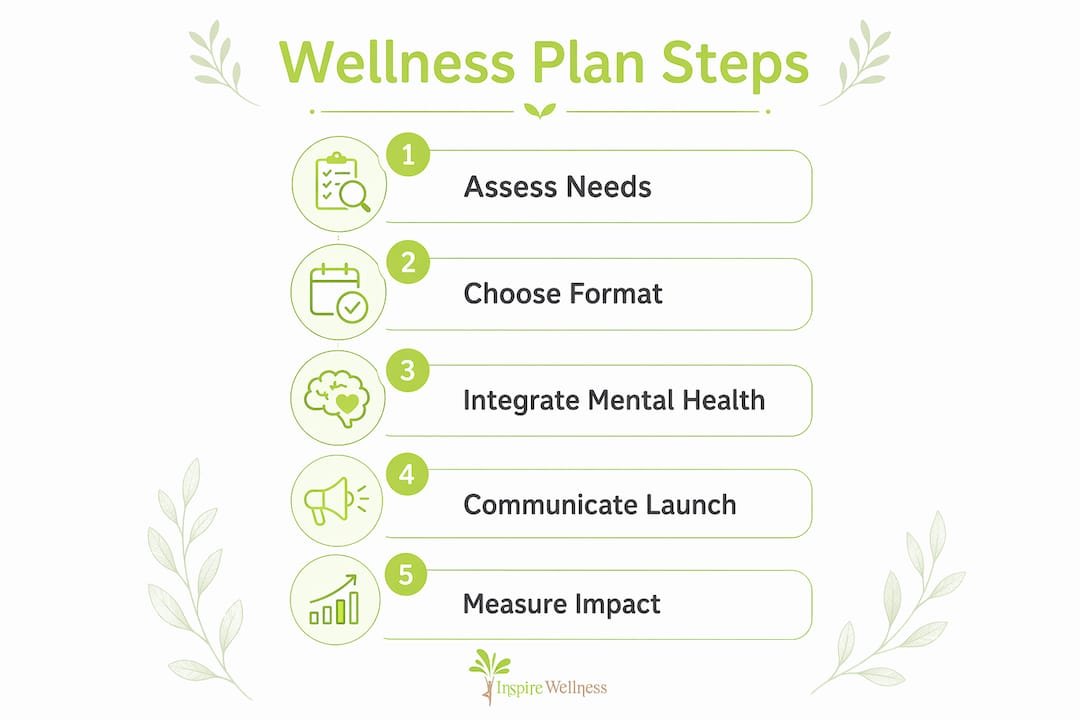
Launching a flexible wellness plan for a Dubai business starts with understanding your team before selecting any program elements. Skip this step and you will spend money on activities nobody uses.
Step 1: Assess your team’s needs
Run a short anonymous survey covering stress levels, physical health concerns, and preferred session formats. Ask whether employees prefer morning or afternoon sessions, group or individual formats, and digital or in-person delivery. This data shapes every decision that follows.
Step 2: Choose your delivery format
- Micro-sessions: 10–20 minute activities embedded in the workday, such as desk stretching or guided breathing
- Workshops: Monthly or quarterly sessions on topics like stress management, sleep, or financial wellbeing
- Digital platforms: Apps or online portals employees access independently
- One-day programs: Structured full-day events covering movement, nutrition, and mental health
Starting with lightweight, repeatable wellness interventions and expanding after measuring engagement is the recommended approach for small Dubai businesses. Adapting delivery to office context and team preferences increases adoption from the start.
Step 3: Integrate mental health from day one
Mental health cannot be an afterthought added once the physical wellness layer is running. Clinical psychology-based models with EAP, workshops, and policy consulting are more effective than programs that treat mental health as a standalone event. Build EAP access and at least one psychoeducational workshop into your first-year plan.
Step 4: Communicate and launch
- Announce the program through a team meeting, not just an email
- Explain confidentiality protections clearly, especially for EAP services
- Set a 90-day review checkpoint to assess participation and adjust
- Celebrate early wins publicly to build momentum
The workplace health program ideas resource from Inspire-wellness offers a practical menu of activities suited to Dubai workplaces in 2026.
What obstacles do small businesses face with wellness programs and how to overcome them?
Small businesses in Dubai face predictable barriers when running employee wellness initiatives. Knowing them in advance lets you design around them.
- Privacy concerns: Employees fear that using EAP services will flag them to management. Address this directly by explaining that EAP utilization reporting gives employers only anonymized trend data, never individual diagnoses. State this policy in writing before the program launches.
- Scheduling conflicts: Small teams often cannot leave their desks for long sessions. The solution is micro-sessions embedded in the workday. A 15-minute team stretch at 10:00 AM requires no coverage planning and no travel.
- Low engagement with premium perks: Gym subsidies and wellness apps with high monthly fees often go unused. Employees in small offices respond better to social, in-person activities than to individual digital benefits they access alone.
- Measuring impact beyond headcounts: Participation numbers tell you who showed up, not whether the program worked. Track absenteeism rates, self-reported stress scores, and employee satisfaction quarterly.
- Sustaining momentum: Programs that launch with energy and fade within three months are the most common failure pattern. Build repeatable, enjoyable activities into a fixed calendar so wellness becomes a habit, not an event.
“The biggest mistake small businesses make is investing in a flashy wellness benefit that looks good on a job posting but delivers no real health outcome. A weekly 20-minute posture session that employees actually attend beats an unused gym membership every time.”
How do you measure the effectiveness of a wellness program in a small Dubai business?
Measurement turns a wellness program from a cost center into a business case. Without it, leadership support erodes within 12 months.
The most useful metrics for small businesses fall into four categories:
- Participation rates: Track attendance at each session type. A rate below 50% signals a format or timing problem, not a motivation problem.
- Absenteeism: Compare sick days per employee before and after the program launches. Even a one-day reduction per person per year represents real cost savings.
- Employee satisfaction scores: Run a quarterly pulse survey with three to five questions on stress, energy, and job satisfaction. Keep it short so people actually complete it.
- EAP utilization trends: Anonymized reports show whether employees are accessing mental health support. Rising utilization in the first year is a positive sign, not a red flag. It means people feel safe enough to seek help.
| Metric | What it tells you | How to collect it |
|---|---|---|
| Session attendance | Program reach and format fit | Sign-in sheets or app logins |
| Sick days per employee | Absenteeism impact | HR records, quarterly comparison |
| Stress self-rating | Perceived wellbeing change | Anonymous pulse survey |
| EAP utilization rate | Mental health support uptake | Anonymized provider report |
Corporate wellness budgets must be realistic and dedicated annually to overcome CFO skepticism and ensure program sustainability. Pairing your budget request with these four metrics gives finance leaders the evidence they need to approve continued investment. The Inspire-wellness guide on building a credible wellbeing strategy walks through how to present this data internally.
Key Takeaways
A wellness program for small businesses in Dubai succeeds when it combines physical and mental health support, fits within a dedicated annual budget, and measures outcomes beyond simple participation counts.
| Point | Details |
|---|---|
| Start with a needs assessment | Survey employees on stress, health concerns, and preferred session formats before selecting activities. |
| Budget AED 300–2,000+ per person | Basic programs start at AED 300–800 annually; premium tiers with coaching exceed AED 2,000 per employee. |
| Use micro-sessions for adoption | Short, workday-integrated sessions outperform long offsite events for small Dubai teams. |
| Protect mental health confidentiality | EAP reports give employers trend data only, never individual diagnoses, which removes the stigma barrier. |
| Measure four core metrics | Track attendance, sick days, stress scores, and EAP utilization to build a credible business case. |
What I have learned from watching small Dubai businesses launch wellness programs
I have seen two types of small business owners approach wellness programs. The first type spends three months researching the perfect program, then launches with a gym subsidy and a wellness app that 80% of the team never opens. The second type starts with a 15-minute weekly stretch session, measures who shows up, asks why others did not, and builds from there. The second type always gets better results.
The trap is confusing visible investment with real impact. A branded wellness portal looks impressive in a board presentation. A consistent Tuesday morning breathing session that 90% of your team attends actually changes behavior. The research backs this up: adapting delivery to office context and team preferences increases adoption far more than increasing budget.
Mental health is where I see the most hesitation from small business owners. They worry that offering EAP services signals that something is wrong with their culture. The opposite is true. Offering confidential mental health support signals psychological safety, and that signal alone improves retention. The mental health priority guide from Inspire-wellness addresses this concern directly and is worth reading before you design your program.
My honest advice: commit to a 12-month plan with a fixed budget, start with two or three activities you can run consistently, and review your four core metrics at 90 days. You will know exactly what to expand and what to cut. That data-driven approach is what separates programs that last from programs that quietly disappear after the first quarter.
— Neelam
How Inspire-wellness supports small business wellness in Dubai
Small business owners in Dubai do not need to figure out corporate wellbeing alone. Inspire-wellness brings together behavioral science, mental health expertise, and practical program design into one structured approach built for teams of every size.
The workplace wellbeing improvement process from Inspire-wellness gives you a proven, step-by-step framework for designing, launching, and measuring a program that fits your budget and culture. Whether you are building your first wellness initiative or strengthening an existing one, the Inspire-wellness team provides expert consultation, digital tools, and workshop facilitation tailored to Dubai’s workplace environment. Explore the full range of corporate wellness programs available for Dubai businesses and take the first step toward a healthier, more engaged team.
FAQ
What is a wellness program for a small business in Dubai?
A wellness program for a small business in Dubai is a structured set of physical, mental, and emotional health initiatives scaled to small teams and local workplace conditions. It typically includes micro-sessions, EAP access, and mental health workshops.
How much does a small business wellness program cost in Dubai?
Annual costs range from AED 300–800 per employee for basic programs to AED 2,000+ for premium tiers that include coaching and gym subsidies.
How do I get employees to actually use the wellness program?
Micro-sessions integrated into the workday consistently outperform long offsite events for small Dubai teams. Short, repeatable activities that fit the natural work schedule drive the highest participation.
Should a small business in Dubai include mental health support?
Yes. Programs that combine EAP access, psychoeducational workshops, and policy changes produce better outcomes than physical wellness activities alone. EAP services protect employee privacy through anonymized reporting, which removes the main barrier to uptake.
How do I measure whether my wellness program is working?
Track four metrics quarterly: session attendance, sick days per employee, self-reported stress scores from pulse surveys, and anonymized EAP utilization rates. These four data points give you a clear picture of both reach and impact.
Recommended
- Corporate Wellness: A Comprehensive Guide for Business Dubai – Inspire Wellness
- Wellness Program Benefits for Companies: 2026 Guide
- The Importance of Physical Wellbeing in the Workplace: A Strategic Advantage for Dubai Businesses – Inspire Wellness
- Wellness program best practices for UAE multinationals