Resilience training works when it is treated as a program, not an event. The research shows a real but modest benefit from a single workshop, and the benefit fades within weeks unless it is reinforced, tailored to the pressures your people actually face, and paired with changes to how work is organized. This guide explains how to design resilience training for a UAE workforce, which team exercises are worth your time, and how to judge whether a provider’s offer will hold up.
TL;DR
- Resilience training has a small average effect (d=0.21), and gains measured within a month are far larger than those measured later. Plan for reinforcement, not a one-day event.
- Longer, more frequent programs beat short seminars, and one-on-one coaching often outperforms generic classroom sessions.
- Start with a needs assessment, then tailor the content to your real stressors, whether client pressure in finance or constant change in a multinational.
- Train leaders first, and fix workload and role clarity alongside the training, or it can backfire.
- Team exercises should build shared habits: setback debriefs, thinking-trap checks and agreed rituals.
Table of Contents
- What resilience training for employees actually is
- What the evidence says, honestly
- Why training alone is not enough
- The UAE context
- Designing a program that lasts
- Resilience exercises for teams that hold up
- Our perspective
- Working with us
- Questions HR teams ask
- Sources
What resilience training for employees actually is
Resilience training teaches people the skills to adapt, recover and stay effective when work becomes demanding. Typical content includes reframing unhelpful thoughts, managing energy and stress responses, building social support, and learning how to recover after a setback. It is not a way to make people tolerate unreasonable conditions, and a good program says so openly.
For HR leaders in Dubai and Abu Dhabi, the practical question is rarely whether to offer it. It is how to avoid buying a one-off session that people enjoy on the day and forget by the following month. The sections below are built around that question.
What the evidence says, honestly
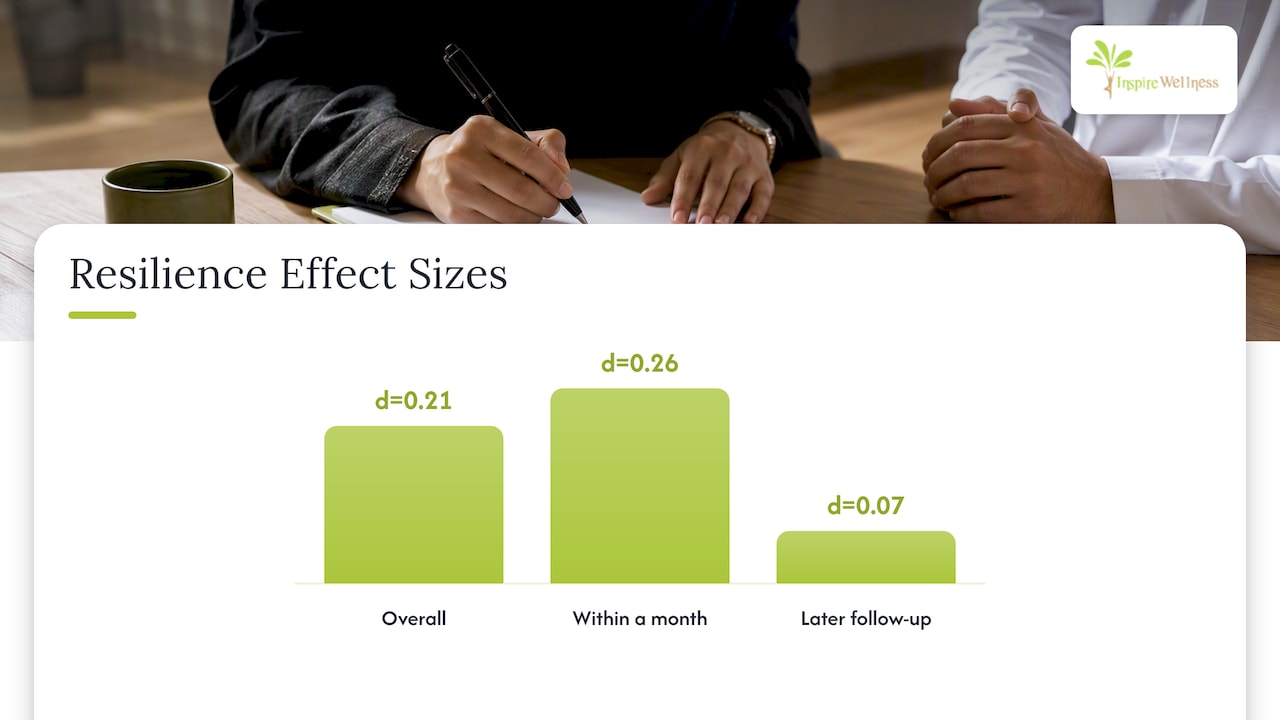
The most useful finding for a buyer is also the least glamorous. A systematic review of resilience-based workplace interventions reports small overall effect sizes of d=0.21. Effects measured within a month of training sit around d=0.26, and effects measured later fall to roughly d=0.07.
An earlier meta-analytic review of resilience-building programs reached a similar conclusion: resilience can be developed at work, but the gains need support to last. The same systematic review notes that programs with higher frequency and longer duration are associated with larger effects than short, single-session trainings.
Three practical conclusions follow:
- Budget for a sequence, not a day. Monthly follow-ups, short refreshers and coaching touchpoints keep the skills alive.
- Prefer depth over reach. A smaller group followed for several months usually serves you better than a large audience in a ballroom for ninety minutes.
- Aim at those under the most strain. The review’s practitioners point out that training is most impactful for people already facing elevated stress or lacking protective resources. That is a reason to assess first and target second.
A caution on interpretation: these reviews cover many program types and settings, including public sector workplaces, and they measure outcomes in different ways. Treat them as a guide to design principles, not a guarantee of any specific result in your organization.
Why training alone is not enough
One misconception does more damage than any other: that resilience is a personal trait employees must build on their own. If workload is unmanageable, roles are unclear or the culture punishes people for speaking up, training individuals can come across as blaming them for the problem.
The WHO guidelines on mental health at work stress organizational interventions, and the related WHO guidance on workplace strategies identifies ten categories of psychosocial risk. They include work content, workload and pace, control, organizational culture, interpersonal relationships, role ambiguity, career development and the home-work interface. Resilience training belongs next to action on these, not in place of it.
In practice, that means running two tracks at once:
- The skills track: workshops, coaching and practice that build individual and team capability.
- The conditions track: reviewing workload peaks, decision rights, meeting load and manager behavior, and changing what the data points to.
If you want a structured way to find those conditions, our guide to turning UAE workplace stress assessments into action in six weeks walks through the process.
The UAE context
Employers here are not working in a vacuum. The Abu Dhabi Public Health Centre runs a Workplace Wellness and Safety Program for government entities, and its 2025 calendar includes a September session on workplace mental health covering resilience and coping mechanisms. The program is aimed at government bodies, but it signals that resilience is now part of the mainstream wellbeing conversation in the emirate, and private employers increasingly benchmark against it.
There is also a legal dimension. A law firm briefing on implementing the UAE Mental Health Law at work explains that the law, together with the disability discrimination provisions of the UAE Labour Law, limits how employers may treat employees with psychiatric conditions, and that penalties for non-compliance can be significant. Resilience training is not a compliance measure, and it does not replace a clear policy or access to professional care. If you are unsure of your obligations, take advice from a UAE employment lawyer, and see our walkthrough on how to build a compliant UAE mental health policy in 90 days.
Designing a program that lasts
Start with a needs assessment
Generic, off-the-shelf modules are the weakest option. Before any workshop, identify the specific stressors in each group. A finance team may be dealing with deadline compression at quarter close and demanding clients. A multinational’s regional office may be absorbing frequent restructures and decisions made in other time zones. A luxury retail team may carry emotional labor on the shop floor and long, irregular hours.
Use a short survey, a few small-group conversations and whatever data you already hold, such as absence patterns and exit interview themes. Then shape the content to what you find. The shift is from fixing the employee to resourcing the employee: giving people tools, time and support that match their real situation.
Train leaders first
A systematic review and meta-analysis of leader-targeted stress management interventions found that interventions aimed at leaders can improve outcomes for them and for their teams. When managers can recognize stress, set healthy boundaries and model recovery, the effect reaches people who never attended a session. It also makes the team’s training believable, because employees watch what managers do, not what a slide says.
For senior teams, our guides on executive resilience and building emotional resilience as an HR leader cover the leadership side in more depth.
Choose the format to match the goal
| Format | Best for | Watch out for |
|---|---|---|
| One-off workshop | Awareness, shared language, kicking off a program | Effects fade quickly without follow-up |
| Multi-session workshop series | Building skills in a whole team over time | Needs manager time protected for practice |
| Group coaching | Teams with a shared challenge, peer learning | Requires trust and a stable group |
| One-on-one coaching | Leaders, high-risk individuals, personalized change | Higher cost per person, so target it |
| Digital refreshers | Reinforcement between sessions | Low completion if not tied to team routines |
The research summarized above points toward one-on-one coaching as often the most effective route, and toward longer, higher-frequency group programs over single seminars. A sensible blend is a group workshop series for the wider team, with coaching for leaders and for those in the highest-pressure roles.
Measure what matters
Decide on your measures before launch: a validated resilience or wellbeing scale at baseline, one month and three to six months, plus business indicators you already track, such as absence, turnover in the target group and engagement scores. Given the pattern of fading effects in the research, the later readings are the honest ones. If they dip, you know where to add reinforcement.
Resilience exercises for teams that hold up
Team resilience is more than the sum of individual coping skills. Practitioners emphasize building collective resilience through rituals, shared values and psychological safety. A collection of resilience activities and workshop ideas describes workshop formats built on exactly this, including thinking-trap identification, real-time resilience cues and structured debriefs after setbacks. The exercises below draw on those ideas, adapted for a typical UAE office team.
1. Thinking-trap check (20 minutes)
Each person writes down a recent work moment that felt worse than it was. In pairs, they name the thinking trap involved, such as catastrophizing, mind-reading or all-or-nothing thinking, then write one more balanced reading of the same event. Teams that do this together build a shared vocabulary that lets colleagues say “that sounds like a trap” without offense.
2. Setback debrief (30 minutes, repeated)
After a missed deadline, lost pitch or difficult client escalation, hold a short debrief with three questions: what happened, what was in our control, and what do we do differently next time. The rule is no blame and no rehash. Run it consistently, not only after failures, so it becomes routine instead of a warning sign.
3. Real-time reset cues (15 minutes to teach, seconds to use)
The team agrees on a small set of in-the-moment cues for pressure: a slow breath before replying to a tense message, a one-line reframe, a ten-second pause before a difficult call. The point is to make them concrete and personal, then practice them in a role-play of a realistic scenario.
4. Strengths and support map (30 minutes)
Each person lists the people, resources and strengths they rely on under pressure, and where the gaps are. The team then identifies who could cover which gaps. Social connection is a recognized protective factor, and a public health activity guide for adults lists strong social connections and a sense of belonging among the things that can increase resilience.
5. Team rituals (ongoing)
Pick two or three rituals the team owns: a Monday priorities check-in, a Thursday win-sharing round, a protected focus block each day. Rituals carry the training forward after the facilitator has left, which is where most programs lose their effect.
If you prefer to run some sessions in-house, a university-built resilience workshop kit from the Doerr Institute at Rice University offers a ready-to-deliver format that internal teams can adapt. Pair any self-run session with the follow-up structures above.
Our perspective
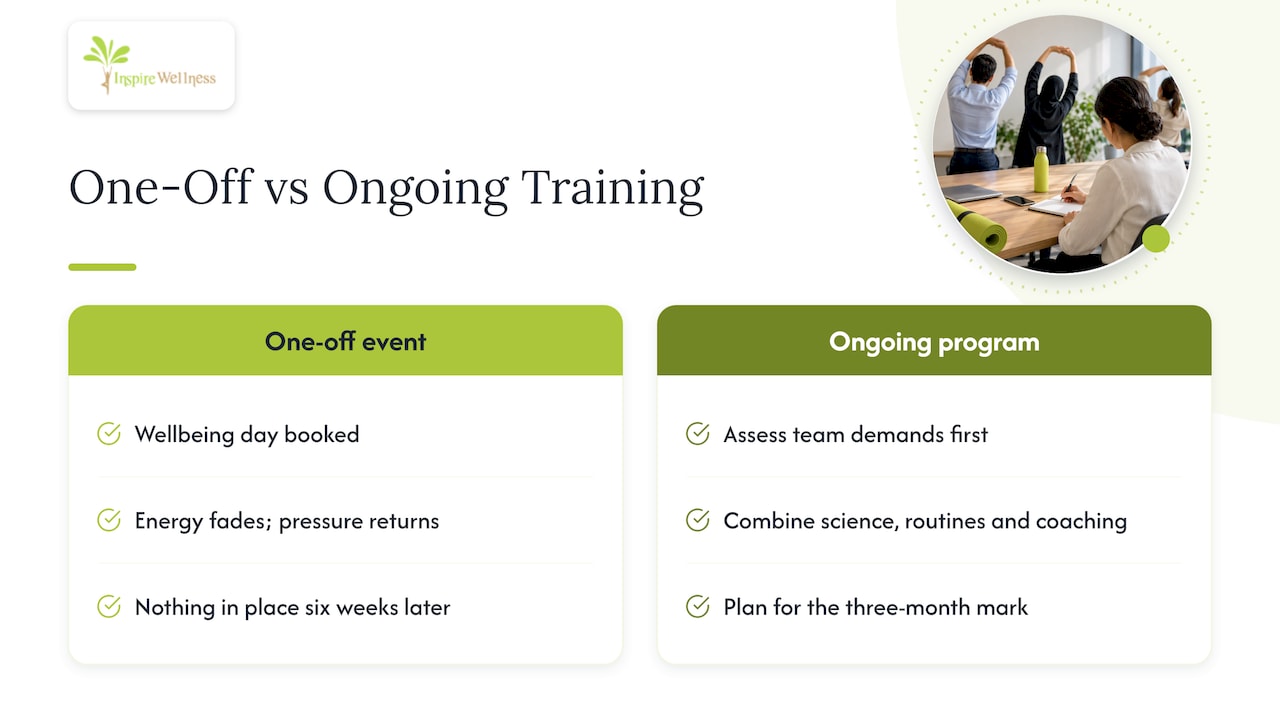
We see the same pattern again and again with HR heads in Dubai and Abu Dhabi: a team is strained, a wellbeing day is booked, everyone leaves energized, and six weeks later the pressure is back with nothing in place to meet it. The problem is rarely the quality of the session. It is that resilience was treated as an event.
Our approach starts from the opposite end. We look at the specific demands on a team first, whether that is the intensity of financial reporting cycles, the pace of change in a multinational or the standards expected in a luxury brand, and then we build the program around them. We combine behavioral science, emotional intelligence, energy management and coaching, because a mindset shift without practical routines rarely lasts, and routines without a mindset shift rarely stick.
We also say plainly to leadership teams that training cannot carry the whole load. If workload, role clarity or culture are driving burnout, those need attention alongside any workshop. We would rather help you build a program that does a modest job reliably, and keeps working, than promise a transformation in an afternoon.
Our most important advice is simple: invest in leaders first, assess before you design, and plan for the three-month mark, not just the day itself.
— Neelam
Working with us
We design resilience and wellbeing programs for organizations across the UAE, from group workshops to coaching for leaders and teams. Our corporate wellness programs and wellness workshops can be shaped around your needs assessment, and our group coaching for teams supports the reinforcement phase that the research says matters most.
Our published packages give you a clear starting point: Reset & Recharge at 3,000 AED one-off, Transform & Thrive at 5,500 AED one-off, and Master Your Wellbeing at 10,000 AED one-off. Programs outside these packages are scoped to your organization, so talk to us about what your teams need.
Questions HR teams ask
What are the 7 C’s of resilience?
The 7 C’s are a popular model that lists competence, confidence, connection, character, contribution, coping and control as building blocks of resilience. It originates in youth development thinking and is often borrowed for workplace sessions as a conversation framework. It is useful as a discussion tool, but it is a model and not a measured standard, so pair it with practical exercises and a proper assessment.
How long should resilience training for employees run?
Longer and more frequent programs are associated with larger effects than single short sessions, according to the systematic review of workplace resilience interventions. A practical shape is a kickoff workshop followed by monthly sessions or coaching over three to six months. The right length depends on the group’s stress levels and your measurement plan.
Does resilience training reduce burnout?
It can help, but the average effect is small, and the evidence says it works best alongside changes to workload, autonomy and culture. If you are seeing high burnout, run an assessment of those factors first. Anyone showing signs of a mental health condition should be directed to a qualified clinician or your employee assistance provider, not to a workshop.
Should we train the whole company or only some teams?
Usually, start with leaders and the highest-pressure groups. Training tends to matter most for people already facing elevated stress or lacking protective resources, and a targeted launch lets you test what works before scaling. A needs assessment shows you which teams to prioritize.
What are good resilience exercises for a team session?
Thinking-trap checks, setback debriefs, real-time reset cues, a strengths and support map and shared team rituals all suit a team setting. They build common language and habits rather than only individual coping. Choose two or three and repeat them over several weeks instead of covering everything once.
Sources
- Resilience-based interventions in the public sector workplace: a systematic review
- Can resilience be developed at work? A meta-analytic review
- Effectiveness of leader-targeted stress management interventions
- WHO guidelines on mental health at work
- WHO guidance on workplace mental health strategies
- ADPHC 2025 Workplace Wellness and Safety Program
- Implementing the UAE Mental Health Law in the workplace
- 19 Resilience Activities & Training to Overcome Adversity
- Resilience Workshop Kit, Doerr Institute for New Leaders