Group wellness sessions are defined as structured, facilitated programs in which employees engage collectively in physical, mental, or emotional health activities to build social connection, shared accountability, and measurable wellbeing gains. The role of group wellness sessions extends well beyond scheduling a team yoga class. Research now confirms these programs activate specific psychological and social mechanisms that individual wellness efforts simply cannot replicate. For HR professionals and organizational leaders, understanding this distinction is the difference between a wellness initiative that transforms culture and one that quietly fades after the first quarter. This article presents the evidence, explains the mechanisms, and gives you a practical framework for implementation.
What does the evidence say about group wellness benefits?
Group-based wellness programs consistently outperform individual approaches on measurable outcomes. A meta-analysis of 71 studies with 22,042 participants found a statistically significant functional outcome advantage for group-based interventions (g=0.164, 95% CI 0.032–0.297, P=0.015). That number tells you something important: the advantage is real, replicable, and not explained by chance.
The evidence on longevity is equally compelling. A structured six-week group course built around the “Five Ways to Wellbeing” framework produced sustained wellbeing improvements at both 6 and 15 months post-program, with effect sizes ranging from Cohen’s d=0.21 to 0.63. The intervention group also showed statistically stronger mental health gains than the comparison group (p=0.012 post-test; p=0.002 at 15 months). Wellbeing gains that hold for over a year represent genuine organizational value, not a short-term morale spike.
One finding that surprises many HR leaders: virtual group wellness sessions produce outcomes comparable to face-to-face formats when the core social mechanisms are properly facilitated. This matters enormously for distributed teams and hybrid workplaces. The format is less important than the quality of facilitation and the deliberate activation of peer support.
“The most effective group wellness programs are not defined by their setting or their content alone. They are defined by the social and psychological processes they deliberately activate among participants.”
| Outcome area | Evidence summary |
|---|---|
| Functional gains | Group interventions show a significant advantage over individual approaches across 71 studies. |
| Mental health | “Five Ways to Wellbeing” group course produced improvements sustained at 15 months. |
| Virtual effectiveness | Online group formats match face-to-face outcomes when facilitation activates social support. |
| Longevity of benefits | Without booster sessions, initial gains from organizational wellness programs often decline. |
How do group sessions build accountability and social support?
The core advantage of group wellness activities is not the content delivered. It is the social architecture created around that content. When employees participate together, they experience relatedness, peer encouragement, and a sense of shared purpose that individual programs cannot generate. These are not soft benefits. They are the mechanisms that drive the measurable outcomes cited above.
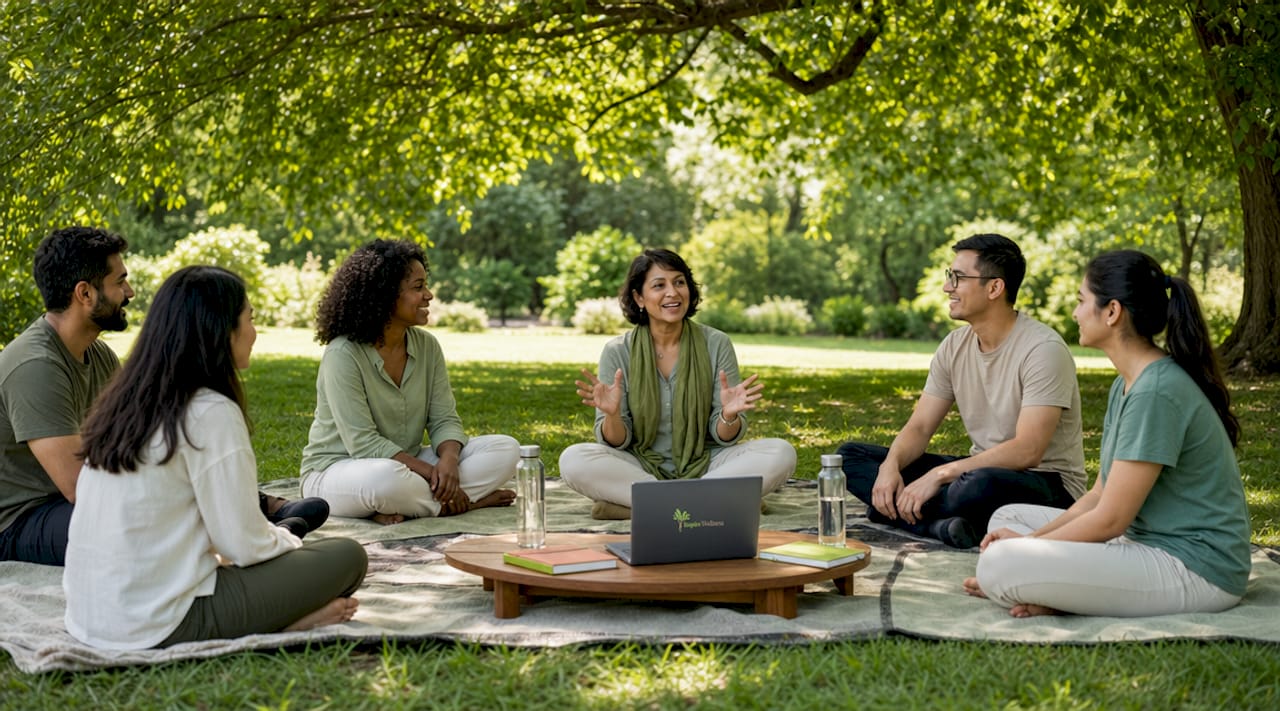
Research confirms that effective groups are intentional about social norms and peer support rather than ad hoc gatherings. A team that happens to attend the same webinar is not a wellness group. A team that reflects together, sets shared goals, and holds each other accountable across sessions is. This distinction explains why so many wellness workshops for groups underdeliver: they deliver content to a group rather than building a group around content.
Skilled facilitation is the variable that converts group presence into group benefit. Facilitator-led experiential activities, brief theory segments, and structured reflection periods transform passive attendance into active social engagement. Without this structure, employees sit in the same room without meaningfully connecting, and the wellbeing gains evaporate.
Key social mechanisms that group wellness sessions must activate:
- Peer accountability: Participants commit to goals in front of colleagues, creating positive social pressure to follow through.
- Shared language: Groups develop common vocabulary around wellbeing, making it easier to discuss stress, energy, and mental health openly.
- Relatedness: Feeling genuinely connected to colleagues is itself a health outcome, not just a means to one.
- Reciprocal support: Employees who receive encouragement are more likely to offer it, creating a self-reinforcing cycle of engagement.
Pro Tip: Design at least one structured peer-sharing activity into every session. Even a three-minute paired reflection exercise activates social connection more effectively than a 30-minute lecture delivered to the same group.
What challenges do HR leaders face when implementing group wellness?
Implementation is where well-designed programs most commonly fail. The barriers are predictable, and knowing them in advance gives you a significant advantage. A qualitative study of group psychoeducational wellness programs found that workload, limited protected time, and space constraints were the primary factors reducing participation and diluting outcomes. These are organizational problems, not employee motivation problems.
The most consequential implementation decision you will make is whether sessions occur during protected work time with managerial endorsement. When employees must choose between attending a wellness session and completing their workload, most will choose their workload. Protected time is not optional for programs that aim to reach the employees who need them most, particularly those already experiencing high stress or burnout.
Sustainability is the second major challenge. A systematic review of six organizational mental health promotion trials found positive initial effects on burnout, depression, stress, and resilience, but noted that benefits frequently waned without ongoing support structures. A single wellness workshop, however well designed, does not produce lasting change. You need a cadence.
Practical steps for effective implementation:
- Secure managerial buy-in before launch. Managers who actively encourage participation double attendance rates compared to programs announced through email alone.
- Schedule sessions during core hours. Lunchtime or after-hours sessions consistently attract lower participation and signal that wellness is optional.
- Assign a qualified facilitator. A trained facilitator, not a rotating volunteer, is responsible for activating the social mechanisms that drive outcomes.
- Plan booster sessions from day one. Schedule follow-up sessions at 3 and 6 months as part of the original program design, not as an afterthought.
- Audit your physical and virtual infrastructure. Breakout rooms, reliable video platforms, and private spaces for sensitive discussions are prerequisites, not luxuries.
Pro Tip: For hybrid teams, use the same session structure for both in-person and virtual participants simultaneously. Separate tracks create two-tier experiences and undermine the shared accountability that makes group wellness work. The WHO’s 2026 guidance confirms that digital platforms require active facilitation to generate genuine social health benefits.
How can HR leaders maximize long-term impact from group wellness programs?
Maximizing the impact of community wellness programs requires treating them as ongoing organizational systems rather than one-time events. The design, measurement, and reinforcement of these programs each require deliberate attention. Here is how to approach each dimension.
Design for social interaction, not just information delivery. Every session should include experiential activities, a brief evidence-based framework, and structured reflection. The “Five Ways to Wellbeing” model, which covers connecting, being active, taking notice, learning, and giving, provides a practical structure that explicitly builds social connection skills alongside individual wellbeing practices. Programs built on this model show stronger long-term outcomes precisely because social connection is treated as a skill to develop, not a byproduct to hope for.
Measure both individual and social outcomes. Most HR dashboards track individual metrics: absenteeism, engagement scores, self-reported stress. These matter, but they miss half the picture. Research shows that social connection mediates wellbeing improvements, meaning programs that improve social connection produce better individual outcomes downstream. Add perceived social support and loneliness measures to your evaluation toolkit. If your group wellness program is not moving these metrics, it is not activating the mechanisms that produce lasting change.
Build a reinforcement ecosystem around sessions. Booster sessions, peer mentorship pairings, and manager check-ins between formal sessions all extend the half-life of program benefits. A systematic review of organizational mental health interventions identifies these reinforcement structures as the primary differentiator between programs that sustain gains and those that plateau after the initial cohort. You can also explore wellness program best practices tailored to multinational teams for additional implementation frameworks.
- Track social connection metrics alongside individual wellbeing scores every quarter.
- Pair each formal session with a structured peer check-in between sessions.
- Use manager briefings before each program cycle to align leadership messaging.
- Evaluate format preferences annually: some teams thrive in person, others perform better virtually, and the data should guide your decision.
- Integrate step-by-step wellness initiatives into your annual HR planning cycle rather than treating wellness as a standalone project.
Key takeaways
Group wellness sessions produce their strongest outcomes when social connection, peer accountability, and skilled facilitation are treated as the core program mechanisms rather than incidental features.
| Point | Details |
|---|---|
| Group advantage is proven | A meta-analysis of 71 studies confirms group interventions outperform individual approaches on functional outcomes. |
| Virtual formats work with facilitation | Online sessions match face-to-face results when social support mechanisms are actively facilitated. |
| Protected time drives participation | Scheduling sessions during work hours with managerial endorsement is the single most important implementation decision. |
| Booster sessions prevent benefit decay | Without follow-up sessions and organizational reinforcement, initial wellbeing gains typically decline within months. |
| Measure social connection directly | Tracking perceived support and loneliness alongside individual metrics reveals the true drivers of program impact. |
Why facilitation quality is the variable most HR leaders underestimate
I have worked with organizations that invested significantly in wellness content, beautiful session materials, and well-marketed program launches, only to see participation drop after week two and outcomes fail to materialize. The pattern is consistent, and the cause is almost always the same: facilitation was treated as a delivery function rather than a clinical and social skill.
The research is unambiguous on this point. Groups that activate genuine peer support and accountability produce meaningfully better outcomes than groups that simply share the same content. That activation does not happen automatically. It requires a facilitator who knows how to create psychological safety, structure reflection, and draw out the social dynamics that turn a group of colleagues into a genuine support network.
What I find most underappreciated is the role of the booster session. Organizations celebrate a successful six-week program and then move on. Twelve months later, they wonder why engagement scores have not shifted. The “Five Ways to Wellbeing” research shows that gains at 15 months are statistically stronger than at post-test, but only in programs that maintained ongoing contact and reinforcement. That is not a coincidence. It is a design feature.
My honest recommendation: before you invest in content, invest in your facilitator. Before you plan your launch, plan your 6-month booster. And before you measure individual stress scores, add a social connection metric to your dashboard. The impact of group health sessions on workplace culture is real and measurable, but only when the program is designed to activate the right mechanisms from the start.
— Neelam
How Inspire-wellness supports your group wellness strategy
Inspire-wellness works with HR professionals and organizational leaders across Dubai and the UAE to design, implement, and sustain corporate wellness programs that go beyond content delivery. Our approach is grounded in behavioral science and built around the social mechanisms that research confirms drive lasting wellbeing gains. We help you structure sessions for maximum social engagement, train or source qualified facilitators, and build the booster and measurement frameworks that prevent benefit decay. Whether your teams are in-person, hybrid, or fully remote, our workplace wellbeing improvement guide gives you a proven, step-by-step process for turning group wellness from a calendar event into a genuine organizational asset.
FAQ
What is the role of group wellness sessions in the workplace?
Group wellness sessions build social connection, peer accountability, and shared goals among employees through structured, facilitated activities. Research confirms they produce stronger functional and mental health outcomes than individual wellness efforts when properly designed.
Are virtual group wellness sessions as effective as in-person?
Yes. A meta-analysis of 71 studies found no meaningful difference in outcomes between online and face-to-face group wellness formats, provided that social support and accountability mechanisms are actively facilitated rather than left to emerge on their own.
How often should organizations run group wellness sessions?
A six-week structured program followed by booster sessions at 3 and 6 months is the evidence-supported cadence. The “Five Ways to Wellbeing” research shows that sustained mental health gains at 15 months depend on ongoing organizational reinforcement beyond the initial program.
What makes a group wellness session fail?
The most common failure points are lack of protected work time, absence of a skilled facilitator, and no follow-up booster sessions. Qualitative research identifies workload pressure and space constraints as the primary participation barriers in organizational wellness programs.
How should HR measure the impact of group wellness programs?
Track both individual wellbeing metrics (stress, engagement, absenteeism) and social connection metrics (perceived support, loneliness scores). Meta-analysis data confirms that social connection mediates individual wellbeing improvements, so programs that ignore social metrics miss the primary driver of long-term outcomes.