
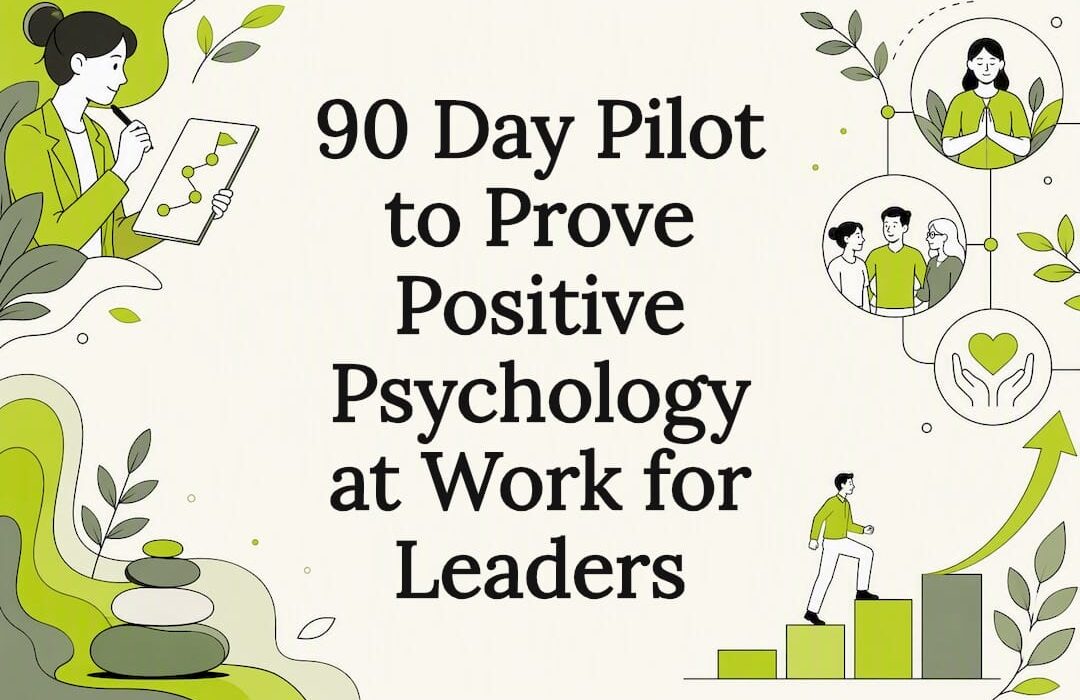
Positive psychology interventions produce moderate, measurable gains in employee wellbeing and job performance, not vague morale boosts. The move for leaders is simple: baseline a few core wellbeing outcomes now, then run a small, time-boxed pilot rather than rolling out a company-wide program on faith. Everything below shows you the evidence behind that claim, which interventions actually work, and how to measure the results your board will ask about.
TL;DR:
- In-person delivery of positive psychology interventions consistently yields stronger results in employee wellbeing and performance improvements.
- Prioritizing team purpose, strengths-based role alignment, and manager coaching on PsyCap offers high-impact, low-cost ways to boost wellbeing metrics.
- Embedding interventions into existing work routines and limiting pilots to two initiatives increases sustainability and clarity of results.
- Short, focused pilots with clear measurement milestones provide credible evidence to executive leadership and foster ongoing support.
- Combining positive psychology with mental health support and resilience training creates a more durable, comprehensive approach to workplace wellbeing.
Table of Contents
- What Is Positive Psychology at Work?
- What Does the Research Actually Show?
- Which Interventions Should You Actually Run?
- How Do You Implement This Without It Fading in a Quarter?
- How Do You Measure Impact That the C-Suite Will Believe?
- What Does This Look Like in Practice?
- Why Employee Input Belongs at the Design Table
- How Does This Fit With Mental Health and Resilience Programs?
- What Should Leaders Prioritize Over the Next Three Years?
- How Inspire-wellness Turns This Research Into a Working Pilot
- Where This Article’s Evidence Comes From
- Sources
What Is Positive Psychology at Work?
Positive psychology at work applies the science of human flourishing (strengths, positive emotion, meaning, resilience) to how organizations design roles, teams, and leadership behavior. It is distinct from generic “employee happiness” initiatives because it rests on specific, testable models rather than intuition. If you are building or evaluating a workplace wellbeing strategy, three frameworks matter more than any others.
PERMA, developed by psychologist Martin Seligman, breaks flourishing into five measurable components: Positive emotion, Engagement, Relationships, Meaning, and Accomplishment. It gives leaders a diagnostic lens. A team can score high on Accomplishment while scoring low on Relationships, and that gap tells you exactly where to intervene rather than guessing.

Psychological capital (PsyCap) is the second model worth knowing. It bundles four psychological resources, hope, efficacy, resilience, and optimism, into a single construct that researchers can train and measure over time. Unlike a personality trait, PsyCap is a state. It moves with coaching and experience, which is precisely why it shows up so often in workplace intervention studies.
Strengths-based management is the third, and arguably the most operational, of the three. Rather than fixing weaknesses, it aligns roles to what people are already good at. This is not motivational fluff. Leaders who apply it can see fast movement in engagement and output when they treat strengths-based management as a role-design discipline rather than a positive-thinking exercise.
Why do these models matter beyond theory? Because they give you a shared vocabulary for diagnosis before you spend budget on solutions.
- PERMA tells you which dimension of flourishing is weakest on a given team.
- PsyCap gives you a trainable, measurable target for coaching investment.
- Strengths-based management gives you a lever you can pull inside existing role design, no new program required.
Positive emotions themselves are not incidental to this picture. Research on affect at work shows that positive emotional states broaden cognition and behavior, contributing to creativity, engagement, and even physical health outcomes over time, which is part of why interventions built around these models tend to outperform generic “wellness” content.
What Does the Research Actually Show?
The strongest available evidence comes from a 2025 systematic review pooling 24 workplace studies on positive psychology interventions (PPIs). The findings are specific enough to plan around, not just directionally encouraging.
The numbers: the meta-analysis found PPIs produced moderate, statistically significant gains in subjective wellbeing (g = 0.50), psychological wellbeing (g = 0.46), and job performance (g = 0.42). Effects were consistently stronger when interventions were delivered in person rather than remotely.
An effect size around 0.4 to 0.5 is a real, practically meaningful shift, not a rounding error, but it is also not a cure-all. This is a case for disciplined, well-designed interventions, not for assuming any wellbeing initiative will automatically move the needle.
Two other bodies of evidence widen the picture. The U.S. Surgeon General’s Framework for Workplace Mental Health & Well-being identifies five essentials that any positive psychology program should reinforce rather than compete with:
- Protection from harm
- Connection and community
- Work-life harmony
- Mattering at work
- Opportunity for growth
Separately, McKinsey’s analysis of 115 evidence-based workplace health interventions reaches a design conclusion that echoes the meta-analysis: embed wellbeing into the actual flow of work, target more than one health dimension at once, and prioritize team-level interventions over individual ones because the impact compounds across more people.
Three moderators consistently show up across this research, and skipping them is the most common reason pilots underperform.
First, delivery format matters. In-person and blended delivery outperform fully remote formats, likely because social accountability and shared experience amplify the intervention’s effect. Second, context sensitivity matters. A 2024 Frontiers review found that positive psychology components, including engagement, meaning, PsyCap, resilience, and optimism, improve adaptive performance across sectors, but the specific mix that works varies by job type and culture. Third, the evidence has real limits: most studies run over weeks or months, not years, so claims about long-term retention of gains should stay modest until longer-horizon data exists.

Which Interventions Should You Actually Run?
Not every positive psychology intervention deserves equal budget. Some have strong evidence behind them and low implementation friction. Others sound appealing but rarely survive contact with a real org chart. Here is a prioritized list, ordered by evidence strength and ease of deployment.
- Strengths-based role alignment. Use a validated strengths assessment, then adjust task allocation within existing roles so people spend more time on work that matches their strengths. This is the highest-leverage, lowest-cost intervention on the list because it requires no new headcount, just better delegation.
- Team purpose workshops. A structured, facilitated session where a team articulates how its work connects to a larger mission. This directly targets the Meaning component of PERMA and the “mattering at work” essential from the Surgeon General’s framework.
- Manager coaching on PsyCap. Train managers to build hope, efficacy, resilience, and optimism in direct reports through specific coaching conversations, not generic pep talks. Managers often notice a strength or a stress signal before any survey does, which is why training managers to observe and act early pays off faster than waiting for quarterly data.
- Embedded micro-break nudges. Short, scheduled prompts (a five-minute breathing break, a walk between meetings) built directly into calendar tools or team rituals. Standalone wellness workshops rarely sustain participation the way habits embedded into daily routines do.
- Recognition systems. Structured, frequent, specific recognition tied to actual contributions, not generic “employee of the month” theater. This reinforces Accomplishment and Relationships simultaneously.
- Resilience training. Skills-based sessions on stress reappraisal and recovery, ideally delivered alongside, not instead of, structural fixes like workload management.
Format guidance: favor team-based delivery over solo e-learning modules, and favor in-person or blended sessions over fully remote ones where the meta-analytic effect sizes were strongest. Dosage matters too. A single 90-minute workshop rarely shifts behavior on its own. Plan for a cadence: an initial session, then reinforcement touchpoints every two to four weeks for at least a quarter.
Three quick templates make this concrete:
- 1-hour team exercise: a facilitated PERMA “strengths spotlight,” where each team member shares one strength colleagues can lean on, then the group maps current projects against those strengths.
- 1-day workshop: morning session on PsyCap fundamentals for managers, afternoon session applying it to live team challenges with a facilitator.
- 90-day pilot plan: week 1 to 2 baseline survey, weeks 3 to 10 intervention delivery with biweekly nudges, weeks 11 to 12 re-measurement and a leadership readout.
Pro Tip: Do not launch more than two interventions at once in a pilot. Stacking five initiatives in one quarter makes it impossible to know which one actually caused a shift in your outcome metrics.
A caution belongs here too. Token initiatives, a single mindfulness app license, a one-off “wellness week”, rarely move any of the metrics above, because they do not address structural drivers like chronic overwork, unclear roles, or unsafe management behavior. If your organization has a burnout problem rooted in staffing shortages, no strengths workshop will fix that. Positive psychology interventions work best as a layer on top of sound workload and role design, not as a substitute for it.
How Do You Implement This Without It Fading in a Quarter?
The single biggest predictor of whether a positive psychology program survives past its launch quarter is whether it gets embedded into the actual flow of work, versus treated as a bolt-on event. McKinsey’s review of 115 interventions makes this the top design principle, and it matches what shows up across the implementation literature more broadly: interventions embedded into daily routines sustain participation far better than standalone sessions people have to remember to attend.
A pilot, measure, iterate model keeps the risk low while you build internal evidence. Structure it like this:
- Sponsor it at the senior level. A named executive sponsor signals this is not an HR side project.
- Assemble a small cross-functional squad. HR, one line manager, and one frontline employee representative, not a committee of twelve.
- Set a measurement rhythm before you launch. Baseline, midpoint check, and post-pilot survey, on fixed dates, not “whenever we get to it.”
- Choose one or two teams for the pilot, not the whole company. A contained pilot that works becomes your internal case study for scaling.
Manager enablement deserves its own line of investment, because managers are the delivery mechanism for almost every intervention on the list above. That means coaching managers on how to have strengths conversations, giving them light role-design tools so they can actually shift task allocation, and training them to spot early behavioral signals of disengagement or overload before those show up in an exit interview. This is also where psychological safety becomes foundational rather than optional. Employees will not engage honestly with a strengths conversation or a wellbeing survey if they do not trust how the information will be used.
Here is a realistic pilot timeline and light resource estimate for a single-team rollout:
| Phase | Duration | Core activity | Resource need |
|---|---|---|---|
| Baseline | Weeks 1 to 2 | Survey + manager briefing | 1 HR lead, survey tool |
| Delivery | Weeks 3 to 10 | Interventions + biweekly nudges | 1 facilitator, manager time |
| Measurement | Weeks 11 to 12 | Re-survey + leadership readout | 1 HR lead, dashboard |
For teams ready to move past a single pilot, a structured workplace wellbeing improvement process gives HR leaders a repeatable playbook instead of reinventing governance for every new team.
How Do You Measure Impact That the C-Suite Will Believe?
Separate inputs from outcomes before you report anything upward. A program launched is an input. A shift in how people actually feel and perform is an outcome, and outcome KPIs are what predict business metrics like retention and customer satisfaction, not attendance figures.
Track a compact set of KPIs rather than a sprawling dashboard:
- Engagement score (from your existing pulse survey)
- A PsyCap snapshot (short validated scale, quarterly)
- Voluntary turnover and absenteeism rates
- eNPS (employee Net Promoter Score)
- Self-reported performance or output confidence
For survey items, keep it to three or four short questions capturing positive affect (“I felt energized by my work most days this week”), belonging (“I feel like I matter to this team”), and meaning (“My work connects to something I care about”). Sample the same group before and after the pilot, use a small enough team that response rates stay high, and resist drawing strong conclusions from a single-digit sample size. When reporting up, pair the numbers with one or two concrete employee stories. A structured feedback method makes both the dashboard and the narrative easier to build consistently.
What Does This Look Like in Practice?
A mid-sized finance team came to Inspire-wellness with a familiar problem: solid pay and benefits, but rising quiet attrition and flat engagement scores. The objective was narrow on purpose: improve a sense of mattering and recognition within one quarter, without adding new headcount. The approach combined manager coaching on PsyCap conversations, a strengths-based review of task allocation, and a lightweight recognition system built into weekly team rituals.
Three practical lessons carried over from that engagement, and from Inspire-wellness’s broader coaching work with organizations across the UAE:
- Manager behavior shifts faster than culture surveys do, so track manager actions early, not just quarterly scores.
- Recognition tied to specific work, not generic praise, sustains engagement longer than one-off perks.
- A narrow, well-measured pilot builds more executive buy-in than a company-wide launch ever does.
Why Employee Input Belongs at the Design Table
A positive psychology program designed entirely by HR, without employee input, tends to solve the wrong problem well. Employees know where the friction actually lives: which meetings drain energy, which recognition efforts feel hollow, which “flexibility” policies exist on paper but not in practice. Skipping their input is how organizations end up funding a mindfulness app while the real driver of burnout, unclear handoffs between two departments, goes untouched.
Build participation into the design phase itself, not just the feedback phase after launch. A short listening session with frontline employees before you choose which interventions from the prioritized list to pilot will usually reveal that one or two options fit your culture far better than the others. Manufacturing teams and knowledge-work teams rarely respond to the same intervention the same way, and only the people doing the work can tell you that ahead of time.
Participation also strengthens buy-in through the pilot itself. Employees who helped shape a recognition system or a team purpose workshop are far more likely to actually engage with it, rather than treating it as one more mandatory HR exercise. This is consistent with why culturally sensitive, contextually grounded programs consistently outperform generic ones: the design reflects the people using it, not a template pulled from a different industry entirely. Build in a short pulse check after the first few weeks, and be willing to drop or adjust an intervention that employee feedback flags as not landing.
How Does This Fit With Mental Health and Resilience Programs?
Positive psychology at work is not a replacement for mental health support or resilience training. It is a complement, and treating it as a standalone track is a common design mistake. Wellbeing interventions that build meaning, strengths alignment, and recognition work best when layered on top of, not instead of, structural mental health support and stress-management skill building.
Think of it as two different jobs happening at once. Mental health support and employee assistance resources address risk and crisis, catching people before things get worse. Positive psychology interventions build capacity, PsyCap, strengths use, social connection, so people have more resilience in reserve before a crisis point is even reached. An organization that only invests in crisis-response mental health support, without building this proactive capacity, will keep treating the same recurring problems. One that only runs positive psychology workshops without any mental health safety net leaves people without support when things get genuinely hard.
Resilience training bridges the two most directly, since it draws on PsyCap concepts while also equipping people with concrete coping skills for acute stress. Organizations that integrate these tracks, rather than running them as separate initiatives with separate budgets and separate owners, tend to see the strongest and most durable outcomes. That integration is also where a partner like Prime First Aid Training’s mental-health-first-aid style courses can extend manager capability, giving frontline leaders a concrete skill set for recognizing when a wellbeing conversation needs to become a mental-health referral instead.
What Should Leaders Prioritize Over the Next Three Years?
Systems beat apps and one-off events, every time. A meditation app license does nothing for a team whose manager does not know how to run a strengths conversation. The evidence points toward three priorities: strengthen social connection and belonging, since it consistently predicts retention and performance; build organizational adaptability by training PsyCap and resilience rather than reacting to burnout after the fact; and embed measurement into the operating rhythm, not just an annual survey nobody acts on.
My pledge to leaders reading this: pick one team, run one measured pilot this quarter, and report the real numbers, good or bad, to your leadership team. That is how positive psychology at work stops being a slogan and starts being a management discipline.
— Neelam
How Inspire-wellness Turns This Research Into a Working Pilot
Inspire-wellness is the operational partner for leaders who want the pilot described above built and measured, not just theorized. Instead of a generic wellness subscription that gets forgotten by month two, Inspire-wellness designs a contained pilot around your team’s actual PERMA and PsyCap baselines, coaches your managers directly, and sets up the measurement rhythm so you walk into your next leadership review with real numbers, not an attendance sheet.
A discovery call typically covers your current wellbeing baseline, which one or two teams make sense for an initial pilot, and what a 90-day measurement plan would look like for your organization. From there, Inspire-wellness’s workplace wellbeing improvement process gives HR leaders a structured path from pilot to scaled program, backed by manager coaching and the kind of before-and-after measurement this article recommends. If you are ready to see what a measured pilot could look like for your team, book a discovery call with Inspire-wellness and bring your current engagement numbers to the conversation.
Where This Article’s Evidence Comes From
The MDPI systematic meta-analysis supplies the core effect-size evidence on PPIs across 24 workplace studies. The U.S. Surgeon General’s Framework defines the five essentials underpinning program design. McKinsey’s analysis of 115 interventions shapes the embedding and governance guidance. The Frontiers 2024 review supports claims about adaptive performance, and the World Economic Forum piece backs the social connection findings.
Sources
- Systematic Review and Meta-Analysis of Positive Psychology Interventions in Workplace Settings
- Framework for Workplace Mental Health & Well-being — U.S. Surgeon General
- Positive psychology and adaptive performance — Frontiers in Psychology
- How to improve workplace wellbeing – and why it matters | World Economic Forum