
Executive coaching wellness integration is the practice of combining physiological, psychological, and strategic coaching techniques to sustainably optimize leadership performance and workplace wellbeing. Senior leaders face a category of strain that traditional coaching programs rarely address: the physical and emotional cost of sustained high-stakes decision-making. When wellness coaching techniques are embedded directly into leadership coaching programs, the results go beyond mindset shifts. They produce measurable changes in cognitive clarity, energy sustainability, and stress resilience. At Inspire-wellness, we see this integration not as a luxury add-on but as a structural requirement for leaders who need to perform at their best over the long term.
What are the core principles behind executive coaching wellness integration?
Effective executive coaching wellness integration rests on behavioral change science, not expert prescription. The Wellcoaches Coaching Protocol identifies four forces that drive lasting behavioral change: honoring autonomy, expressing compassion, generating positivity, and uncovering motivation. Each force positions the client as the agent of change, not a passive recipient of advice. This distinction matters enormously at the executive level, where leaders are accustomed to being told what to do by consultants and resist it accordingly.
Traditional leadership consulting prescribes solutions. Wellness-integrated coaching partners with the leader to surface what actually drives their behavior and health choices. The Thrive-Ability™ Model builds on this by centering performance-focused, long-term sustainability coaching that addresses both physiological and emotional strain without adding complexity to an already demanding role. The model respects executive realities: limited time, high accountability, and low tolerance for programs that feel like homework.

Leaders also carry what researchers call physiological “hidden taxes.” These are the burnout and stress-induced costs that accumulate invisibly until they impair judgment, presence, and decision quality. Strategic coaching alone does not address cortisol dysregulation or nervous system fatigue. Integrating physiological awareness into the coaching conversation is what separates a wellness-informed leadership program from a standard executive development offering.
Pro Tip: When selecting a coaching framework for your leadership team, look for protocols that explicitly treat the client as the change agent. Programs built on autonomy and motivation produce more durable behavior change than those that rely on prescriptive advice.
Key behavioral science principles that underpin effective executive wellness coaching include:
- Autonomy: The leader defines their own goals and pace of change.
- Compassion: The coach holds space for the human cost of leadership without judgment.
- Positivity: Sessions build on strengths and progress, not deficits.
- Motivation: Coaching surfaces intrinsic drivers, not external compliance.
How to incorporate health data into executive coaching programs
Executive health coaching treats health as a strategic asset, with programs built around metabolic assessments, cortisol rhythm analysis, and nervous system regulation rather than generic fitness goals. This physiological literacy gives coaches and leaders a shared language for understanding why performance fluctuates, why sleep quality drops during board cycles, and why recovery time lengthens with age and pressure.
Incorporating health data into coaching requires a structured, privacy-first approach. The following steps reflect best practice for C-suite programs:
- Baseline physiological assessment. Gather metabolic health markers, cortisol rhythm data, and nervous system indicators before the first coaching session. This creates an objective foundation for the coaching conversation.
- Integrate diagnostic frameworks. Frameworks like Five Element diagnostics, drawn from functional medicine, help coaches and leaders interpret patterns in energy, mood, and cognitive performance across the day.
- Align medical data with coaching goals. Work with the leader’s existing medical team where relevant. The coach does not replace clinical expertise but uses health data to contextualize performance coaching.
- Establish a privacy protocol. All health data must be handled under strict confidentiality agreements. Privacy and discretion are non-negotiable in C-suite coaching, where reputational risk is real and trust is the foundation of the relationship.
- Review and recalibrate. Reassess physiological markers at regular intervals, typically every 8–12 weeks, to track progress and adjust the coaching focus.
Pro Tip: Never ask a senior leader to share health data without a written confidentiality agreement in place first. The moment trust breaks in C-suite coaching, the program ends. Protect the data as carefully as you protect board-level strategy.
| Assessment type | What it measures | Coaching application |
|---|---|---|
| Metabolic health panel | Blood glucose, lipids, inflammation markers | Energy management and cognitive stamina |
| Cortisol rhythm analysis | Stress hormone patterns across the day | Recovery planning and decision-making windows |
| Nervous system regulation | Heart rate variability, sleep quality | Resilience building and stress response coaching |
What modular wellness coaching strategies deliver measurable outcomes?
Corporate wellness programs are most successful when they achieve measurable outcomes within the first 8–12 weeks. That timeline is not arbitrary. It reflects the window within which executives and HR sponsors decide whether a program is worth continuing. Programs that cannot show early traction lose organizational support before they reach their full impact.
Modular formats work best for executive populations because they fit into compressed schedules and allow HR teams to scale across leadership tiers. The three primary delivery formats each serve a different need:
- One-to-one coaching. The most personalized format, suited to C-suite leaders with specific physiological or performance challenges. Sessions are typically 60 minutes, fortnightly, with lightweight check-ins between sessions.
- Group coaching cohorts. Effective for senior leadership teams working through shared challenges such as post-merger stress or hybrid team management. Group formats build psychological safety and peer accountability simultaneously.
- Digital and hybrid formats. Digital coaching with AI support and hybrid delivery reduces friction and increases adoption among overloaded executives. SMS coaching and brief check-ins fill the gaps between formal sessions, keeping momentum alive between stress moments and action.
Escalation pathways are a structural requirement, not an optional feature. Wellness coaching does not replace clinical mental health support. Every program must include clear referral routes to licensed providers. This protects both the client and the organization from the risk of a wellness coach becoming a de facto therapist, a boundary that, when crossed, creates ethical and legal exposure for everyone involved.
Measuring outcomes requires pre-agreed KPIs. Useful metrics include absenteeism rates, self-reported energy levels, 360-degree feedback scores, and retention data for senior roles. Programs aligned with these business indicators earn continued investment from finance and the board.
How can HR professionals implement wellness coaching in leadership programs?
Structured wellness interventions integrated with leadership development deliver higher impact than casual perks. The difference lies in design. A yoga class offered as a benefit is a perk. A 12-week coaching program tied to leadership KPIs, with privacy protocols and escalation pathways, is a structured intervention. HR professionals who understand this distinction build programs that survive budget cycles.
The role of leadership in wellness is also a prerequisite for program success. If senior leaders do not visibly participate in and endorse wellness coaching, adoption rates across the organization remain low. Leadership buy-in is not a soft success factor. It is the primary driver of program reach.
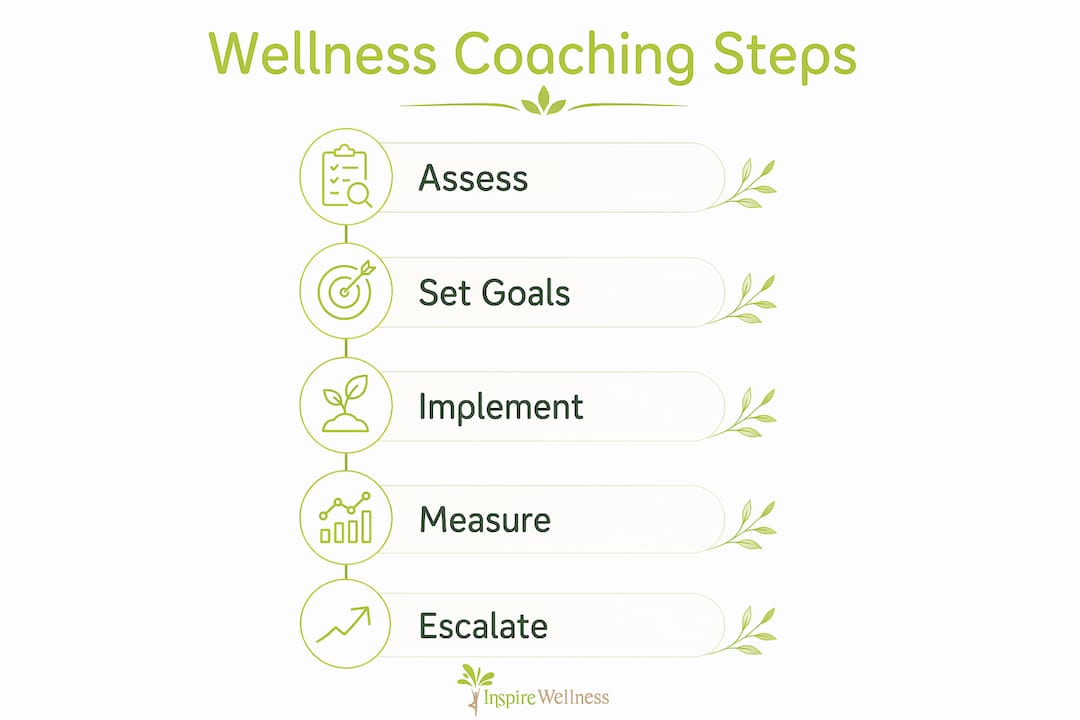
Follow these steps to integrate wellness coaching into existing leadership development programs:
- Secure executive sponsorship. Identify one or two C-suite champions who will participate publicly and communicate the program’s value to peers.
- Define privacy protocols before launch. Establish what data is collected, who sees it, and how it is stored. Communicate these protocols clearly to all participants before enrollment.
- Align coaching goals with organizational KPIs. Map each coaching objective to a measurable business outcome: reduced sick days, improved engagement scores, or faster decision cycles.
- Select coaches with dual competency. The most effective coaches at this level combine boardroom strategic insight with deep understanding of stress physiology, including cortisol rhythms and nervous system regulation.
- Build in early measurement. Collect baseline data before the program starts and schedule a formal review at the 8-week mark. Early wins sustain organizational commitment.
- Plan for escalation. Document the referral pathway to licensed mental health providers before the program begins, not after a crisis arises.
Pro Tip: Pilot the program with a small cohort of six to ten senior leaders before scaling. A pilot generates real outcome data, surfaces design flaws, and creates internal advocates who can speak credibly to peers about the program’s value.
Common pitfalls include treating wellness coaching as a one-time event, failing to communicate privacy protections, and selecting coaches who lack physiological literacy. Each of these errors reduces participation, erodes trust, and ultimately kills the program before it can demonstrate ROI. The coaching role in wellbeing is most powerful when it is sustained, structured, and tied to real organizational outcomes.
Key Takeaways
Executive coaching wellness integration works because it combines behavioral science, physiological literacy, and structured program design to produce measurable leadership performance gains that traditional coaching cannot achieve alone.
| Point | Details |
|---|---|
| Behavioral science is the foundation | Coaching built on autonomy, compassion, positivity, and motivation drives lasting behavior change. |
| Physiological data improves outcomes | Metabolic, cortisol, and nervous system assessments give coaching a concrete, measurable basis. |
| Modular formats increase adoption | Programs delivering early results within 8–12 weeks earn sustained organizational investment. |
| Privacy protocols are non-negotiable | C-suite participants require strict confidentiality agreements before sharing any health data. |
| Escalation pathways protect everyone | Clear referral routes to licensed providers keep coaching within ethical and legal boundaries. |
Why wellness integration is the next frontier in leadership development
I have spent years watching leadership development programs treat the body as irrelevant to the boardroom. The assumption has always been that if you fix the mindset, the performance follows. What I have seen in practice is different. Leaders who are physiologically depleted make worse decisions, communicate less clearly, and recover more slowly from setbacks, regardless of how strong their strategic thinking is.
The most significant shift I have observed is when executives stop treating their health as a personal matter separate from their professional performance and start treating it as a leadership variable. That reframe changes everything. It makes cortisol management as relevant as financial modeling and sleep quality as worth protecting as a board meeting.
Privacy is the factor that most programs underestimate. Senior leaders will not engage honestly with a wellness coach if they fear that their health data could affect their standing in the organization. The programs that work are the ones that build trust first, data second. When a leader feels genuinely safe, the depth of the coaching conversation changes entirely.
The future of leadership development runs through this integration. Organizations that build wellness literacy into their leadership pipelines will produce leaders who are more durable, more present, and more capable of sustaining high performance over time. That is not a wellness trend. It is a competitive advantage.
— Neelam
How Inspire-wellness supports wellness integration for HR teams
Inspire-wellness has developed a proven, modular approach to workplace wellbeing improvement that gives HR teams a clear framework for embedding wellness into leadership programs. The approach combines behavioral science, privacy-respecting assessment protocols, and measurable KPIs to produce outcomes that finance and the board can see.
Our programs are built for organizations that want more than a wellness perk. We work with HR leaders to design structured interventions aligned with your leadership development goals, your organizational culture, and your specific performance challenges. Whether you are building a pilot for a senior leadership cohort or scaling a program across multiple tiers, Inspire-wellness provides the expertise, the frameworks, and the ongoing support to make it work. Connect with our team to discuss a program designed around your organization’s needs.
FAQ
What is executive coaching wellness integration?
Executive coaching wellness integration is the practice of combining physiological, psychological, and strategic coaching to improve leadership performance and organizational wellbeing. It treats health as a strategic asset rather than a personal concern separate from professional performance.
How long does it take to see results from wellness coaching programs?
Corporate wellness programs are most successful when they achieve measurable outcomes within the first 8–12 weeks. Early measurement at the 8-week mark is the standard benchmark for assessing program traction and securing continued organizational investment.
What health data is typically used in executive health coaching?
Executive health coaching programs commonly use metabolic health panels, cortisol rhythm analysis, and nervous system regulation indicators such as heart rate variability. These assessments provide a physiological baseline that informs personalized coaching goals.
How do HR teams protect executive privacy in wellness programs?
Privacy protection requires written confidentiality agreements before any health data is collected, strict data storage protocols, and clear communication to all participants about who has access to their information. Trust is the foundation of C-suite wellness coaching, and privacy protocols must be established before enrollment begins.
When should a wellness coach refer a client to a licensed mental health provider?
Wellness coaching does not replace clinical mental health support. Every program must include pre-defined escalation pathways to licensed providers, activated whenever a client presents with symptoms that fall outside the scope of coaching, such as clinical depression, anxiety disorders, or crisis situations.