What is digital wellbeing, and why does it matter?
Digital wellbeing is the state of maintaining mental, emotional, and physical health through intentional, balanced use of technology. It is not about avoiding screens or going offline. It is about using technology thoughtfully so that it supports your life rather than quietly draining it.

The International Telecommunication Union defines digital wellbeing through a three-part framework: how you perceive yourself in digital spaces, how you perceive your digital environment, and how you manage the influences that digital technology exerts on you. These three dimensions interact constantly, and they shift depending on your age, goals, and context. A teenager navigating social media faces a different set of pressures than a professional managing a full inbox, yet both are working through the same core challenge.
What makes this concept genuinely useful is that it treats technology as neutral. Technology’s impact on your wellbeing depends almost entirely on the extent and manner in which you use it. The goal is not restriction. It is maximizing the benefits while keeping loss of control to a minimum.
Key facets of digital wellbeing include:
- Mental and emotional balance: Feeling in control of your digital habits rather than driven by them
- Physical health awareness: Recognizing how device use affects your body, from sleep to posture to eye health
- Intentional engagement: Choosing which digital activities serve your values and which ones quietly erode them
- Social connection quality: Distinguishing between online interactions that strengthen relationships and those that replace or weaken them
- Digital literacy: Understanding how platforms and algorithms are designed, so you can engage on your own terms
Digital wellbeing is personal and dynamic. There is no universal screen-time limit that works for everyone. What matters is whether your relationship with technology feels purposeful and within your control.

How digital technology affects your mental, emotional, and physical health
Technology reshapes health across three dimensions, and the effects run in both directions. Used well, digital tools reduce isolation, expand access to mental health resources, and help people stay connected across distance. Used poorly, or excessively, the same tools contribute to stress, depression, and physical strain.
On the mental and emotional side, excessive or inappropriate technology use correlates with increased stress, loneliness, and social isolation. Passive scrolling through social media, in particular, tends to trigger social comparison, which chips away at self-esteem over time. Constant connectivity also makes it harder to mentally disengage from work, which is one of the clearest drivers of burnout.
Physical health takes a hit in ways that are easy to overlook until they become chronic. Prolonged screen use disrupts melatonin production, shortening and fragmenting sleep. Eye strain from extended screen exposure is now common enough that optometrists have a clinical term for it: digital eye strain. Poor posture while using devices contributes to neck and back pain, particularly in people who work at desks for long hours. Paying attention to ergonomic habits can meaningfully reduce that physical toll.
The picture is not all negative. Digital technology genuinely empowers people when used with intention. Telehealth platforms extend mental health support to those who previously had no access. Online communities provide connection for people navigating isolation or chronic illness. Productivity tools, when used with clear boundaries, free up time and reduce cognitive load.
Common health impacts of technology use include:
- Stress and anxiety: Notification overload and always-on expectations raise baseline stress levels
- Sleep disruption: Blue light exposure and late-night device use delay sleep onset and reduce sleep quality
- Eye strain: Extended screen time causes dryness, blurring, and headaches
- Loneliness: Heavy passive social media use can increase feelings of isolation despite constant connectivity
- Improved access: Digital tools expand access to healthcare, education, and social support for many people
- Focus impairment: Frequent task-switching and notification interruptions fragment attention over time
The OECD’s research confirms that maintaining digital wellbeing improves focus, sleep quality, and overall life satisfaction — outcomes that compound positively across both personal and professional life.
Common challenges that get in the way of healthy digital habits
Most people do not set out to develop an unhealthy relationship with technology. The challenges tend to accumulate gradually, often below the threshold of awareness, until the effects become hard to ignore.
Excessive screen time is the most visible problem, but it is rarely the root cause. The deeper issue is usually a lack of intentionality: using devices out of habit, boredom, or anxiety rather than for a clear purpose. When technology fills every idle moment, the mind never gets the recovery time it needs to process, rest, and reset.
Emotional consequences build quietly. Social comparison on image-heavy platforms creates a persistent sense of inadequacy. The fear of missing out, amplified by real-time feeds, keeps people checking their phones even when they know it is not serving them. Overwhelm from information overload is another pattern that is easy to underestimate: the sheer volume of content, news, and messages that arrives daily exceeds what the human brain was designed to process comfortably.
Factors that commonly impair digital wellbeing include:
- Excessive screen time: Hours spent on devices without purpose or recovery breaks
- Tech-driven distraction: Constant notifications that fragment focus and interrupt deep work
- Multitasking overload: Switching between apps, messages, and tasks increases cognitive fatigue
- Lack of clear boundaries: No separation between work and personal device use, especially when working from home
- Social comparison: Measuring your life against curated highlight reels on social platforms
- Digital addiction patterns: Compulsive checking behavior driven by variable-reward design in apps
- Poor ergonomics: Slouching over phones or laptops for hours, leading to chronic neck and back pain
- Sleep disruption: Using devices in the hour before bed, which delays sleep onset and reduces sleep depth
- Information overload: Consuming more news and content than the mind can meaningfully absorb
Work-related technology use differs meaningfully from leisure use, and blurring those two contexts is one of the most common sources of digital stress. When the same device serves as your work tool, entertainment platform, and social lifeline, setting any kind of boundary becomes genuinely difficult.
Practical strategies to improve and maintain your digital wellbeing
Improving your relationship with technology starts with intention, not restriction. The goal is to curate your digital life around what actually serves you, rather than defaulting to whatever the platform or notification wants you to do next.
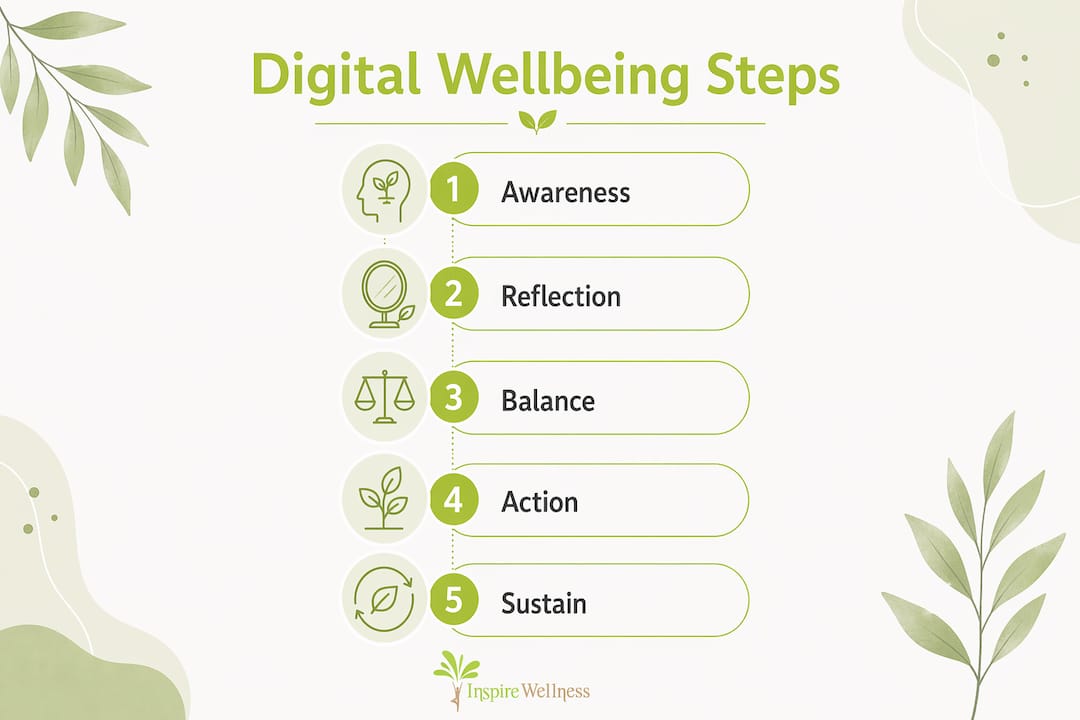
The most effective starting point is honest self-reflection. Before reaching for your phone, ask yourself what you are hoping to get from that interaction. This single habit, practiced consistently, creates a gap between impulse and action that gives you real agency over your digital behavior. Pairing this with mindful technology use at work can reduce both stress and reactive screen time significantly.
Setting boundaries is not about willpower. It is about designing your environment so that healthy defaults are easier than unhealthy ones. Turning off non-essential notifications, keeping your phone out of the bedroom, and designating specific times to check email are all structural changes that reduce the cognitive burden of constant decision-making.
Practical strategies that support digital wellbeing:
- Schedule screen-free time: Block out periods in your day, especially in the morning and before bed, where devices stay off
- Use app timers: Built-in tools on iOS and Android let you set daily limits for specific apps, creating a natural pause before you exceed them
- Practice single-tasking: Focus on one digital task at a time rather than juggling multiple tabs and conversations simultaneously
- Conduct a weekly digital audit: Review your screen time data once a week to spot patterns and adjust intentionally
- Create physical distance: Charge your phone in a room other than your bedroom to remove the temptation of late-night scrolling
- Prioritize face-to-face connection: Use digital tools to arrange in-person time rather than as a substitute for it
- Take regular movement breaks: Stand up and move every 45–60 minutes to counteract the physical effects of prolonged sitting and screen use
- Curate your feeds actively: Unfollow accounts that consistently leave you feeling worse, and follow those that genuinely add value
Pro Tip: Pair your screen time tracking app with a brief daily check-in on how you feel emotionally after major digital sessions. Usage data tells you what you did; your emotional state tells you whether it served you. Together, they give you a complete picture.
Supporting mental health at work often requires the same intentional approach: building structures that make healthy digital habits the path of least resistance, not the exception.
What research and experts say about digital wellbeing in 2024–2026
The academic and policy consensus on digital wellbeing has sharpened considerably in recent years, moving away from simple screen-time debates toward a more nuanced understanding of how context, intention, and design shape outcomes.
The OECD’s framework positions digital wellbeing as a dynamic, context-dependent construct rather than a fixed state. Digital wellbeing is context-dependent: the same hour of screen time can be restorative or depleting depending on what you are doing, why you are doing it, and what else is happening in your life. This is why blanket rules about screen time rarely hold up in practice.
Research published in academic journals increasingly frames digital wellbeing not as the absence of tech-related harm, but as the presence of controlled enjoyment and functional support. People with high digital wellbeing use technology comfortably and with a sense of satisfaction, experiencing minimal loss of control even in environments where devices are omnipresent. That framing shifts the conversation from “how much is too much” to “how well does my technology use serve my actual goals.”
Organizations are also being held to a higher standard. Organizations share responsibility for digital wellbeing by designing environments that are accessible, equitable, and genuinely empowering. This means that digital wellbeing is not solely an individual challenge. Employers, platform designers, and policymakers all play a role in shaping the conditions under which people engage with technology.
Key research findings shaping the field:
- Intentionality over avoidance: Curation of technology use aligned with personal values predicts better wellbeing outcomes than simple reduction of screen time
- Dynamic boundaries: Flexible, context-sensitive limits on technology use reduce cognitive load and stress more effectively than rigid rules
- Organizational design matters: Equitable, well-designed digital environments support wellbeing at a systemic level, not just an individual one
- Emotional self-awareness is key: Tools that track usage are most effective when paired with reflection on emotional impact, not just time logged
- Education reduces risk: Raising awareness of online risks, including misinformation and data privacy, equips people to make better decisions and reduces vulnerability
The OECD’s research confirms that technology is neutral in itself — its impact on wellbeing depends entirely on the extent and manner of use, which means every individual and organization has genuine power to shape that outcome.
The role of managers in modeling and supporting healthy digital habits has also gained traction as a research priority, recognizing that leadership behavior sets the tone for how entire teams relate to technology.
Benefits of maintaining good digital wellbeing
When you actively tend to your digital wellbeing, the gains show up across every area of life, not just in reduced screen time. The benefits are cumulative and often reinforce each other in ways that make the investment worthwhile.
Better sleep is one of the most immediate and measurable improvements. When you stop using devices in the hour before bed and keep your phone out of the bedroom, sleep onset becomes faster and sleep quality improves. Better sleep, in turn, sharpens focus, stabilizes mood, and reduces the kind of emotional reactivity that makes stressful days feel unmanageable.
Clearer focus follows naturally from reducing notification overload and multitasking. When your attention is not constantly fragmented, you can do deeper, more satisfying work. That sense of accomplishment feeds motivation and reduces the low-grade anxiety that comes from feeling perpetually behind. Digital wellness programs in workplace settings consistently show that employees who manage their digital habits well report higher engagement and lower burnout rates.
The social benefits are equally real. When you use technology to strengthen relationships rather than replace them, the quality of your connections improves. Meaningful communication, whether in person or through intentional digital interaction, builds the kind of social support that protects mental health over the long term.
Additional benefits include:
- Reduced stress: Fewer notifications and clearer boundaries lower baseline cortisol and improve emotional regulation
- Stronger relationships: Intentional, present-focused interaction builds deeper connection than passive, distracted communication
- Greater sense of control: Feeling in charge of your digital habits rather than driven by them increases confidence and self-efficacy
- Improved physical health: Less sedentary screen time, better posture, and reduced eye strain all contribute to physical comfort and long-term health
- Higher productivity: Focused, single-task work consistently outperforms fragmented, always-on multitasking
Tools and apps that help you monitor and improve your digital habits
The right tools make it easier to see your patterns clearly and act on what you find. Most people are surprised by what their actual usage data reveals, which is exactly why these tools are worth using.
Built-in screen time features on iOS (Screen Time) and Android (Digital Wellbeing) give you a clear breakdown of daily and weekly usage by app, category, and time of day. These dashboards show you not just how long you spent on your phone, but which apps consumed the most attention. Setting app limits directly within these tools creates a friction point that prompts reflection before you exceed your intended usage.
For focus and deep work, apps like Forest and Freedom block distracting sites and apps during designated work periods. Forest adds a behavioral layer: you grow a virtual tree during focus sessions, and leaving the app kills it. That small consequence is surprisingly effective at interrupting the reflex to check social media mid-task.
Sleep tracking tools, including those built into wearables like Fitbit and Apple Watch, connect your device habits to sleep outcomes in a way that makes the relationship concrete. Seeing that late-night scrolling correlates with shorter, lower-quality sleep is often more motivating than any general advice about blue light.
For physical health, ergonomic guidance paired with posture reminder apps helps counteract the physical strain of prolonged device use. Apps like Stretchly prompt regular movement breaks, reducing the cumulative toll of sitting and screen exposure throughout the workday.
Journaling apps like Reflectly or Day One add the emotional self-awareness layer that pure usage metrics miss. Logging how you feel after significant digital sessions, whether energized, drained, anxious, or satisfied, builds the self-knowledge needed to make genuinely informed choices about your technology use.
A few principles for getting the most from these tools:
- Start with observation, not restriction: Spend one week simply tracking your usage before setting any limits, so your changes are based on real data
- Pair usage data with emotional check-ins: Numbers tell you what happened; your emotional state tells you whether it mattered
- Adjust limits gradually: Sudden, dramatic restrictions tend to backfire; incremental changes build lasting habits
- Use tools that fit your context: A professional managing a high-volume inbox needs different boundaries than someone whose primary concern is evening scrolling
Key Takeaways
Digital wellbeing is not a passive state you arrive at by using less technology. It is an active, ongoing practice of aligning your digital habits with your values, health, and goals.
| Point | Details |
|---|---|
| Digital wellbeing defined | It is the state of maintaining mental, emotional, and physical health through intentional, balanced technology use. |
| Technology is neutral | Its impact on wellbeing depends on the extent and manner of use, not on technology itself. |
| Three core dimensions | Digital wellbeing involves how you perceive yourself digitally, your digital environment, and the influences technology exerts on you. |
| Practical improvement | Scheduling screen-free time, using app timers, and pairing usage data with emotional check-ins are the most effective starting points. |
| Shared responsibility | Organizations and employers share responsibility for creating digital environments that support, rather than undermine, employee wellbeing. |
Ready to build a healthier relationship with technology at work?
At Inspire-wellness, we work with organizations to build the conditions where people can thrive, digitally and beyond. Our corporate wellbeing coaching programs address the full picture of employee health, including the habits, boundaries, and mindset shifts that make digital wellbeing sustainable at scale. Whether you are an HR leader looking to reduce burnout or a business owner ready to invest in your team’s long-term performance, we are here to help you build something that lasts. Explore our corporate wellness programs to see how we can support your workforce.