
Launching a corporate wellness program in the UAE sounds straightforward until you realize that the region’s multinational workforce, legal requirements, and cultural landscape create a complexity that generic global playbooks simply cannot address. Many organizations invest in popular wellness activities, see low participation, and wonder what went wrong. The reality is that success depends on following a structured, research-backed process that accounts for UAE-specific labor laws, expat community needs, and the kind of sustained leadership commitment that transforms a wellness initiative from a nice-to-have into a genuine business driver.
Table of Contents
- Set the foundation: Engage leadership and assess needs
- Design inclusive, localized wellness options
- Drive engagement: Communication, incentives, and diversity
- Track success: Measure outcomes and adapt programs
- The uncomfortable truth about wellness program best practices
- Next steps: Boost your UAE workforce wellness
- Frequently asked questions
Key Takeaways
| Point | Details |
|---|---|
| Leadership drives results | Visible executive support and manager involvement are essential for high-impact wellness programs in the UAE. |
| Cultural fit matters | Programs must be tailored to local laws, languages, and the needs of multinational staff for best outcomes. |
| Incentives boost engagement | Diverse wellness options and strategic incentives can increase participation by up to 50%. |
| Track and adapt | Regular measurement, feedback, and iteration ensure programs continuously deliver value. |
Set the foundation: Engage leadership and assess needs
Every effective wellness program begins long before the first yoga class or health screening is scheduled. The two most critical early steps are securing genuine executive buy-in and conducting a structured needs assessment that reflects your actual workforce, not a hypothetical one.
Leadership engagement is not a formality. When executives visibly participate, endorse initiatives, and train managers as wellness champions, they signal to every employee that wellbeing is a strategic priority, not a box-checking exercise. This peer-level visibility drives participation far more effectively than email campaigns or posters in the break room. In the UAE, where organizational hierarchy carries significant cultural weight, a C-suite endorsement can be the single factor that determines whether employees engage or stay on the sidelines.
The needs assessment phase is where most programs either gain traction or lose it. A well-structured process typically follows these steps:
- Distribute workforce surveys covering physical health, mental wellbeing, financial stress, and work environment satisfaction, ensuring questions are available in the primary languages of your employee population.
- Conduct stakeholder interviews with department heads, HR business partners, and employee representatives to surface issues that surveys may miss.
- Analyze existing data such as absenteeism records, Employee Assistance Program (EAP) usage, and health insurance claims to identify patterns.
- Run listening groups with employees across different nationalities, roles, and seniority levels to validate survey findings and gather qualitative insight.
- Prioritize needs by frequency, impact, and feasibility, then map them to program pillars such as physical, mental, emotional, and financial wellness.
According to program design timelines, a thorough needs assessment via surveys and stakeholder interviews typically takes 4 to 8 weeks, followed by program design and vendor selection spanning another 6 to 10 weeks. Plan for this timeline honestly with your leadership team so expectations are realistic from day one.
“The most powerful thing a leader can do for a wellness program is show up, not just sign off.” This distinction between visible participation and passive approval is what separates programs that thrive from those that quietly fade.
Pro Tip: When building your listening groups in the UAE, include regional leaders and employees from your largest expat communities. Their input will surface cultural nuances that no survey template can fully capture, and their involvement creates organic program advocates before the program even launches. You can explore how wellness programs in Dubai are structured to support this kind of inclusive foundation, and consider engaging a wellbeing coach to facilitate early listening sessions with authenticity and cultural sensitivity.
Design inclusive, localized wellness options
Once your foundation is in place, the program design phase is where UAE-specific context becomes absolutely non-negotiable. A wellness program that works beautifully in a European headquarters may fail in Dubai or Abu Dhabi if it ignores the legal, cultural, and logistical realities of the region.
When designing for UAE and GCC environments, your program must account for a specific set of requirements:
- Labor law alignment: Ensure all wellness activities, particularly those involving physical exertion or mandatory participation, comply with UAE labor regulations and do not inadvertently create liability.
- Heat safety and the Midday Break rule: Outdoor fitness activities must respect the UAE Midday Break regulation, which prohibits outdoor work between 12:30 PM and 3:00 PM from June 15 to September 15. This directly affects scheduling for walking challenges, outdoor fitness sessions, and team sports.
- Cultural and religious values: Ramadan significantly changes the rhythm of the workday and the appropriateness of certain wellness activities. Programs should offer modified schedules and alternative options during this period.
- Mental health law compliance: The UAE has specific regulations around mental health services and data privacy. Any program involving counseling, psychological support, or mental health screening must be structured in compliance with local law.
- Multilingual materials: With over 200 nationalities represented in the UAE workforce, offering resources in English, Arabic, Hindi, Tagalog, and other common languages is not optional. It is a participation driver.
- Expatriate-specific challenges: Relocation stress, family separation, financial pressures from remittances, and cultural adjustment are real wellbeing factors for a significant portion of your workforce.
Your program offerings should span all four pillars of wellbeing. Physical wellness might include onsite fitness classes, ergonomic assessments, and nutrition coaching. Mental health support should include access to counseling, stress management workshops, and resilience training. Financial wellbeing resources, including guidance on savings, debt management, and retirement planning, address a dimension that many UAE employers overlook despite its direct impact on productivity and focus.
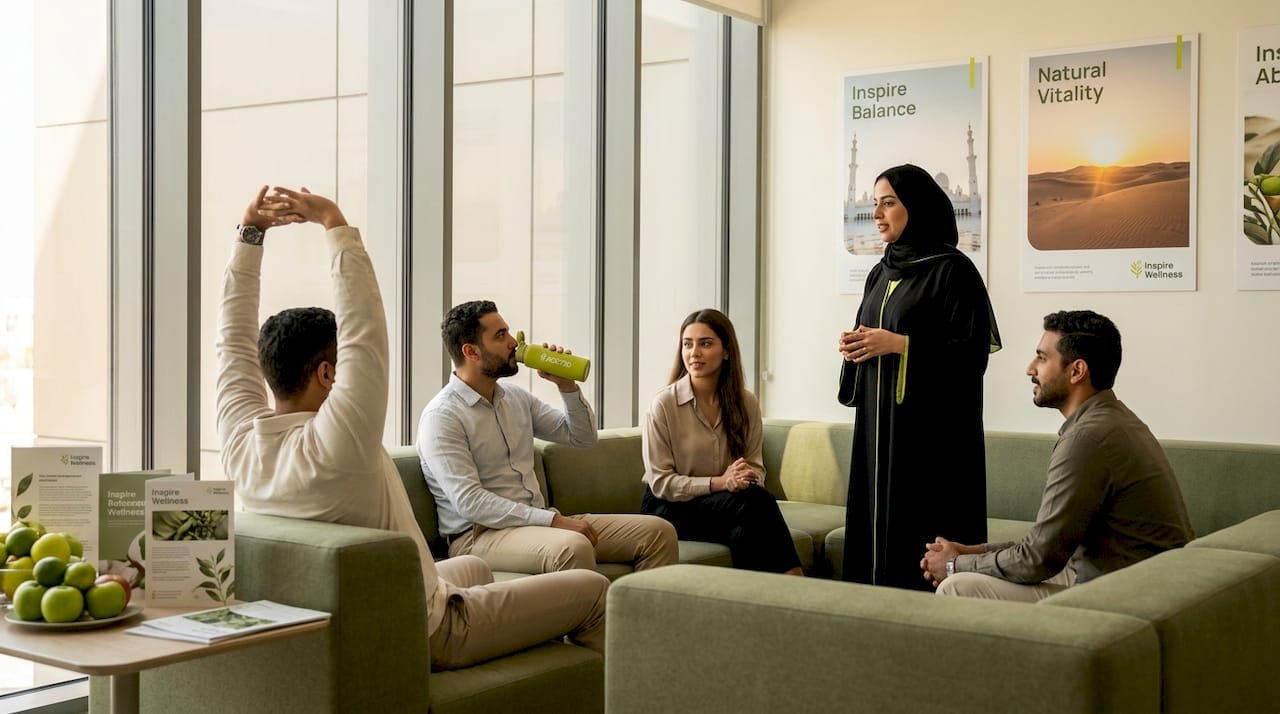
Pro Tip: Partner with vendors who have direct experience operating in the UAE and GCC. Ask them specifically how they have adapted programs for Ramadan, for multilingual workforces, and for expat communities. A vendor who cannot answer those questions with confidence is not the right fit for your context.
Drive engagement: Communication, incentives, and diversity
Designing a great program is only half the work. Getting employees to actually use it requires a deliberate, sustained communication and engagement strategy. This is where many well-designed programs underperform.
Multi-channel, multilingual communication that highlights personal benefits rather than corporate goals is the foundation of strong participation. Employees need to understand what is in it for them, not just what the company hopes to achieve. Effective channels for UAE multinational workforces include:
- Digital platforms: Mobile apps, intranet portals, and WhatsApp groups (widely used across nationalities in the UAE) for ongoing communication and program access.
- Onsite activation: Wellness fairs, health screenings, and lunchtime sessions that create visible, tangible touchpoints.
- Manager coaching: Training line managers to have genuine wellness conversations and refer employees to available resources.
- Performance integration: Connecting wellness participation to broader talent development conversations, not as a punitive measure, but as a signal that the organization values the whole person.
Incentives are a proven lever. Incentives can boost participation by 50%, and the data on overall program ROI is compelling.
| Metric | Benchmark outcome |
|---|---|
| ROI per $1 invested | $3 to $6 return |
| Healthcare cost reduction | Up to 26% |
| Absenteeism reduction | Up to 27% |
| Productivity gain | Up to 2.5 hours per week per employee |
| Average participation rate | 46% without incentives |
| Participation with incentives | Up to 69% |
The diversity of program options matters as much as the incentives themselves. Employees who do not connect with a yoga class may engage deeply with a financial wellness workshop or a mental resilience seminar. Offering a range of physical wellbeing strategies alongside mental and financial options ensures that every employee can find an entry point that feels relevant to their life. Cultivating a wellness mindset across your organization means normalizing the idea that wellbeing is personal, multidimensional, and worth investing in.
“The goal is not to create a wellness program. The goal is to create a culture where wellness is the natural default.” That shift in framing changes how HR leaders design, communicate, and sustain their initiatives over time.
For a deeper look at structuring these elements cohesively, a detailed wellness program guide tailored to the Dubai and UAE context can help you map your strategy with precision.
Track success: Measure outcomes and adapt programs
Measurement is what separates a wellness program that evolves and improves from one that stagnates and eventually gets cut. Without clear key performance indicators (KPIs) and a structured feedback process, even well-designed programs lose momentum.
The most important KPIs for UAE corporate wellness programs include:
- Participation rate: Track overall enrollment and session attendance by department, nationality, and role level to identify gaps.
- Employee satisfaction scores: Use post-session surveys and quarterly pulse checks to measure perceived value and relevance.
- Health impact indicators: Where possible and with appropriate privacy safeguards, track biometric outcomes, EAP utilization, and self-reported health improvements.
- Absenteeism and presenteeism data: Monitor changes in sick day usage and productivity metrics over time.
- ROI calculation: Compare program costs against measurable savings in healthcare, recruitment, and productivity.
The evidence from the UAE itself is encouraging. A 90-day UAE wellness study demonstrated significant improvements in body weight, waist circumference, functional capacity, and cardiovascular fitness among healthcare workers, showing that structured programs deliver real physiological results in this region.
That said, be aware of common edge cases that can derail measurement efforts. Low engagement, budget constraints, expat adaptation challenges, and data privacy concerns are the four most frequently cited obstacles in UAE corporate wellness implementation. Address them proactively by building privacy protections into your data collection process from the start, and by designing your program so that participation is genuinely voluntary and psychologically safe.
It is also worth acknowledging that participation rates often range from only 24 to 46% even in well-resourced programs, and that some research notes variability in ROI depending on program design and targeting. This does not mean wellness programs do not work. It means that measurement and adaptation are not optional extras. They are core to the program lifecycle.
Pro Tip: Start with a pilot program targeting one department or site before rolling out company-wide. A 90-day pilot gives you real data, surfaces unexpected barriers, and builds a group of engaged advocates who can champion the broader rollout. Engage a workforce wellbeing coach during the pilot phase to facilitate reflection and gather qualitative feedback that quantitative metrics alone will not capture.
The uncomfortable truth about wellness program best practices
Here is what most wellness program guides will not tell you directly: the best practices outlined in research and expert frameworks are necessary but not sufficient. The gap between a program that looks good on paper and one that genuinely transforms employee wellbeing is almost always a people problem, not a program design problem.
We have seen organizations invest significantly in platforms, vendors, and content, only to find that participation hovers around 24 to 46% because employees do not trust that the program is truly for them. They suspect it is a cost-reduction tool dressed up in wellness language. That suspicion is not irrational. It is a direct response to how leadership communicates about and engages with the program.
The ROI statistics are real, but they can mislead decision-makers into treating wellness as a financial optimization exercise rather than a genuine investment in people. When the framing is “we will save money on healthcare costs,” employees feel it. When the framing is “we want you to thrive here,” they feel that too, and they respond differently.
Sustained C-level involvement is not a launch-phase activity. It is a continuous commitment. The organizations we see achieving lasting wellness impact at work are the ones where senior leaders talk openly about their own wellbeing practices, where managers are trained and held accountable for supporting their teams’ health, and where the program adapts visibly based on employee feedback. That visible responsiveness is what builds the trust that drives participation beyond the initial wave of enthusiasm.
Contextual adaptation for the UAE specifically means more than translating materials into Arabic. It means genuinely understanding that your workforce carries a diverse set of stressors, from financial pressures to cultural adjustment to family separation, and designing a program that meets people where they actually are.
Next steps: Boost your UAE workforce wellness
Armed with this playbook, you are ready to move from strategy to action. We work with HR leaders and wellness coordinators across the UAE to design and implement employee wellbeing programs that are culturally adapted, legally compliant, and built around the real needs of multinational workforces.
Our corporate wellness programs cover every dimension of wellbeing, from stress management and emotional resilience to leadership coaching and mindful communication. We also offer specialized financial wellbeing services that address one of the most overlooked drivers of employee stress in the UAE. Whether you are building a program from scratch or strengthening an existing one, we bring the research-backed frameworks and local expertise to help you achieve measurable, lasting results.
Frequently asked questions
What are the most important success factors for wellness programs in the UAE?
Leadership involvement, cultural adaptation, compliance with local laws, and continuous communication are foundational for UAE wellness program success. UAE-specific requirements such as Midday Break compliance, multilingual materials, and mental health law alignment are non-negotiable elements of any effective program.
How long does it take to launch a corporate wellness program?
A needs assessment phase typically takes 4 to 8 weeks, with program design and vendor selection spanning another 6 to 10 weeks, meaning a full launch from start to finish realistically takes three to five months.
What ROI can UAE employers expect from wellness programs?
Consistent ROI ranges from $3 to $6 per $1 invested, with healthcare cost reductions of up to 26%, absenteeism reductions of up to 27%, and productivity gains of up to 2.5 hours per employee per week.
How can companies boost employee participation in wellness programs?
Offering diverse program options and meaningful incentives, combined with multi-channel, multilingual communication that emphasizes personal benefits, can increase participation rates by up to 50% compared to programs without these elements.
Are there proven wellness program outcomes specific to the UAE?
A 90-day UAE study demonstrated measurable improvements in body weight, waist circumference, functional capacity, and cardiovascular fitness among healthcare workers, confirming that structured wellness programs deliver real results in the UAE context.
Recommended
- Corporate Wellness Programs in Dubai, UAE
- Transform Your Workforce with Corporate Wellbeing Coach in UAE
- Corporate Wellness: A Comprehensive Guide for Business Dubai – Inspire Wellness
- The Importance of Physical Wellbeing in the Workplace: A Strategic Advantage for Dubai Businesses – Inspire Wellness