Workplace civility training teaches employees and managers the everyday behaviors that make a team respectful: how to disagree, give feedback, run meetings, write messages and respond to tension without eroding trust. In the UAE, where teams span dozens of nationalities and communication norms, it works best when it is built around your own culture, tied to your legal obligations, and reinforced by leaders, not delivered as a single one-off seminar.
This guide explains what the training should cover, what the UAE legal framework expects of you, how to design a program that changes behavior, and how to measure whether it did.
TL;DR
- Civility is the low-intensity layer of respect: tone, courtesy, inclusion and constructive disagreement. It sits below harassment and bullying but, left alone, often leads toward them.
- UAE law prohibits harassment, bullying and psychological abuse, so training should be connected to policy and reporting, not treated as a standalone course.
- Evidence favors multi-component programs: skills practice, clear policy and visible leadership commitment, with employees involved in the design.
- Aim training at managers and people with structural power, not only at bystanders.
- Track outcomes you can observe: turnover, absence, pulse-survey results and reporting patterns.
Table of Contents
- What workplace civility actually means
- Why it matters to a UAE employer
- The UAE legal and compliance context
- What good civility training includes
- A practical program design
- Perspective: what we have learned about civility and wellbeing
- How to measure whether it worked
- Common mistakes to avoid
- How we can support your team
- FAQ
- Sources
What workplace civility actually means
Civility is often mistaken for politeness. A systematic review and meta-analysis of the research describes it as respectful and courteous behavior toward colleagues, which includes treating people with dignity and showing appreciation for their contributions. That is broader than saying please and thank you.
In practice, civility shows up in small, repeatable moments:
- Whether a junior colleague is credited in a meeting or talked over.
- Whether feedback arrives privately and specifically, or publicly and sharply.
- Whether a late-night message respects someone’s time zone, prayer times or family commitments.
- Whether people from different cultural backgrounds feel the same standard of courtesy applies to them.
- Whether a manager’s frustration lands on a person or on the problem.
The last point matters in digital work too. A systematic review of cyber incivility looks at HR strategies for incivility in digital workplaces, which is relevant for hybrid teams that spend half the day in chat threads and email.
Civility is also not the same as harassment. Harassment and bullying are conduct that can trigger legal consequences. Incivility is the quieter behavior that, if tolerated, shapes what people believe they can get away with. Training addresses the second so you rarely have to deal with the first.
Why it matters to a UAE employer
The business case
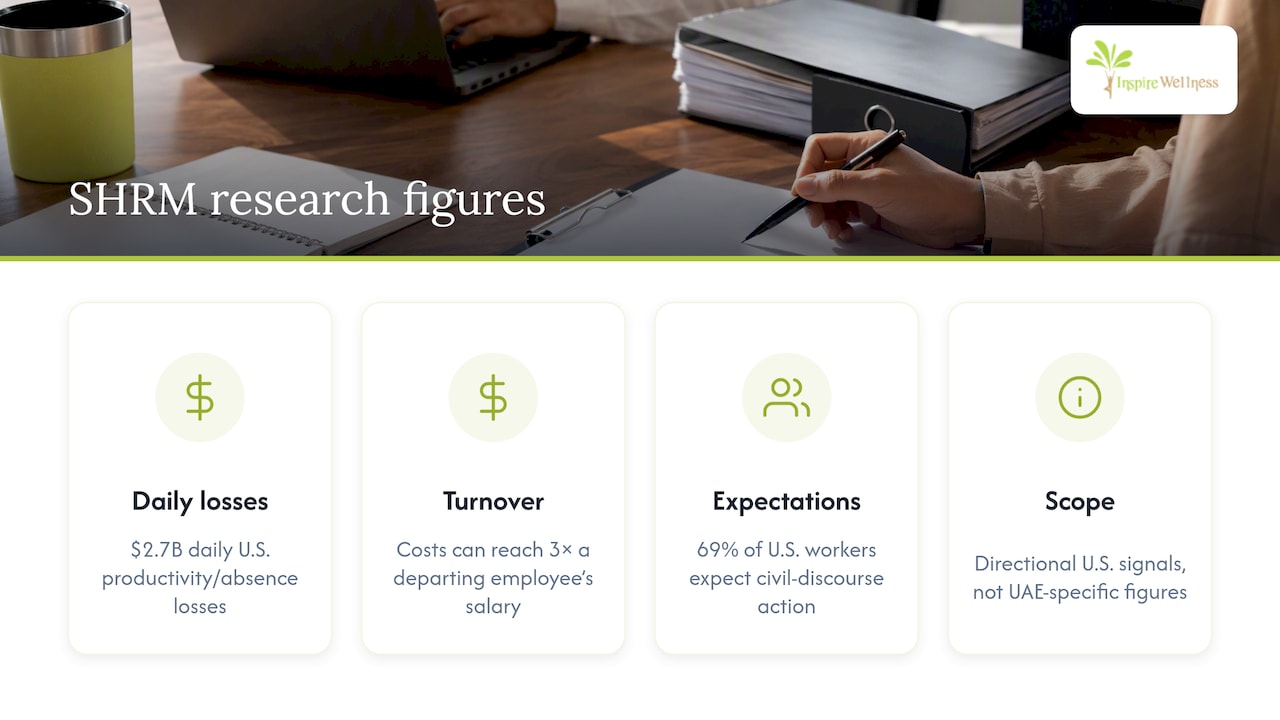
SHRM’s workplace civility handbook cites an estimated $2.7 billion in lost productivity and absenteeism per day tied to incivility, and turnover costs that can reach up to three times a departing employee’s salary. These are figures from SHRM’s research and reflect a U.S.-centered analysis, so treat them as a directional signal rather than a UAE number. The same handbook reports that 69% of U.S. workers expect their organization to try to address civil discourse at work.
For a Dubai or Abu Dhabi employer, the logic is easy to translate. Replacing a senior analyst, a relationship manager or a boutique’s top sales advisor is expensive, and people rarely leave a role only because of workload. They leave because of how they are treated.
The wellbeing link
Civility is closely tied to psychological safety, the belief that you can raise a concern or admit a mistake without being punished. Research summarized in the literature links safer, more respectful climates with higher job satisfaction and lower turnover, and they act as a buffer against the chronic stress that feeds burnout. We cover the leadership side of this in our piece on what leaders get wrong about psychological safety.
If you are also looking at how stress shows up in individuals, a short, private burnout self-check can be a useful starting point for reflection, though it is a Dutch-language tool built for coaches and is not a clinical assessment.
The UAE legal and compliance context
Civility training is not a legal requirement in itself for most private-sector employers onshore, but it supports obligations that are.
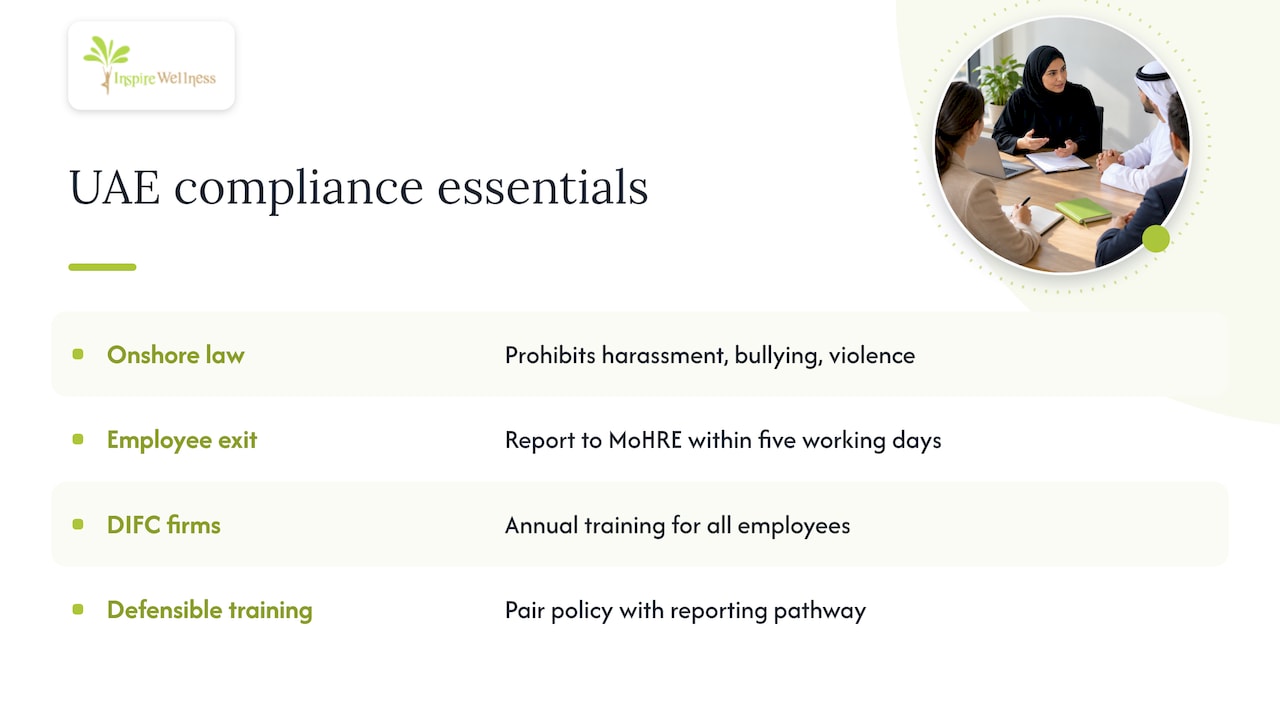
Onshore labour law. Under Federal Decree Law No. 33 of 2021, as summarized on the official UAE government portal, employers may not allow harassment, bullying or psychological abuse. An employee who is subjected to assault or harassment can end the employment agreement without notice, provided the incident is reported to MoHRE within five working days. The text of the decree-law itself prohibits sexual harassment, bullying and verbal, physical or psychological violence against a worker by the employer, superiors or colleagues.
Free zones. Law-firm commentary notes that the UAE onshore jurisdiction, DIFC and ADGM each have specific provisions prohibiting discrimination and harassment in employment. For DIFC-registered firms, a 2025 compliance guide from Hossam Zakaria describes annual training for all employees, supervisors and directors covering conduct standards, reporting options and non-retaliation, along with zero-tolerance and non-retaliation language in policy. If you operate in a free zone, confirm the current requirements with your legal counsel, as these rules can change.
What this means for design. The same guide frames training as a risk-management foundation, not a box-ticking exercise: it has to be paired with a clear policy and a reporting pathway to be defensible. That is where many companies fall short. They run a session, but employees do not know who to call, or managers do not know what to do when someone does.
For wider context on your obligations, see our guides on mapping wellness programs to UAE regulators and building a compliant workplace mental health policy.
What good civility training includes
The CIPD evidence review on bullying and incivility points to a consistent pattern: effective interventions combine individual skill-building, such as role-play and cognitive rehearsal, with organizational policy and visible leadership commitment. A single module rarely does the job.
| Component | What it looks like | Who it is for |
|---|---|---|
| Shared definition | Concrete examples of respectful and disrespectful behavior in your own context | Everyone |
| Skills practice | Role-play on feedback, disagreement, interruptions, email and chat tone | Everyone, with extra depth for managers |
| Manager module | Setting norms, spotting early signs, handling complaints, avoiding retaliation | People leaders |
| Policy and reporting | Where to report, what happens next, non-retaliation | Everyone |
| Leadership commitment | Senior leaders model the standards and are held to them | Executives, board |
| Reinforcement | Short follow-ups, team agreements, pulse checks | Teams |
Make employees part of the design
The CIPD review also stresses that employees should be active participants, not passive recipients. When staff help decide which behaviors matter and which scenarios to practice, they feel ownership, which is what keeps a new norm alive after the workshop ends. In a multicultural workforce, this is also the only reliable way to surface where expectations differ, for example around directness, hierarchy or humor.
Do not rely on bystanders alone
Bystander training is popular, but the evidence is mixed. A study on bystander intervention training examines how employee intentions collide with organizational barriers, and a 2026 systematic review of interpersonal-interaction programs in higher education argues that approaches focused only on bystanders place an unfair burden on them and ignore the people with structural power. The review comes from a university setting, so apply it with care, but the lesson carries over: train managers and senior people as the primary audience, and give bystanders support rather than sole responsibility.
Cover the digital layer
Most incivility now travels through screens. Include norms for response times, tone in written messages, use of group chats, camera expectations and escalation: when to stop typing and pick up the phone.
A practical program design
Here is a sequence we see working for UAE organizations, from a 40-person firm to a regional office of a multinational.
- Listen first. Run a short anonymous survey and a few small-group conversations. Ask where respect breaks down: meetings, handovers, cross-office work, client interactions.
- Align with policy. Review your code of conduct, anti-harassment policy and reporting channel. Fix gaps before training so that what you teach matches what employees can actually do.
- Brief leaders. Start with executives and heads of department. If they skip this step, everything else loses credibility.
- Train managers in depth. Give them practice in difficult conversations, handling early complaints and protecting people who speak up.
- Run team sessions. Use real scenarios from your survey. Keep groups small enough for honest discussion.
- Agree team norms. Each team writes down three to five behaviors it will commit to, and reviews them quarterly.
- Reinforce and measure. Short refreshers, pulse surveys, and a regular look at the data.
Adapting it to your sector
- Financial firms. High-pressure deadlines, regulatory scrutiny and hierarchy can mask incivility as “intensity.” Focus on feedback under pressure and on how senior staff treat juniors. If you are in Abu Dhabi, our guide to OSHAD compliance pilots shows how to get board support for pilots.
- Luxury and retail. Customer-facing teams absorb rude behavior from clients and sometimes from each other. Include scripts for handling difficult customers and clear backing from managers.
- Multinational offices. Cultural differences in directness and escalation are the main friction point. Make them discussable, without stereotyping.
- SMEs and founder-led firms. The owner’s behavior is the culture. Begin with one-to-one coaching for the founder and leadership team.
Perspective: what we have learned about civility and wellbeing
We approach civility as a wellbeing issue first and a compliance issue second, although both matter. When people feel disrespected at work, they spend energy on self-protection: rehearsing conversations, avoiding colleagues, staying quiet in meetings. That energy is no longer available for the work, for creativity or for recovery at home.
That is why we do not believe in a standalone etiquette course. In our experience, lasting change comes when three things connect: leaders who change their own habits, managers who have the skills to handle tension early, and teams that agree on norms they wrote themselves. Behavioral science helps here, because habits change through practice and feedback, not through information alone.
We also find that civility and resilience support each other. People who can regulate their stress respond more calmly to friction, and teams that treat each other well recover faster from setbacks. If you want to build both, our emotional resilience resource is a good place to begin.
One caution we give every HR leader: do not launch training without a visible commitment from the top and a safe way to report concerns. A program that raises expectations and then fails to act on what it uncovers does more damage than doing nothing.
— Neelam
How to measure whether it worked
Attendance and satisfaction scores tell you the session was pleasant. They do not tell you whether behavior changed. Use a mix of indicators and compare against a baseline taken before training:
- Pulse-survey items on feeling respected, comfort speaking up and trust in the reporting process.
- Turnover and exit-interview themes, especially among newer and junior staff.
- Absence patterns in teams with high stress.
- Reporting data: an early rise in reports can be a good sign, because people trust the channel. Look at how quickly cases are resolved and whether anyone reports retaliation.
- Manager behavior: 360 feedback items on fairness, listening and tone.
- Observed norms: whether team agreements are still referenced six months later.
Review results every quarter, share a summary with employees, and act on it visibly. Nothing builds trust faster than “you said, we did.”
Common mistakes to avoid
- One-and-done sessions. Behavior change needs repetition.
- Generic content. Examples from another country or industry make employees dismiss the lesson.
- Targeting only junior staff. Incivility often flows from seniority. Start at the top.
- No link to consequences. If a senior performer behaves badly with no response, the training becomes a joke.
- Ignoring wellbeing. Overloaded, exhausted teams are less civil. Address workload and stress alongside behavior. Our workplace wellbeing tips for managers cover practical steps.
How we can support your team
We design workplace wellbeing programs for UAE organizations, combining behavioral science, coaching and resilience training with your company culture. For civility work, that typically means group coaching for teams to build shared norms, wellbeing coaching for leaders and managers, and workshops within our corporate wellness programs.
If you want a defined starting point, our packages are priced on a one-off basis: Reset & Recharge at AED 3,000, Transform & Thrive at AED 5,500 and Master Your Wellbeing at AED 10,000. You can compare them on our pricing and packages page and tell us what your team needs.
FAQ
Is workplace civility training mandatory in the UAE?
There is no general onshore rule that names civility training as mandatory, but employers must not allow harassment, bullying or psychological abuse under the Labour Law. In DIFC, guidance describes annual training on conduct standards and reporting for all staff. Check your jurisdiction and policy requirements with legal counsel.
Who should attend first?
Senior leaders and people managers. They set the norms and handle the first signs of conflict, and research warns against placing the burden only on bystanders. Team-wide sessions follow once leaders are aligned.
How long should a program run?
Think in months, not hours. A typical arc includes a listening phase, leader and manager sessions, team workshops, and quarterly reinforcement. Short courses exist, but evidence favors programs that combine skills, policy and leadership commitment over time.
How is civility different from harassment training?
Harassment training focuses on prohibited conduct and legal consequences. Civility training addresses everyday behavior such as tone, inclusion and feedback, which shapes whether serious issues arise at all. Most organizations benefit from both, connected through one policy and one reporting route.
Can it work for remote and hybrid teams?
Yes, if it covers digital behavior: message tone, response expectations, meeting etiquette and when to escalate to a call. Research on cyber incivility suggests HR strategies should address these digital settings specifically.
Sources
- UAE Government portal: employment laws and regulations in the private sector
- Federal Decree by Law No. 33 of 2021 (UAE Legislation)
- SHRM Workplace Civility Handbook
- CIPD: Bullying and incivility at work, evidence review
- Hossam Zakaria: DIFC workplace harassment prevention and compliance guide
- Morgan Lewis: Labour and Employment, UAE (2022)
- Advancing Workplace Civility: systematic review and meta-analysis (PMC)
- Does Bystander Intervention Training Work?
- Systematic review of interpersonal interaction training programs (Springer)
- Managing cyber incivility in digital workplaces