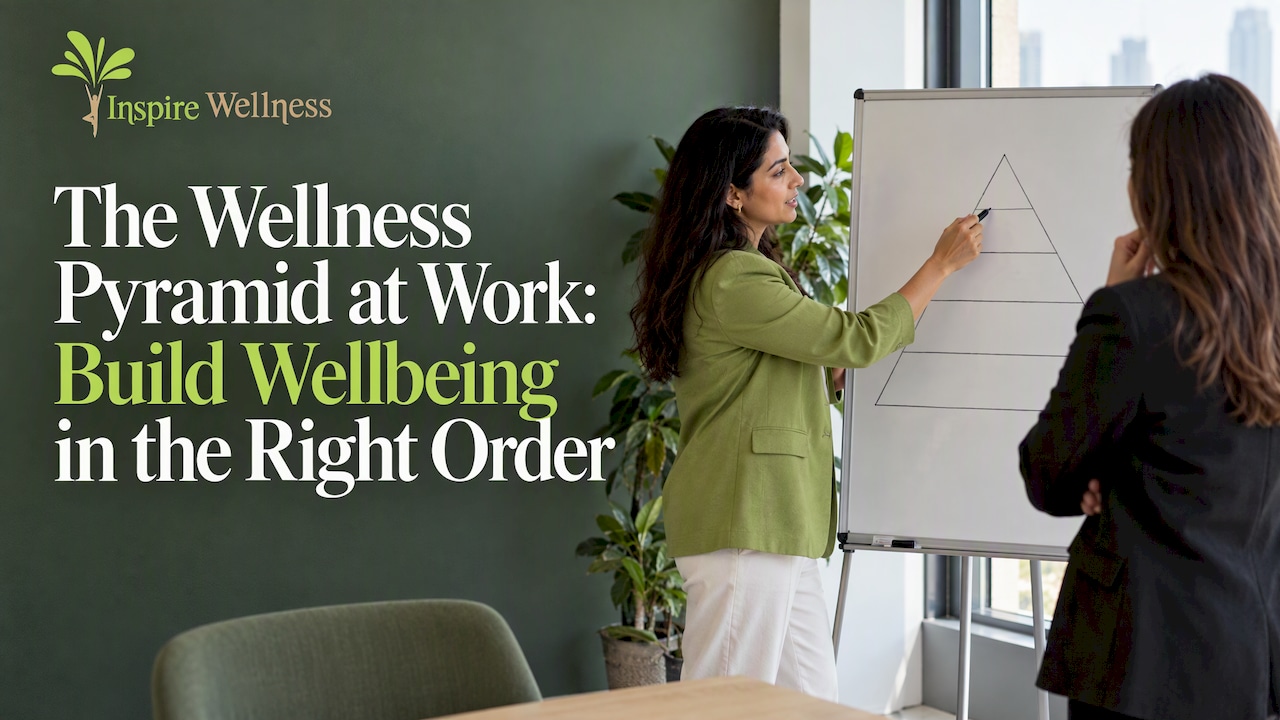
A wellness pyramid for the workplace is a layered model that puts culture, leadership and people management at the base, and individual perks such as coaching, apps and fitness benefits at the top. The order matters: programs placed on top of a weak foundation tend to disappoint, while the same programs on a solid base can reinforce each other. This guide explains how the model works, where UAE organizations most often go wrong, and how to apply it in your own company.
TL;DR
- The wellness pyramid ranks workplace wellbeing efforts by foundation: leadership and culture first, team-level data second, individual interventions last.
- Employee-facing perks such as meditation apps and gym memberships rarely change burnout or absenteeism when the base layer is neglected.
- Managers are the most direct route to better wellbeing, so manager capability belongs in the foundation, not in an optional add-on.
- In the UAE, the most common gap is a rich set of individual benefits sitting on top of unclear leadership commitment and weak psychological safety.
- You can audit your own pyramid in a single working session, and fix it layer by layer.
Table of Contents
- What the wellness pyramid means in a workplace
- Why the base layer decides the result
- The trap we see most in UAE organizations
- Applying the pyramid in six steps
- A quick self-audit for your leadership team
- What this looks like by layer
- Our perspective
- Where our programs fit
- Common mistakes to avoid
- FAQ
- Sources
What the wellness pyramid means in a workplace
The idea is simple and borrowed from a familiar shape. Like Maslow’s hierarchy, a pyramid says that higher-order outcomes (energy, engagement, performance) depend on lower-order conditions being in place. Several versions exist, and they agree on the logic even where they differ on labels.
The CIPD, the UK professional body for HR, publishes a well-being pyramid with leadership, culture and people management as the base, with wellbeing and engagement built on top. A three-level version, the Workplace Health Pyramid, sets out the sequence like this:
| Level | Focus | What happens here |
|---|---|---|
| 1. Organization | Culture and leadership | Senior commitment, values, policies, how decisions about workload are made |
| 2. Business unit | Data and local risk | Identify where stress, absence or turnover concentrate, team by team |
| 3. Employee | Specific interventions | Coaching, workshops, health support, chosen because the data points to them |
The source is clear that skipping the order significantly weakens return on investment and the staying power of a program. That claim is worth sitting with, because most workplace programs are built in exactly the opposite direction: someone buys a benefit, announces it, and hopes culture follows.
The pyramid is not a ranking of importance in the sense that individual support does not matter. Coaching and mental health support matter a great deal. The point is sequence and fit: the top layer works best when the layers beneath it are already doing their job.
Why the base layer decides the result
Three findings explain why practitioners keep returning to this shape.
Safety comes before wellness. A facilities-management article on the Prevention Pyramid argues that occupant wellness cannot be fully realized until employees feel their basic safety needs are met. Applied to knowledge work, that means physical safety and psychological safety. A mindfulness session offered to a team that fears speaking up about errors can feel insincere, and employees notice.
Leadership behavior shapes health. Research reviewed in a Yale paper on leadership and employee well-being separates constructive leadership, which is supportive and transformational, from negative behaviors such as hostility. It also points to a less obvious risk: leaders who swing between positive and negative can be harder on staff wellbeing than those who are consistently negative. Predictability, in other words, is itself a wellbeing factor.
Managers carry the program. The CIPD report on developing managers to manage sustainable employee engagement, health and well-being makes the case that line managers, through communication and the handling of conflict, strongly influence how employees experience work. A wellbeing program run only by HR, from the top down, misses the person who sees your people every day.
The World Health Organization points the same way. Its 2022 guidelines on mental health at work recommend organizational interventions, manager training and psychologically safe conditions, rather than relying only on tools that ask individuals to cope better. The WHO frames this as integrating mental health protection into existing occupational safety and health management, not treating it as an optional extra.
The trap we see most in UAE organizations
The pattern is familiar across Dubai and Abu Dhabi. A company invests in visible, easy-to-launch benefits: a meditation app subscription, a gym allowance, a wellness day. These are all level 3 items. They are welcome, and they photograph well. But practitioners of the pyramid approach note that, without prior investment in leadership capability and psychosocial safety, such perks often have little effect on long-term absenteeism or burnout. The Workplace Health Pyramid describes this mismatch directly: provision is widespread, yet employees often do not feel it reaches them.
For firms with long hours, client-driven peaks and multinational reporting lines, such as financial services and luxury retail, the base layer has a specific shape:
- Do senior leaders model the behavior they ask of teams, including taking leave and not sending messages at midnight?
- Do managers know how to hold a hard conversation about workload without it becoming a performance issue?
- Can an employee in a regional office raise a concern with a head office in another time zone and be heard?
If the honest answer to any of these is no, a new app will not fix it. We cover the leadership side in more depth in our piece on psychological safety at work and what leaders get wrong.
Applying the pyramid in six steps
Here is a practical sequence an HR head can run over a quarter. It works for a 60-person firm and for a regional office of a multinational.
1. Secure real sponsorship
Choose a senior sponsor who will take part, not just approve a budget. Ask them to commit to specific behaviors: attending sessions, communicating the rationale, and reviewing results quarterly. CIPD’s work places senior and line leadership at the base of the pyramid for good reason.
2. Audit the foundation
Review what already exists at level 1: wellbeing commitments in writing, workload and leave policies, how absence and resignations are discussed, and whether managers have any training in supporting a struggling colleague. Be candid. A short written audit is more useful than a polished one.
3. Gather data by team
Averages hide problems. Use anonymous pulse surveys, absence trends and exit interview themes, cut by business unit. Our guide to team wellbeing feedback methods for HR leaders covers practical ways to collect honest input without survey fatigue.
4. Build manager capability
Train managers to spot early signs of strain, have supportive conversations and manage conflict consistently. Our wellbeing tips for managers are a good starting point for a short internal briefing.
5. Choose interventions the data supports
Only now pick level 3 activities. If one unit shows exhaustion, energy management and stress reduction workshops fit. If another shows unclear priorities, performance coaching or group coaching may serve better. You can browse options in our guide to workplace health program ideas that actually work.
6. Review and adjust
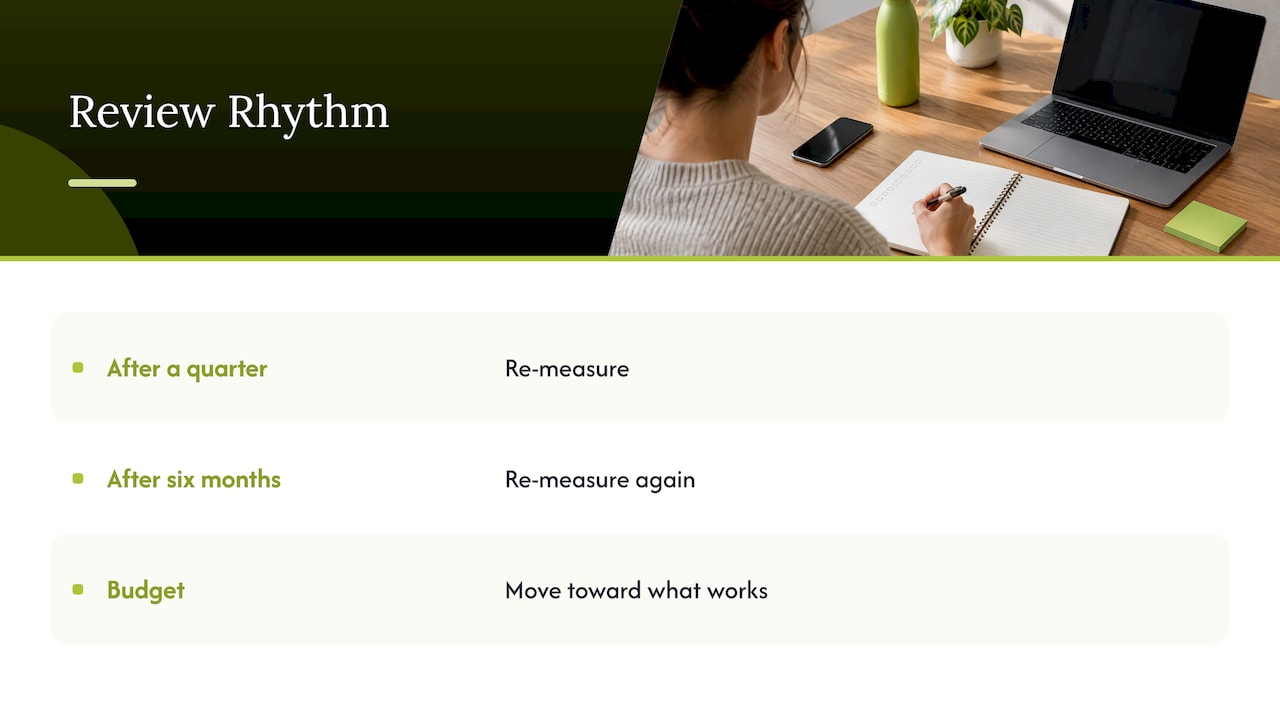
Re-measure after a quarter and again after six months. Move budget toward what works. The workplace wellbeing improvement process sets out a review rhythm that HR teams can adopt directly.
A quick self-audit for your leadership team
Use this list in a 45-minute meeting. Score each statement from 1 (not true) to 5 (fully true).
- Our senior leaders can explain why wellbeing matters to the business in their own words.
- Managers have received training in supporting wellbeing, not only in performance management.
- Employees can say that a mistake or a concern will not be punished.
- We know which teams carry the highest stress and absence, and we have data to show it.
- Every wellbeing activity we offer can be traced to a need we identified.
- We review results at least twice a year and have stopped something that did not work.
Low scores on statements 1 to 3 mean the work starts at the base. Low scores on 4 to 6 mean the base may be sound but the middle layer lacks data. Mostly high scores suggest you are ready to deepen individual support.
What this looks like by layer
| Pyramid layer | Typical weak signal | A stronger approach |
|---|---|---|
| Organization | Wellbeing statement exists, but no leader owns it | Named executive sponsor, annual commitments, visible participation |
| Business unit | One company-wide survey, no team breakdown | Quarterly pulse by team, with action owners |
| Employee | Generic perks open to all | Targeted coaching, workshops and support matched to team data |
If you work in financial services, the pressure points differ again: reporting deadlines, compliance load and market-driven peaks. We discuss these in our wellness program for finance teams guide and in how wellbeing drives engagement in UAE financial firms.
Our perspective
We built our approach around the idea that wellbeing has to be injected into a company’s DNA, not attached to it. That is why our Wellness Pyramid is a framework for sequence rather than a menu of activities. When a UAE organization asks us for a wellness program, our first conversation is rarely about which workshop to book. It is about who sponsors the effort, how managers are supported, and what the data from each team says.
This can feel slower than launching a benefit, and we understand the pressure to show something quickly. But we have found that leaders who invest in the foundation first tend to get more from every program they add afterward, because employees see consistency between what is said and what is done. Behavioral science, resilience training and emotional intelligence matter most when the environment lets people use them.
Our advice to HR heads: start where it is least comfortable. Look at leadership behavior and manager readiness before you shop for tools. Then choose individual support that fits the specific people in front of you, not a generic template.
— Neelam
Where our programs fit
Once your foundation work is under way, individual and team interventions become effective. We offer corporate wellness programs and workshops tailored to company culture, as well as wellbeing coaching, performance coaching and group coaching for teams.
For organizations that want a defined starting point, our pricing packages are published: Reset & Recharge at AED 3,000 one-off, Transform & Thrive at AED 5,500 one-off, and Master Your Wellbeing at AED 10,000 one-off. Programs beyond these are scoped with you, since customization to your culture and workforce is the point.
Common mistakes to avoid
- Treating wellbeing as an HR-only project. Without line managers, it stays a poster.
- Launching before listening. If you have not asked teams what drains them, you are guessing.
- Measuring participation only. Sign-ups show interest, not impact. Track absence, retention and engagement by team as well.
- Ignoring inconsistency. A supportive message from leadership followed by an after-hours demand undoes the message. The Yale research on inconsistent leadership explains why.
- Running one-off events as a strategy. A single seminar can help, but lasting change comes from repeated, connected activity.
If you are weighing how to explain this to a board or CFO, our guide to building a credible wellbeing strategy for UAE workplaces gives language that works with finance-minded executives.
FAQ
What is a wellness pyramid in the workplace?
It is a layered model that arranges workplace wellbeing activity from foundation to peak. Culture, leadership and people management form the base, team-level data and local risk sit in the middle, and individual interventions sit at the top. The principle is that upper layers work best when lower ones are secure.
Is there one official wellness pyramid model?
No. Several versions exist, including the CIPD well-being pyramid and the three-level Workplace Health Pyramid. They differ in labels but share the same logic of building from leadership and culture upward. Choose the one that your leadership team can explain in a sentence.
How long does it take to apply the pyramid?
The audit and data-gathering steps can be done in a quarter. Changes in leadership behavior and manager capability take longer, and you should expect to review progress over six months or more. Treat it as an ongoing cycle rather than a project with an end date.
Can we offer coaching and workshops before the foundation is perfect?
Yes, and many organizations do. Individual support helps people now, and it should not wait. What the pyramid warns against is relying on it alone: pair it with manager development and leadership commitment so the benefits are believed and used.
Who should own the wellness pyramid inside a company?
An executive sponsor should own the commitment, with HR coordinating and line managers carrying the day-to-day practice. Shared ownership matters because no single function controls culture, workload and leadership behavior at once.
Sources
- The Workplace Health Pyramid – Creating a Healthier Workplace
- CIPD: Growing the health and well-being agenda (well-being pyramid)
- Safety First, Wellness Third
- Leadership and Employee Well-being (Yale)
- CIPD: Developing managers to manage sustainable employee engagement, health and well-being
- WHO guidelines on mental health at work