Work-life balance means maintaining enough recovery, role fulfillment, and personal control to sustain your health, relationships, and performance over time — not splitting your hours equally between work and everything else. TL;DR: When you protect your recovery and feel in control of your commitments, your health, productivity, and relationships all benefit. Three things you can do today:
- Start a 10-minute end-of-work ritual. Close your laptop, write tomorrow’s top three tasks, and step outside briefly. This signals your brain that work is done.
- Use a simple boundary script. When asked to take on more than you can handle, say: “I want to do this well — let me check my current load and get back to you by [time].”
- Keep a one-week energy log. Note which activities drain you and which restore you. That data tells you where to make changes faster than any time-tracking app.
Table of Contents
- What work-life balance really means — and what it doesn’t
- Why work-life balance matters: benefits and health risks
- What U.S. research tells us about hours, flexibility, and health
- How to assess your own work-life balance right now
- Practical strategies to improve your work-life balance
- What employers can do — and how to ask for it
- Red flags of imbalance and when to get help
- Key Takeaways
- A perspective worth considering
- Useful sources and further reading
What work-life balance really means — and what it doesn’t
Work-life balance is a subjective perception of equilibrium between the demands of your professional role and the rest of your life. The key word is subjective. Two people working identical hours can experience completely different levels of balance depending on how much control they feel, how meaningful their work is, and how well their personal needs are being met.
Three models describe how people actually manage this:
- Segmentation model: Clear, enforced boundaries between work and personal life. Work stays at work; personal time is protected. This works well for people who find that mental separation helps them recover fully.
- Integration model: Work and personal life blend fluidly. A parent might take a mid-afternoon break for school pickup and finish work later in the evening. The boundary is permeable but intentional.
- Prioritization/resource model: Balance is managed by energy, not time. You ask “What needs my best attention right now?” and allocate accordingly, accepting that some roles will take more in certain seasons.
Three common misconceptions deserve direct correction:
- “Balance means equal hours.” It doesn’t. A 50/50 time split with no recovery is worse than a 60/40 split where you genuinely recharge.
- “Flexibility automatically creates balance.” Flexibility is a tool, not a solution. Without clear expectations and personal boundaries, flexible arrangements can extend work into every hour of the day.
- “Balance is a fixed state.” It shifts constantly with life circumstances. A new parent, a remote worker navigating isolation, and an early-career professional building skills all need different configurations.
Three short scenarios:
- Parent: Uses the integration model on school days, batching focused work in the morning and protecting afternoons for family. Sets a firm “no-work” rule after 8 PM.
- Remote worker: Uses segmentation — a dedicated home office, a start-time ritual, and a physical “commute” (a short walk) to create the psychological separation a commute once provided.
- Early-career professional: Uses the prioritization model, investing heavily in skill-building now while protecting one full weekend day and a consistent sleep schedule.
Why work-life balance matters: benefits and health risks
Poor balance is not a productivity problem. It is a health issue. Chronic overload harms sleep quality, mood stability, cardiovascular function, and immune response. The symptoms tend to appear gradually: persistent fatigue, difficulty concentrating, and growing tension in close relationships.
Benefits of a healthy balance include:
- Improved sleep duration and quality
- Higher sustained productivity and creative output
- Stronger immune function and lower cardiovascular risk
- Better relationship quality at home and at work
- Reduced absenteeism and lower turnover intention
The risks of chronic imbalance are well-documented and serious. Long work hours are associated with roughly a 20% higher mortality rate, and work-life conflict combined with chaotic work organization contributes to an estimated 120,000 excess deaths annually in the United States. Those are not abstract statistics — they represent real people whose health deteriorated under sustained occupational pressure.
Building emotional resilience in the workplace is one of the most effective ways to buffer against these risks, because resilience determines how quickly you recover from stressors rather than simply whether you encounter them.

Pro Tip: Prioritize recovery activities that actively replenish your energy — a short walk, a creative hobby, time with people you care about — rather than defaulting to passive rest like scrolling. Passive rest reduces fatigue; active recovery restores psychological resources.
What U.S. research tells us about hours, flexibility, and health
The evidence on work hours is consistent and worth taking seriously. Productivity begins to fall after roughly 48 hours per week and drops steeply beyond 55 hours — meaning that chronic long weeks don’t just harm health, they also undercut the very output they’re meant to produce. Aiming slightly below 40 hours per week is a realistic target for sustained wellbeing and performance.
Flexibility matters, but the type of flexibility matters more than the fact of it. Flexible control over when, where, and how people work increases performance, satisfaction, and reduces attrition across multiple studies. NIH-funded trials found that training workers and managers to work flexibly, normalize caregiving, and focus on performance rather than hours present improved health, sleep, and family time for participants.
| Research area | Key finding | Practical implication |
|---|---|---|
| Work hours and productivity | Output falls after ~48 hrs/week; steep drop after ~55 hrs | Aim to keep weekly hours below 40 for sustained performance |
| Flexibility type | Control over when/where/how work happens improves satisfaction | Negotiate how you work, not just where |
| Manager training | Training managers to normalize caregiving improved sleep and health | Seek teams with trained, results-focused managers |
| Mortality risk | ~20% higher mortality linked to long hours and work-life conflict, contributing to an estimated 120,000 excess deaths annually in the U.S. | Treat chronic overwork as a health risk, not a badge |
What this means for you, practically:
- Track your actual hours for two weeks before making any changes — most people underestimate by 5–10 hours per week.
- If you regularly exceed 48 hours, identify the two or three recurring tasks that consume the most time and question whether they require your direct involvement.
- Use flexibility to protect recovery, not to extend availability.
- When evaluating a new role, ask specifically how managers measure performance — output-based cultures tend to support better balance than hours-based ones.
How to assess your own work-life balance right now
A useful self-audit rates “energy vs. demands” rather than only counting hours. The question isn’t just “how many hours did I work?” — it’s “which activities are draining my resources faster than I can restore them?”
Start with these self-check questions:
- Do you wake up most mornings feeling rested, or already behind?
- Have you missed personal events (family dinners, social plans, health appointments) due to work in the past month?
- Does work follow you mentally into evenings and weekends, even when you’re not actively working?
- Are you engaging in at least one activity per week that gives you a genuine sense of mastery or joy?
- How often do you feel in control of your schedule versus controlled by it?
One-week tracking table:
| Metric | What to track | Target range |
|---|---|---|
| Hours worked | Total hours per day, including evening check-ins | Below 48 hrs/week |
| Late-night device use | Any work-related screen time after evening hours | rare nights per week |
| Sleep quality | Self-rated 1–5 each morning | 4–5 consistently |
| Mastery activities | Hours spent on hobbies, learning, or creative work | At least 3 hrs/week |
| Energy at day’s end | Self-rated 1–5 each evening | Trending upward by Friday |
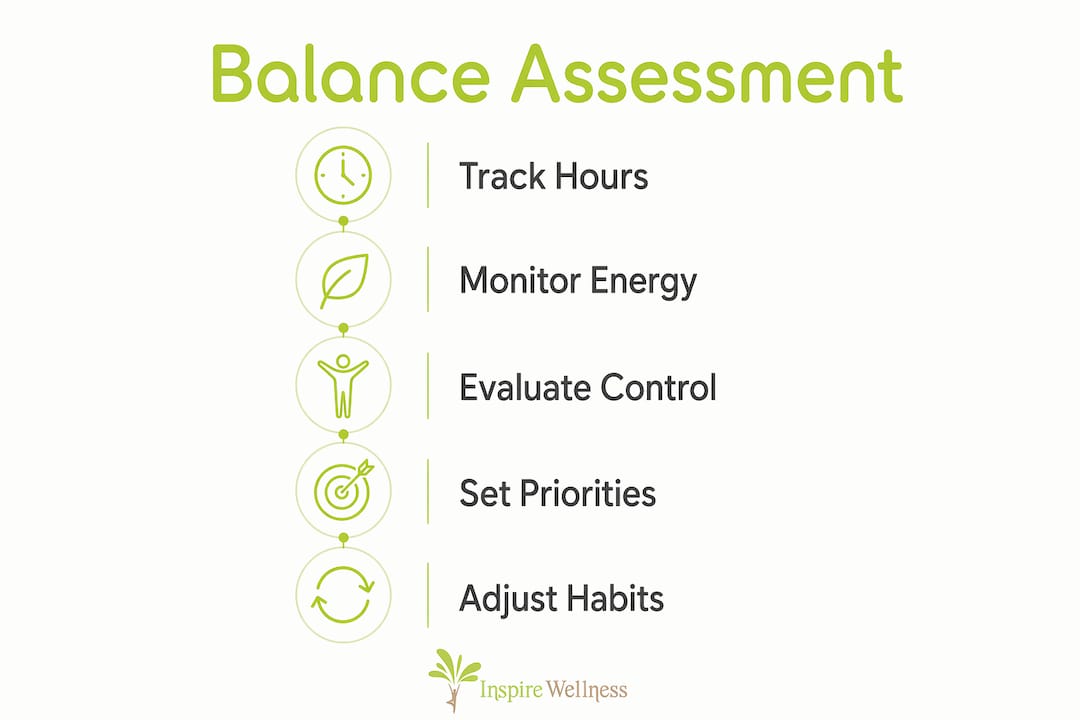
How many hours is a good work-life balance? Research points to slightly below 40 hours per week as the sweet spot for sustained wellbeing and output. Beyond 48 hours, productivity declines measurably; beyond 55, the drop is steep. The goal isn’t a magic number — it’s keeping hours at a level where you can recover fully between workdays.
If your energy rating trends downward across the week and doesn’t recover by Monday morning, that’s a clearer signal of imbalance than any hour count.
Practical strategies to improve your work-life balance
The most effective approach combines daily rituals, clear boundaries, and deliberate recovery scheduling. Individual tactics work best when they’re layered rather than applied one at a time.
Ordered action list:
- Create a consistent end-of-work ritual. Write tomorrow’s top three priorities, close all work tabs, and do something physical — even a five-minute walk. Transition rituals are more effective than rules like “no email after 7 PM” because they help the brain psychologically detach, which improves sleep quality and next-day focus.
- Set a daily hard stop. Choose a time and protect it. Communicate it to your team as a scheduling norm, not an apology.
- Batch similar tasks. Group email responses, calls, and administrative work into two or three defined windows rather than responding reactively throughout the day. This protects deep-focus time.
- Block recovery on your calendar. Treat lunch, exercise, and personal commitments as meetings. If they’re not on the calendar, they’re the first things cut.
- Audit your meetings weekly. Identify which recurring meetings could be an email or an async update. Removing low-value synchronous meetings creates predictable open time and reduces schedule chaos.
Boundary scripts that work:
- To a manager: “I want to deliver my best work on this. My current load is at capacity — can we discuss which priority to move to make room for this?”
- To a peer: “I’m heads-down until [time]. I’ll pick this up then — does that work for your timeline?”
- For after-hours emails: Draft the email when the thought is fresh, then schedule it to send during business hours. Sending emails outside business hours creates pressure on recipients due to workplace power dynamics, even when no response is expected.
A sample one-week plan:
| Time block | Monday–Friday | Saturday/Sunday |
|---|---|---|
| Morning | 90-min deep focus block (no meetings) | Personal time, no work devices |
| Midday | Batched email + calls (30 min) | Physical activity or hobby |
| Afternoon | Collaborative work / meetings | Social or family time |
| End of day | 10-min closing ritual + tomorrow’s top 3 | Full recovery — no work check-ins |
For people managing workplace stress, these structural tactics work best when paired with stress-reduction techniques that address the physiological side of chronic overload.

Pro Tip: A transition ritual doesn’t need to be elaborate; even five minutes of stretching can improve your workplace wellness posture to help signal a psychological shift. Changing out of work clothes, making a cup of tea, or doing five minutes of stretching all signal a psychological shift. The consistency of the ritual matters more than its content.
What employers can do — and how to ask for it
Organizational change is central to lasting improvement. Individual tactics help, but they have a ceiling when the workplace itself creates chronic overload. Corporate wellness programs that address structural drivers — not just individual coping — produce the most durable results.
Employer-side policies that genuinely help:
- Flexible scheduling with control over start/end times and location
- Predictable schedules published at least one week in advance
- Results-based performance metrics rather than hours-present measures
- Manager training on normalizing caregiving and recognizing overload
- Protected “no-meeting” blocks each week for focused work
- Clear norms around after-hours communication (e.g., no expected response outside core hours)
- Access to wellbeing coaching and mental health resources
How to request a flexible arrangement — a step-by-step approach:
- Document your current output and performance record before the conversation.
- Propose a specific arrangement with a defined trial period (e.g., “I’d like to shift my start time to 7 AM and finish at 3 PM for 60 days, with a check-in at day 30”).
- Frame the request around outcomes: “Here’s how I’ll maintain my deliverables and stay accessible to the team.”
- Put the agreement in writing after the conversation, even informally via email.
Checklist: signs a workplace will actually support change:
- Managers are evaluated on team wellbeing, not just output
- Senior leaders model healthy hours and take real vacation
- Flexible arrangements exist and are used without career penalty
- Performance conversations focus on results, not time at desk
- There is a clear process for raising workload concerns without fear of retaliation
Workplace wellbeing tips for managers can help leaders understand what structural support actually looks like in practice — which makes employee requests easier to frame and more likely to succeed.
Red flags of imbalance and when to get help
Some signs of imbalance are easy to rationalize as temporary. They rarely are. Recognizing the pattern early gives you more options.
Red flags that warrant immediate attention:
- Persistent sleep disruption — difficulty falling asleep, staying asleep, or waking unrefreshed for more than two weeks
- Noticeable cognitive decline: forgetting commitments, struggling to concentrate, or making errors you wouldn’t normally make
- Chronic fatigue that doesn’t improve after a weekend or short break
- Rapid mood changes, irritability, or emotional numbness that feels out of character
- Withdrawing from relationships or activities that previously brought satisfaction
- Physical symptoms: frequent headaches, digestive issues, or recurring illness
These are not signs of weakness. They are physiological signals that your nervous system is under sustained stress and needs support.
Next steps, by timeline:
- Immediately: Reduce discretionary load where possible. Protect sleep as a non-negotiable. Tell someone you trust what you’re experiencing.
- This week: Have an honest conversation with your manager about workload. Use the scripts in the previous section. Document the conversation.
- Within the month: If symptoms persist, consult a primary care physician and consider speaking with a mental health professional. Burnout has clinical presentations that respond well to early intervention.
- Ongoing: Build stress management techniques into your weekly routine, not just as a crisis response.
For individuals experiencing burnout, the National Institute of Mental Health (NIMH) and the Substance Abuse and Mental Health Services Administration (SAMHSA) both offer free resources and referral support. Your employer’s Employee Assistance Program (EAP), if available, is another low-barrier first step.
This article provides general information, not professional medical or mental health advice. If you are experiencing persistent symptoms, please consult a qualified healthcare provider for guidance specific to your situation.
Ready to build a healthier, more resilient workforce? At Inspire-wellness, we work with organizations to design corporate wellbeing programs that address the structural drivers of imbalance — not just the symptoms. Explore how our corporate wellbeing coaching can help your team thrive.
Key Takeaways
Work-life balance is a subjective state of control and fulfillment — not an equal hours split — and protecting it is one of the most evidence-backed things you can do for your long-term health and performance.
| Point | Details |
|---|---|
| Balance is about control, not hours | Fulfillment and perceived control matter more than a 50/50 time split. |
| Chronic overwork carries serious health risks | Long hours are linked to roughly a 20% higher mortality rate and an estimated 120,000 excess deaths annually in the United States. |
| Productivity has a ceiling | Output declines after ~48 hours per week and drops steeply beyond ~55 hours. |
| Transition rituals outperform rules | Consistent end-of-work rituals improve psychological detachment and sleep quality more reliably than blanket after-hours bans. |
| Organizational change is necessary | Individual tactics help, but lasting improvement requires employer-side changes: flexible scheduling, manager training, and results-based metrics. |
A perspective worth considering
The conversation about work-life balance tends to focus almost entirely on individual behavior — better time management, stronger boundaries, smarter routines. And those things matter. But the framing quietly places the burden on the person least able to change the system they’re operating in.
What the research actually shows is that the most meaningful improvements come when organizations change how work is structured: when managers are trained to normalize caregiving, when performance is measured by output rather than presence, and when schedules become predictable enough for people to plan their lives around them. Individual resilience is real and worth building. But resilience built on top of a broken structure is just a more efficient way to absorb damage.
The practical implication is this: if you’ve tried every personal tactic and still feel chronically overwhelmed, the problem may not be your habits. It may be the environment. That distinction matters for what you do next — whether that’s a direct conversation with your manager, a formal flexibility request, or a longer-term decision about where you work.
At Inspire-wellness, we see this pattern consistently. The people who make the most lasting progress are those who address both sides simultaneously: building personal practices and advocating for structural change. Neither alone is enough.
Useful sources and further reading
The sources below underpin the claims in this article and offer deeper reading for those who want to go further.
| Source | Why it matters |
|---|---|
| Stanford GSB / New America synthesis | Synthesizes U.S. research on work hours, mortality risk, and excess deaths — the strongest available evidence on health stakes. |
| New America: Seven things to know about work-life balance | Covers NIH-funded trial findings on flexibility, manager training, and health outcomes; essential for employer-side recommendations. |
| Canadian Centre for Occupational Health and Safety (CCOHS) | Authoritative occupational health framing of balance as perceived control and fulfillment, not equal hours. |
| Atlassian: How many hours should you really work? | Synthesizes research on the 48-hour and 55-hour productivity thresholds; practical for hour-based guidance. |
| Goals & Progress: Work-life balance practitioner guidance | Practitioner-level detail on transition rituals, energy audits, and psychological detachment techniques. |
| Acibadem International: Work-life balance and health effects | Clinical framing of chronic overload’s effects on sleep, mood, cardiovascular health, and immunity. |
| UGA News: Living to work or working to live | Research-backed guidance on after-hours communication norms and the power dynamics of off-hours email. |