An Employee Assistance Program, or EAP, is defined as a confidential, employer-funded benefit providing short-term counseling and support for employees facing personal or work-related challenges. Understanding what is employee assistance means recognizing it as one of the most direct investments a business can make in workforce health and productivity. EAPs cover mental health, financial stress, legal concerns, and family issues, all at no cost to the employee. As of 2026, the Employee Assistance Professionals Association (EAPA) sets the standard for program structure, including session limits and clinician qualifications. This guide gives HR professionals and business leaders a clear, practical picture of how EAPs work and why they matter.
What is employee assistance and what does it include?
An EAP is a short-term counseling benefit structured around 3–8 sessions per presenting issue, each lasting roughly 50 minutes, aligned with EAPA standards as of mid-2026. That session range is deliberate. It is enough to address acute stress, relationship conflict, or grief, but not intended to replace long-term therapy or insurance-covered psychiatric treatment.
The scope of employee support services goes well beyond mental health counseling. 64% of programs offer financial assistance and 58% provide legal referrals, addressing the non-clinical stressors that most often derail performance. That breadth matters because financial anxiety and legal uncertainty are among the top drivers of presenteeism, the condition where employees show up but cannot focus.

EAPs also function as a triage system. When an employee’s needs exceed the short-term scope, the EAP counselor connects them to the right level of care through insurance or community resources. This gateway role is what makes EAPs structurally different from health insurance mental health benefits, which focus on ongoing treatment rather than rapid assessment and referral.
Core services typically included
- Short-term mental health counseling: Cognitive behavioral techniques, grief support, and crisis intervention delivered by licensed clinicians
- Financial guidance: Budgeting advice, debt counseling, and referrals to financial planners
- Legal referrals: Initial consultations on family law, housing, or employment matters
- Work-life resources: Childcare referrals, eldercare support, and caregiver guidance
- Crisis hotlines: 24/7 phone access for immediate mental health emergencies
- Delivery modes: In-person sessions, phone, video, and mobile app access
Pro Tip: When evaluating an EAP vendor, ask specifically whether financial and legal services are included in the base contract or charged as add-ons. Many programs list them as features but gate them behind premium tiers.
Who is eligible and how do employees access EAP services?
EAP services are free to employees, with all costs borne by the employer. Eligibility typically extends beyond the individual employee to include immediate family members living in the same household. That inclusion is significant. A parent dealing with a teenager’s mental health crisis or a spouse navigating a legal dispute can access the program without the employee ever needing to attend a session themselves.
Access works through multiple channels. Employees can reach their EAP through a toll-free phone line, a secure web portal, or a dedicated mobile app. Eligibility is verified through the employer’s contract, not personal identification, which removes one common barrier to first contact. For urgent situations, 24/7 crisis hotlines provide immediate support, while routine counseling appointments are typically scheduled within a few days for non-urgent cases.
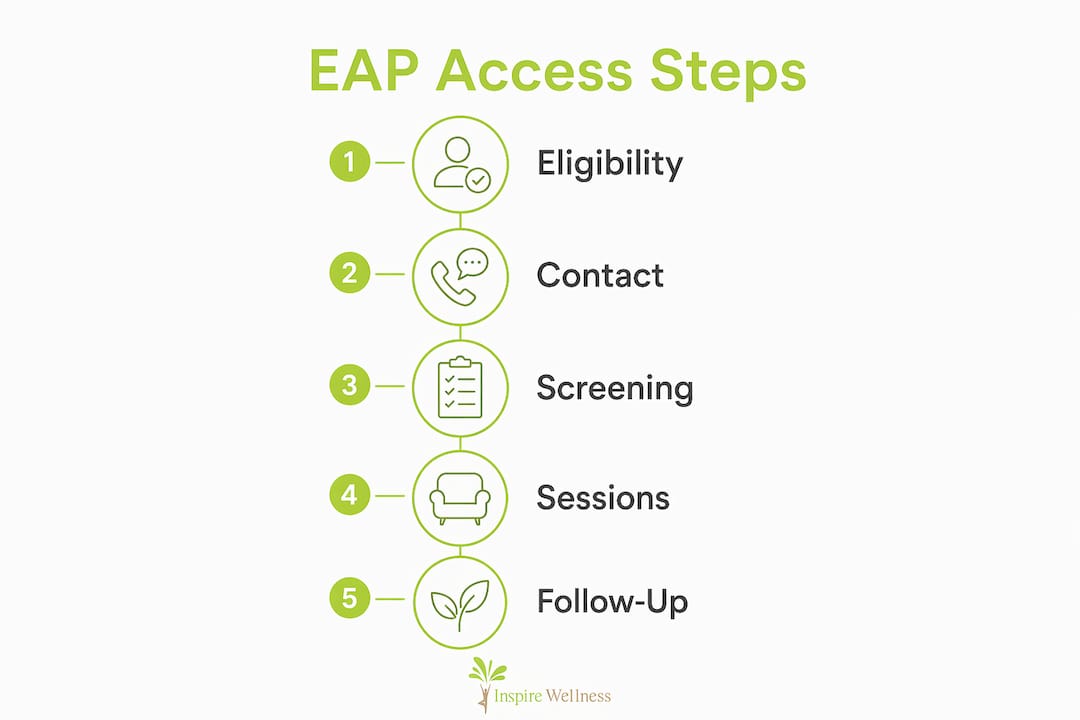
The intake process is handled by a licensed clinician who conducts a brief assessment to match the employee with the right type of support. That first call is not a therapy session. It is a structured conversation designed to clarify the presenting issue and identify the best path forward, whether that is short-term counseling, a financial consultation, or a referral to a specialist.
Steps to access an EAP for the first time
- Locate your EAP contact details via your employee handbook, HR portal, or benefits documentation
- Call the toll-free number or log in to the web portal to initiate contact at any time, including outside business hours for crisis support
- Complete the intake assessment with a licensed clinician who will identify your needs and match you to appropriate services
- Schedule your first appointment within the session limit provided by your employer’s plan, typically 3–8 sessions per issue
- Receive a referral if needed for longer-term care through your health insurance or community resources
Pro Tip: HR teams should include EAP contact details in onboarding materials, the employee intranet, and physical posters in break rooms. Employees who see the number regularly are more likely to use it when a crisis hits.
How do confidentiality protections work in EAPs?
Confidentiality is the structural foundation of every effective EAP. Employers receive only aggregated, anonymous usage data, never individual session details or identifying information. The EAP operates as a third-party entity, legally and operationally separate from HR and management. That separation is not a courtesy. It is a legal requirement enforced by professional licensing standards and, in many jurisdictions, by statute.
The most damaging misconception employees hold is that their manager receives progress reports. This belief suppresses utilization precisely when the program is most needed. HR leaders who address this myth directly, in writing and in conversations, see measurably better engagement with the benefit.
“Employees often mistakenly believe employers get progress reports. Legally, EAPs operate as confidential third-party entities, providing only aggregate usage data to employers. This separation is what makes the benefit trustworthy and worth using.”
What employers do receive is aggregate data: total number of sessions used, general categories of presenting issues (such as “work-related stress” or “family concerns”), and overall utilization rates. That data is valuable for workforce planning and benefit evaluation without compromising any individual’s privacy.
What confidentiality protects in practice
- Individual session content is never shared with HR, managers, or executives
- Employee names are not included in any report provided to the employer
- Counselors are bound by professional licensing standards and ethical codes
- The only exceptions are the standard legal limits: imminent risk of harm to self or others, or mandatory reporting requirements for child abuse
What are the measurable benefits and ROI of an EAP?
The business case for employee assistance programs is direct. Companies see an average ROI between $3 and $10 for every $1 invested in EAP services. That range reflects improvements in employee engagement, reductions in absenteeism, and productivity gains that accumulate across the workforce over time.
The mental health program advantages extend beyond cost savings. Organizations that actively promote EAP use report stronger talent retention, lower turnover costs, and a workplace culture that attracts candidates who prioritize wellbeing. For HR leaders, this positions the EAP not as a compliance checkbox but as a retention tool with measurable financial impact.
| Business Outcome | How EAPs Contribute |
|---|---|
| Reduced absenteeism | Early intervention addresses issues before they become extended leave |
| Lower turnover | Employees who feel supported are less likely to resign |
| Improved productivity | Counseling reduces the cognitive load of unresolved personal stress |
| Stronger engagement | Access to support signals that the organization values its people |
| Lower healthcare costs | Early mental health support prevents escalation to costly clinical treatment |
EAPs also serve as an early warning system for organizational health. When aggregate data shows a spike in work-related stress claims, HR leaders can investigate systemic causes, such as management practices, workload distribution, or team conflict, before they escalate. That early signal is something no annual engagement survey can provide with the same timeliness.
How can organizations increase EAP utilization and reduce stigma?
Low utilization is the most common failure point for EAPs. Employees fear privacy breaches and stigma, which suppresses usage even when the program is confidential and professionally managed. Education and proactive communication substantially increase utilization rates, but only when that communication happens year-round, not just during annual benefits enrollment.
The most effective approach combines leadership visibility with normalized messaging. When a senior leader openly acknowledges that they have used mental health resources, it shifts the cultural signal from “this is for people who are struggling” to “this is what professionals do to stay at their best.” That reframe is the single most powerful driver of utilization change. For practical ideas on building that culture, employee wellness recognition strategies offer a structured starting point.
Proven tactics to improve EAP engagement
- Communicate beyond open enrollment: Send reminders during high-stress periods such as performance review cycles, restructuring announcements, or seasonal workload peaks
- Use multiple channels: Email, intranet posts, team meetings, and physical signage each reach different employee segments
- Normalize use through leadership: Encourage managers to mention EAP resources in team meetings without pressure or personal disclosure
- Address stigma directly: Name the misconception in communications. “Your manager never sees your sessions” is more reassuring than a generic privacy statement
- Track utilization trends: Use aggregate data from your EAP vendor to identify departments or time periods with low engagement, then target outreach accordingly
Pro Tip: Frame EAP use in your communications as a professional skill, not a crisis response. Language like “many high-performing teams use EAP resources proactively” shifts the association from weakness to competence.
For HR teams building a broader mental health framework, the UAE HR mental health guide from Inspire-wellness provides a step-by-step implementation model that complements EAP deployment. Understanding employee engagement as a connected outcome also helps HR leaders see EAPs within the larger picture of workforce morale and retention.
Key Takeaways
An EAP is a confidential, employer-funded benefit that delivers measurable returns through early mental health intervention, financial support, and legal guidance, at no cost to the employee.
| Point | Details |
|---|---|
| EAP definition | A confidential, employer-funded benefit providing short-term counseling and support for personal and work-related issues. |
| Session structure | Programs typically offer 3–8 sessions per issue, aligned with EAPA standards, delivered in-person, by phone, or video. |
| Confidentiality guarantee | Employers receive only anonymous aggregate data; individual session content is never disclosed to HR or management. |
| ROI evidence | Organizations see $3–$10 returned for every $1 invested, driven by reduced absenteeism and improved productivity. |
| Utilization barrier | Stigma and privacy fears suppress usage; year-round communication and leadership endorsement are the most effective remedies. |
EAPs as a professional asset, not a last resort
I have worked with HR teams across industries, and the pattern is consistent: EAPs are purchased, announced once during benefits enrollment, and then quietly forgotten until someone has a crisis. That is the wrong model, and it costs organizations far more than they realize.
The distinction that matters most is this: an EAP is not a substitute for long-term therapy, and it is not a crisis-only resource. It is a professional support tool, similar to a legal retainer or a financial advisor, that works best when used early and often. The employees who get the most value from EAPs are not the ones in acute distress. They are the ones who use a session to work through a difficult conversation with a manager, clarify a financial decision, or process a period of sustained pressure before it becomes burnout.
The confidentiality architecture is also stronger than most employees believe. The legal separation between EAP providers and employers is not a policy preference. It is a structural requirement. HR leaders who communicate this clearly, with specifics rather than reassurances, see utilization climb. Vague statements about “privacy” do not move the needle. Specific statements like “your name never appears in any report we receive” do.
My recommendation for any HR leader reading this: treat EAP promotion as an ongoing communication program, not a one-time announcement. Build it into your mental health calendar, tie it to supporting employee mental health initiatives, and measure utilization quarterly. The ROI is there. The infrastructure is there. The only variable is whether employees know the resource exists and trust it enough to use it.
— Neelam
How Inspire-wellness helps organizations build on EAP foundations
Inspire-wellness works with organizations across the UAE to build workplace wellbeing programs that go beyond standard EAP offerings. Where an EAP provides short-term counseling and referral, Inspire-wellness delivers structured coaching, resilience training, and behavioral science-based frameworks that address the root causes of stress and disengagement at the team and leadership level.
For HR professionals who want to strengthen the impact of their employee support services, Inspire-wellness offers corporate wellbeing coaching designed to complement and extend what an EAP starts. Programs are built around your organization’s specific challenges, whether that is reducing burnout, improving manager effectiveness, or building a culture where mental health support is normalized and used. Connect with Inspire-wellness to see how a tailored wellbeing strategy can amplify the value of every benefit you already offer.
FAQ
What is an employee assistance program in simple terms?
An EAP is a confidential, employer-paid benefit that gives employees access to short-term counseling, financial guidance, and legal referrals for personal or work-related issues. Employees use it at no cost, and their employer never sees individual session details.
How many sessions does an EAP typically provide?
Most EAPs offer 3–8 counseling sessions per presenting issue, aligned with EAPA standards, with each session lasting approximately 50 minutes. Sessions are available in-person, by phone, or via video.
Can my employer see what I discuss in an EAP session?
No. Employers receive only anonymous, aggregate usage data and never individual session content or employee names. EAPs operate as legally separate third-party entities to protect employee confidentiality.
Who is eligible to use an EAP?
Eligibility typically includes the employee and immediate family members living in the same household. Access is verified through the employer’s contract, not personal identification, and is available at no cost to the employee.
Why do employees underuse EAPs despite the benefits?
Stigma and fear of privacy breaches are the primary barriers, even though EAPs are legally confidential. Year-round communication, leadership endorsement, and direct messaging about confidentiality protections are the most effective ways to increase utilization.