Organizational health is defined as a company’s ability to align around a shared strategy, execute against it effectively, and renew itself faster than the competition. The concept, formalized through frameworks like McKinsey’s Organizational Health Index (OHI), goes well beyond employee satisfaction surveys or HR program checklists. Organizations with high health scores generate total shareholder returns 3 times higher than their unhealthy peers. That gap signals something fundamental: organizational health is not a soft metric. It is a direct driver of business performance, resilience, and long-term sustainability. For HR professionals and business leaders, understanding what organizational health means in practice is the first step toward building a workforce that performs and endures.
What are the key factors that influence organizational health?
Organizational health is shaped by a set of interconnected internal dimensions. No single factor operates in isolation. When one dimension weakens, it creates drag across the others.
The most critical factors include:
- Leadership clarity and accountability. Leaders who set clear expectations and model desired behaviors create the conditions for execution. Without this, even well-designed strategies stall.
- Organizational culture and climate. Culture defines how work actually gets done, not how it is described in a values document. A culture that rewards collaboration and psychological safety produces better decisions and faster learning.
- Employee engagement and wellbeing. Engaged employees bring discretionary effort. Organizational wellbeing integrates physical, psychological, and occupational health, increasing employee fulfillment and collective productivity.
- Operational efficiency and capacity for innovation. Healthy organizations remove friction from core processes while preserving space for experimentation. Both matter equally.
- Alignment with strategy and shared vision. When teams understand how their work connects to organizational goals, decision-making speeds up and coordination costs drop.
- Talent management and reward systems. Compensation, recognition, and career development either reinforce or undermine the culture you are trying to build. Misaligned systems are one of the most common reasons health initiatives fail to stick.
A clean, well-maintained physical environment also contributes to employee wellbeing and daily performance. Physical conditions shape how people feel about their workplace, which feeds directly into engagement and culture.
Pro Tip: Map your current culture against your stated values. Where the two diverge most sharply, you will find the highest-leverage opportunity for health improvement.

How can organizations effectively assess their organizational health?
Assessment is where organizational health moves from concept to practice. The goal is to get an accurate picture of both employee sentiment and execution capability, not just one or the other.
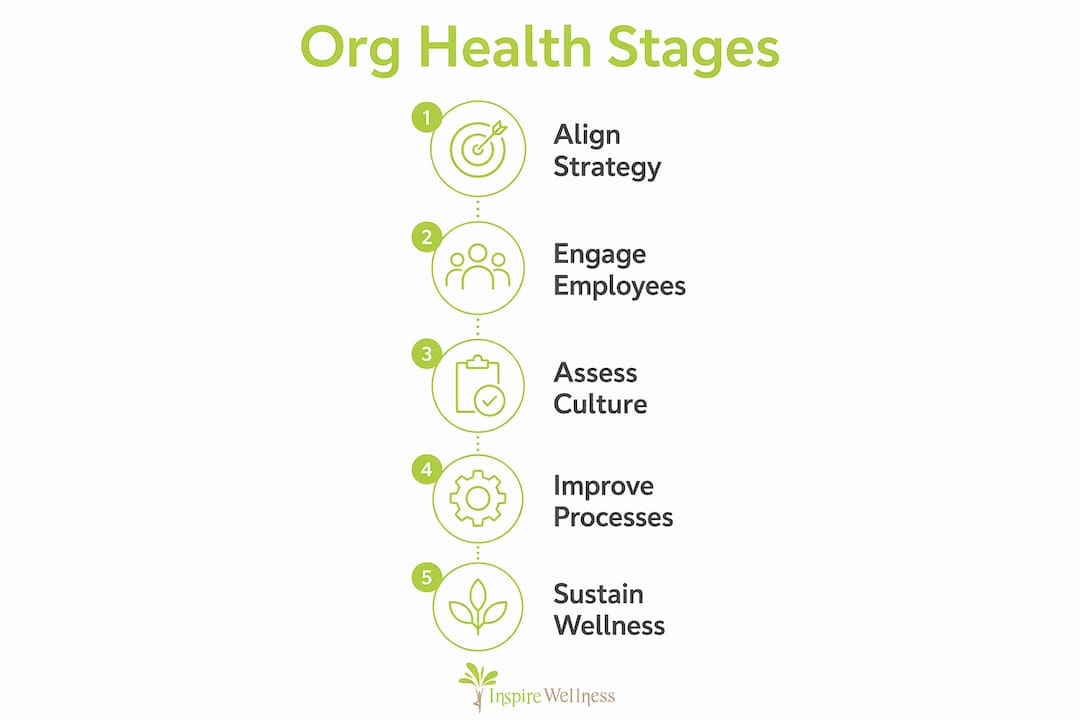
A structured assessment process typically follows these steps:
- Define what health means for your organization. Align on the dimensions most critical to your strategy before selecting any tool or metric.
- Deploy a validated diagnostic. The OHI measures nine dimensions of health, including direction, accountability, coordination, and external orientation. High OHI scores correlate with stronger performance outcomes across both public and private sector organizations.
- Combine quantitative and qualitative data. Surveys provide breadth. Structured interviews and focus groups provide depth. Neither alone gives you the full picture.
- Select metrics aligned with strategic goals. Effective measurement avoids vanity metrics and focuses on turnover rates, engagement scores, alignment indicators, and innovation output. These metrics connect directly to execution.
- Interpret data to drive decisions. A 72% engagement score means little without context. Compare it against prior periods, industry benchmarks, and team-level variation to identify where action is needed.
The most important nuance in assessment is this: high employee satisfaction can coexist with low organizational health when alignment and execution capacity are lacking. A team can report feeling happy at work while the organization drifts strategically. Measuring both sentiment and execution capability gives you a true health picture.
| Assessment Dimension | Example Metric |
|---|---|
| Leadership accountability | 360-degree feedback completion and action rates |
| Employee engagement | Engagement survey scores by team and tenure |
| Strategic alignment | % of employees who can articulate company priorities |
| Operational efficiency | Process cycle times and error rates |
| Innovation capacity | Number of ideas tested and implemented per quarter |
Pro Tip: Run your health assessment at the team level, not just the organizational level. Company-wide averages mask the pockets of dysfunction that most need attention.
Why is organizational health vital for employee wellbeing and business performance?
Organizational health and employee wellbeing are not separate agendas. They reinforce each other in ways that show up directly in business results.
A healthy organization integrates physical, psychological, and occupational health into how it operates day to day. This integration increases employee fulfillment and drives collective productivity upward. When people feel physically safe, psychologically supported, and clear about their role, they bring more of themselves to their work. The result is not just better morale. It is measurably better output.
The connection to financial performance is equally direct. Proactive systemic approaches to wellbeing outperform reactive individual-level programs in sustaining organizational health over time. A company that redesigns workloads, builds manager capability, and creates clear career pathways will outperform one that simply offers a gym subsidy and an employee assistance program hotline.
Healthy culture also reduces burnout and voluntary turnover, two of the most expensive problems any organization faces. Burnout does not appear overnight. It accumulates through chronic misalignment between demands and resources, poor leadership, and a lack of psychological safety. Addressing these root causes is a sustainable wellness investment that pays dividends in retention, performance, and organizational reputation.
“Effective organizational wellbeing requires proactive, ethical systemic changes rather than reactive stress management. Organizations that wait for employees to show signs of distress before acting are managing symptoms, not building health.”
The role of mental health at work deserves particular attention. Psychological wellbeing shapes how employees handle pressure, collaborate, and make decisions. Organizations that treat mental health as a core operational concern, not a personal issue, build teams that are more resilient and more capable of sustained high performance.
What are best practices for improving and sustaining organizational health?
Improving organizational health requires deliberate, sustained effort at every level of the organization. The following practices separate organizations that make lasting progress from those that cycle through initiatives without real change.
- Establish executive-level accountability. Organizations that treat health as an HR project risk superficial implementation. The CEO and senior leadership team must own health outcomes the same way they own financial results.
- Focus on 2–3 high-impact areas first. Attempting to fix everything at once creates initiative fatigue and dilutes effort. Focused improvement over 6–12 months generates quick wins that maintain leadership buy-in and build organizational confidence.
- Align systems with desired culture. Talent management, compensation, and performance systems must reinforce the behaviors you want to see. A culture that claims to value collaboration but rewards only individual performance will not change through communication alone.
- Embed health metrics into regular management processes. Health should appear on the agenda of leadership team meetings, not just in annual surveys. Regular review keeps it visible and creates accountability.
- Prioritize communication and trust-building. Employees need to understand why health initiatives matter and how their feedback shapes decisions. Transparency builds the psychological safety that makes change possible.
- Shift from ad hoc programs to systemic interventions. A step-by-step wellness approach that addresses root causes, such as workload design, manager capability, and career clarity, produces lasting results. One-off workshops do not.
Pro Tip: Assign a named executive sponsor to each health improvement initiative. Sponsorship without a name attached is not sponsorship. It is a good intention.
Key Takeaways
Organizational health is a measurable, multi-dimensional capability that drives financial performance, employee wellbeing, and long-term resilience when leaders treat it as a core business priority rather than an HR function.
| Point | Details |
|---|---|
| Health drives financial returns | Organizations with high health scores generate 3x higher shareholder returns than unhealthy peers. |
| Assessment requires dual focus | Measure both employee sentiment and execution capability to get an accurate health picture. |
| Satisfaction does not equal health | High employee satisfaction can coexist with low health when alignment and execution are weak. |
| Systemic beats reactive | Proactive, systemic wellbeing interventions outperform reactive individual-level programs in sustaining health. |
| Leadership ownership is non-negotiable | Executive accountability separates organizations that sustain health improvements from those that stall. |
Organizational health is a business problem, not an HR problem
I have worked with enough leadership teams to recognize a pattern that repeats itself across industries and geographies. An organization launches a wellbeing initiative with genuine enthusiasm. Surveys go out. A wellness platform gets purchased. A mental health awareness week gets scheduled. Twelve months later, engagement scores have barely moved, and the HR team is exhausted.
The problem is almost never effort. It is framing. When organizational health lives inside the HR function, it gets resourced like an HR function. That means limited budget, limited executive attention, and limited ability to change the systems that actually drive behavior.
The organizations I have seen make real progress treat health as a business execution challenge. They ask: “Why are our best people leaving?” and “Why does our strategy keep failing at the implementation stage?” Those questions lead to root causes, not symptoms. They lead to conversations about accountability structures, workload design, and whether the compensation system actually rewards the behaviors the culture claims to value.
The role of leadership in wellness cannot be overstated here. When a CEO talks about psychological safety in the same breath as quarterly results, the message lands differently than when it comes from a wellbeing coordinator. That signal changes what managers prioritize, which changes what employees experience.
My honest recommendation: before you invest in another program, audit your systems. Look at who gets promoted, what behaviors get rewarded, and where your best people are losing energy. The answers will tell you more about your organizational health than any survey ever will.
— Neelam
How Inspire-wellness supports your organizational health goals
Building a genuinely healthy organization requires more than good intentions. It requires a structured approach grounded in behavioral science and delivered by people who understand the complexity of real workplaces.
Inspire-wellness partners with organizations across the UAE to design and deliver corporate wellbeing programs that address the full spectrum of organizational health. From leadership coaching and resilience training to mental health support and culture-building frameworks, our programs are built around your specific workforce challenges. We combine evidence-based methods with practical implementation support, so your investment produces measurable outcomes rather than good-looking reports. If you are ready to move from awareness to action, Inspire-wellness is the partner that makes that shift possible.
FAQ
What is organizational health in simple terms?
Organizational health is a company’s ability to align its people around a shared strategy, execute that strategy effectively, and adapt over time. It encompasses leadership, culture, employee wellbeing, and operational capability working together.
How does organizational health differ from employee engagement?
Employee engagement measures how motivated and committed individuals feel. Organizational health measures whether the entire system, including leadership, culture, and processes, supports sustained performance. High engagement can exist alongside poor organizational health.
What is the Organizational Health Index?
The Organizational Health Index (OHI) is a diagnostic tool developed by McKinsey that measures nine dimensions of health, including direction, accountability, and coordination. High OHI scores correlate with stronger performance outcomes across sectors.
How long does it take to improve organizational health?
Focused improvement in 2–3 key areas typically produces measurable progress within 6–12 months. Sustainable, organization-wide health improvement is a multi-year effort that requires consistent leadership commitment.
Why do organizational health initiatives fail?
Most initiatives fail because they are treated as HR programs rather than business priorities. Leadership accountability is the single most important differentiator between programs that sustain progress and those that stall.