
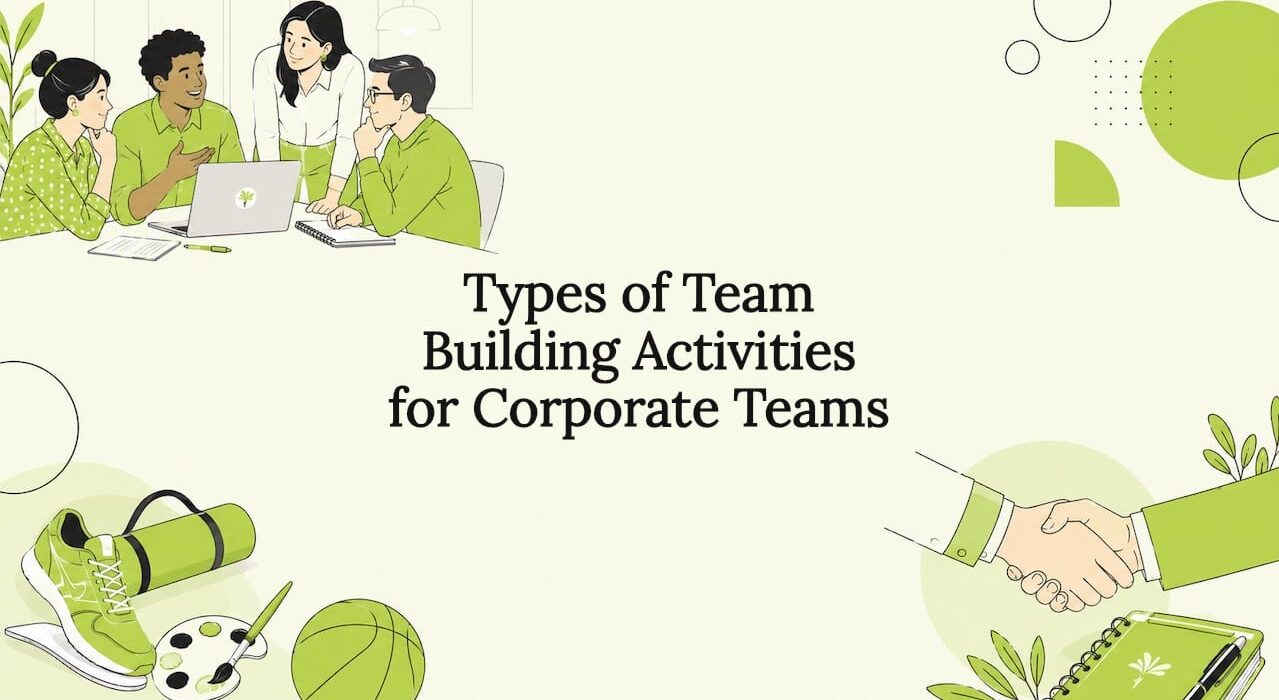
Types of team building activities are structured exercises designed to improve workplace collaboration, morale, and culture through diverse formats and shared objectives. The industry term for this practice is “organizational team development,” though “team building” remains the standard working label across HR and leadership functions. Choosing the right activity type is not a matter of preference. It is a decision that directly shapes trust, communication, and how well your team performs under pressure. Inspire-wellness works with corporate teams across the UAE to align these activities with broader wellbeing goals, because the research is clear: team building must connect to real business outcomes to deliver lasting value.
1. What are the main types of team building activities?
The five core categories of team building activities are sporting, creative, charitable, virtual or remote, and personality-led. Each type targets a different set of team skills, and choosing the wrong one for your context is a common and costly mistake.
| Activity type | Best use case | Primary objective |
|---|---|---|
| Sporting and physical | High-energy teams needing trust and friendly competition | Build camaraderie and physical engagement |
| Creative workshops | Cross-functional or newly formed teams | Spark lateral thinking and shared problem-solving |
| Charitable and volunteering | Teams needing purpose and shared values | Align with CSR goals and boost morale |
| Virtual and remote | Distributed or hybrid teams | Maintain connection across locations |
| Personality-led seminars | Teams with communication or conflict challenges | Build self-awareness and interpersonal understanding |
Sporting activities, such as mini-Olympics or relay challenges, work well for teams that already have a baseline of trust and want to deepen it through friendly competition. Creative workshops, including cooking classes or design sprints, push teams to collaborate outside their usual roles. Volunteering and wellness activities align team building with corporate social responsibility, creating meaning beyond the office. Virtual escape rooms and online trivia games keep remote teams connected without requiring travel budgets. Personality-led seminars, often built around tools like MBTI or DiSC assessments, help teams understand how different working styles affect communication.

Pro Tip: Run a short questionnaire for team building preferences before booking any activity. Knowing whether your team leans toward competitive, creative, or reflective experiences saves time and prevents low engagement.
2. How delivery formats shape the team building experience
Team building activities fall into four delivery formats: self-hosted, professionally facilitated, virtual or remote, and off-site events. The format you choose affects cost, logistics, and the depth of impact you can expect.
- Self-hosted: A manager or internal HR lead runs the activity. This format offers maximum flexibility and zero facilitation cost, but it places the full planning burden on your team. Best for small groups and low-stakes bonding sessions.
- Professionally facilitated: An external expert designs and leads the session. This format produces deeper outcomes, particularly for teams working through conflict or major change. It requires more budget and lead time.
- Virtual or remote: Activities run online via video platforms. Virtual activities cost significantly less than in-person events and extend reach across geographies, but they tend to build shallower trust than face-to-face formats. A hybrid approach, mixing virtual micro-sessions with periodic in-person retreats, often delivers the best results.
- Off-site events: Full-day or multi-day experiences held away from the office. These create the strongest psychological separation from daily work, which accelerates bonding. They also require the most planning and the largest budget.
Team building activities range from no-cost manager-led games to professionally facilitated off-site events requiring weeks of planning and significant budgets. That range means every team, regardless of size or resources, has viable options.
Pro Tip: Combine short micro-activities run weekly with one larger off-site event per quarter. This rhythm sustains team cohesion far more effectively than a single annual retreat.
3. Matching team building exercises to team size and development stage
The most effective team building exercises are matched to where a team currently sits in its development. Psychologist Bruce Tuckman’s model describes four stages: forming, storming, norming, and performing. Each stage calls for a different type of activity.
- Forming: Teams are new and cautious. Use low-pressure icebreakers, personal trivia games, or “two truths and a lie” to build initial comfort.
- Storming: Conflict and role confusion are common. Personality-led seminars and structured communication workshops reduce friction and build mutual understanding.
- Norming: The team is finding its rhythm. Creative challenges and collaborative problem-solving exercises reinforce the positive patterns emerging.
- Performing: High-functioning teams benefit from competitive challenges, innovation sprints, or cross-team projects that stretch their capabilities.
Team size also matters. Large group activities succeed when intentionally designed with story-driven and role-based tasks that give every participant a clear contribution. For groups of 50 or more, breaking into sub-teams with distinct roles prevents passive participation.
For busy managers with limited time, 5-minute team building activities can be highly effective with zero budget and minimal preparation. Bryant University identifies 30 such exercises, including “one-word check-ins,” “gratitude rounds,” and “silent line-ups” where teams arrange themselves by criteria without speaking. These micro-rituals, run consistently at the start of meetings, build cohesion over time without disrupting schedules.
Here are manager-friendly exercises that require no external facilitator:
- One-word check-ins at the start of every team meeting
- “Rose, bud, thorn” reflections at the end of a project phase
- Virtual coffee roulette pairing team members for informal 15-minute calls
- Collaborative playlist building for shared work sessions
- Peer recognition rounds where each person names a colleague’s contribution
Pro Tip: Map your planned activities to Tuckman’s stages before your next planning cycle. A team in the storming phase does not need a fun quiz night. It needs a structured conversation about working styles.
4. How activity selection and post-activity debriefs increase impact
The activity itself is only half the work. Team building must align with clear business objectives like improving communication or integrating new members. Without that alignment, even a well-run event feels like a distraction rather than an investment.
Matching activity intensity to team personality is equally important. Mismatch between team personality profiles and activity intensity can reduce engagement or cause anxiety. A team of introverted analysts will disengage from a high-energy outdoor obstacle course. The same team will thrive in a structured creative workshop or a collaborative data challenge. Knowing your team’s profile before selecting an activity is not optional. It is the difference between a session that lands and one that breeds resentment.
“The goal of team building is not to create excitement for a day. It is to build the trust and open communication that makes teams perform better every day. Structured activities that target relational outcomes are what separate meaningful team development from a fun afternoon.”
Dale Carnegie
Post-activity debriefs help teams connect lessons learned to everyday work, increasing the practical impact of team building. A debrief does not need to be long. Three questions work well: What did we do well together? Where did we struggle? What will we do differently next week? Running this conversation within 24 hours of the activity, while the experience is fresh, produces the most useful insights.
Avoid the single biggest pitfall in corporate team building: the one-off event with no follow-up. Consistency in team building drives stronger collaboration. Activities must fit team culture and goals for ongoing engagement. One retreat per year does not build a culture. A regular cadence of varied, purposeful activities does.
You can explore how structured team building connects directly to trust and communication outcomes in professional teams. A well-designed workspace also supports this work. Research shows that a cleaner office environment can increase focus and support the kind of sustained attention that team building exercises require.
Key takeaways
The most effective team building activities combine clear business objectives, matched delivery formats, and structured post-activity reflection to produce lasting improvements in team performance.
| Point | Details |
|---|---|
| Match type to objective | Choose sporting, creative, charitable, virtual, or personality-led activities based on your team’s specific development need. |
| Use the right delivery format | Self-hosted formats save budget; professionally facilitated events drive deeper outcomes for complex team challenges. |
| Apply Tuckman’s stages | Map activities to forming, storming, norming, or performing stages to maximize relevance and engagement. |
| Run post-activity debriefs | Ask three focused questions within 24 hours of any activity to translate the experience into daily behavior change. |
| Build a consistent cadence | Combine weekly micro-activities with quarterly larger events to sustain cohesion rather than relying on a single annual retreat. |
What I have learned about team building that most guides skip
I have sat in enough planning meetings to know that most team building programs fail before the first activity begins. The failure happens at the selection stage, when leaders pick an activity based on what sounds fun rather than what the team actually needs.
The most common mistake I see is treating team building as a single event rather than a practice. A cooking workshop in March does nothing for a team that has not spoken honestly since November. The activity is not the intervention. The culture of regular, intentional connection is the intervention. The activity is just the vehicle.
What works, in my experience, is a multi-format program that mixes short weekly rituals with periodic larger experiences. The weekly rituals build the habit of connection. The larger events create shared memories that teams reference for months. Neither works well without the other.
I also push back hard on the idea that team building needs to be elaborate. Activity diversity across volunteering, wellness, and competition is what engages varied workforce interests. A 5-minute gratitude round at the start of a Monday meeting, done every week for three months, will do more for team morale than a single expensive off-site. The research from Bryant University backs this up. Consistency and relevance beat novelty every time.
The teams I have seen thrive are the ones whose leaders treat team development as part of their employee wellbeing strategy, not as a separate HR checkbox. When team building is woven into how a team operates, rather than bolted on once a year, the results show up in retention, productivity, and the quality of daily collaboration.
— Neelam
How Inspire-wellness supports your team building goals
Inspire-wellness works with HR teams and leaders across the UAE to build team cohesion into a broader wellbeing strategy, not treat it as a standalone event.
Our corporate wellbeing coaching services help you design a program that connects team building activities to measurable outcomes: stronger communication, lower burnout, and a culture where people genuinely want to show up. We combine behavioral science with practical frameworks to make sure every activity you run serves a clear purpose. If you want team building that actually sticks, we can help you build the structure around it. Explore our corporate wellness programs to see how we approach this work.
FAQ
What are the main types of team building activities?
The five main types are sporting, creative, charitable, virtual or remote, and personality-led. Each type targets different skills, from trust and communication to innovation and self-awareness.
How do I choose the right team building format?
Match the format to your team’s size, budget, and development stage. Self-hosted formats work for small teams with limited budgets; professionally facilitated events suit teams navigating conflict or major transitions.
Can team building activities work for remote teams?
Virtual team building activities are effective for distributed teams and cost significantly less than in-person events. Pairing virtual micro-sessions with periodic in-person gatherings produces the strongest long-term results.
How long should a team building activity last?
5-minute micro-activities run consistently are highly effective for busy teams. Larger facilitated sessions typically run two to four hours, while off-site retreats span a full day or more.
What is a post-activity debrief and why does it matter?
A post-activity debrief is a structured reflection conversation held within 24 hours of a team building session. It helps teams apply what they experienced to their daily work, which is what turns a fun activity into a lasting behavior change.