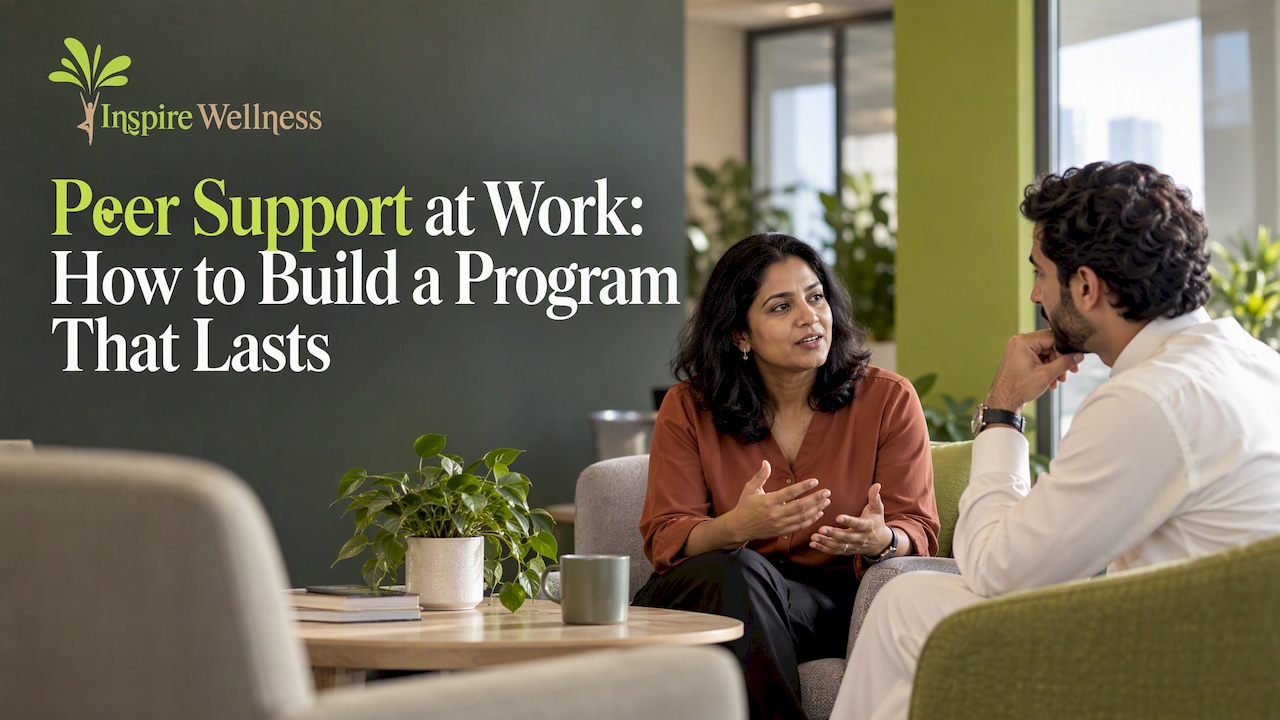
Peer support at work means trained colleagues offering listening, encouragement and signposting to coworkers who are under pressure, inside a structure the organization owns and guides. It works when it is a defined program with clear goals, selected and trained supporters, professional oversight and a route to expert help. It does not work as an informal “be kind to each other” message. This guide shows HR leaders in the UAE how to build the first kind.
TL;DR
- Peer support is structured, nonclinical help from trained colleagues. It complements managers, therapists and employee assistance services and never replaces them.
- Strong programs start with clear goals, select supporters on competencies, and provide standardized training and supervision from mental health professionals.
- Confidentiality, role limits and referral pathways must be written down before the first conversation happens.
- In the UAE, check data protection rules and your wider mental health policy before you collect any information about who uses the service.
- Measure usage and employee feedback together, then improve the program every cycle.
Table of Contents
- What peer support at work actually means
- What a peer supporter does, and what they do not
- Examples of workplace peer support programs
- Why it matters for UAE employers
- Benefits you can reasonably expect
- How to design a workplace peer support program
- Confidentiality, boundaries and referrals
- UAE compliance points to check
- Evaluate and improve
- Common design mistakes
- Our perspective
- Build your program with Inspire Wellness
- FAQ
- Sources
What peer support at work actually means
At its simplest, support from peers involves employees helping each other through shared experiences, active listening and emotional encouragement. In a workplace program, that natural behavior gets a framework. Colleagues who volunteer, or who are selected for their listening skills and credibility, are trained to offer a confidential first conversation and to point people toward the right next step.
Research describes mental health peer support as mutual support built on shared experiential knowledge, skills and social learning. The same review links it to greater mental wellness, self-efficacy and confidence, and to lower stigma around mental health at work. For a business, that last point matters most. Employees often hesitate to approach HR or a manager, yet they will talk to someone who understands the daily reality of their job.
The value is also practical. Pressure in a finance team, a luxury retail floor or a multinational regional office has a particular texture: month-end deadlines, client expectations, long hours and often a workforce far from family. A colleague who knows that texture can make the first conversation easier than any hotline can.
What a peer supporter does, and what they do not
A peer supporter is a trained colleague who listens without judgment, shares coping ideas where appropriate, and helps the person find further help. The role is deliberately narrow. Guidance for high-risk organizations states that peer-support training should cover listening skills, psychological first aid, referral options and ongoing supervision, and that supporters should not provide higher-level interventions.
The table shows how the role sits alongside other sources of help.
| Role | Main purpose | Typical starting point | Clinical care? |
|---|---|---|---|
| Peer supporter | Listen, normalize, encourage, signpost | A colleague who is struggling or simply needs to talk | No |
| Line manager | Workload, expectations, reasonable adjustments | Performance or workload conversations | No |
| Coach | Build skills, energy and resilience toward goals | A development or wellbeing goal | No |
| Employee assistance or counseling service | Confidential professional counseling | Personal or work stress needing expert help | Yes, through licensed professionals |
| Therapist or physician | Assessment, diagnosis and treatment | A persistent or serious condition | Yes |
Three practical differences are worth stating in your program documents:
- A peer has no authority over the person. A supporter should not sit in the same reporting line as the colleague they support, which keeps the conversation free of hierarchy and performance concerns.
- A peer does not diagnose or treat. They recognize when something is beyond their role and hand over warmly.
- A peer is supported too. Supporters carry what they hear, so they need supervision and a way to step back without penalty.
Examples of workplace peer support programs
There is no single model. Three commonly used workplace social-support formats are employee champions, employee resource groups and peer navigators. Here is how each tends to look in practice:
- Wellbeing champions. Volunteers in each department who promote resources, run small activities and act as an approachable first contact.
- Employee resource groups. Communities built around a shared identity or experience, such as new parents, expatriates new to the Emirates or women in leadership, with a sponsor from senior management.
- Peer navigators. Trained colleagues who help people find their way through benefits, insurance, counseling and internal policies.
- Event-based support. Some organizations activate peers after a difficult incident. In the UAE, the Emirates Health Services TRUST program, launched in 2019, includes peer support as its second tier for staff affected by adverse or sentinel events. Your own business may never face a clinical event, but the principle carries over to a major restructure, a client crisis or the loss of a colleague.
- Group formats. Small, facilitated peer circles for teams under sustained pressure. These pair well with group coaching for teams, where a professional coach holds the structure and colleagues learn from each other.
Why it matters for UAE employers
Many employees in the UAE work far from their families and their usual support networks, and many sit in demanding, client-facing roles. When stress builds, the first person they turn to is often a coworker. A 2026 study of non-clinical staff at a UAE psychiatric facility found that respondents commonly ignored problems, avoided stressors and sought support from coworkers, and the authors recommended peer support and mental health literacy programs.
That finding fits what HR leaders tell us: people already lean on each other. A program simply makes that leaning safer, better informed and more consistent. It also supports the wider case for investing in employee mental health, which we cover in why mental health at work drives employee performance and in our Dubai-specific view on why mental health should be a workplace priority.
The public sector is moving in the same direction. The Ministry of Health and Prevention launched a 15-week Quality of Life and Mental Wellbeing programme for its employees in 2021, with five training modules and science-based tools. Private employers who build a structured support layer are following a clear national direction.
Benefits you can reasonably expect
The academic review of workplace mental health peer support points to reduced stigma, empowerment and resilience as the main benefits. In practice, HR teams usually look for:
- Earlier conversations, before stress becomes absence or resignation.
- A culture where asking for help is normal rather than a career risk.
- Better use of existing resources, because peers point colleagues toward counseling, coaching and benefits they did not know about.
- Stronger team connection, which supports collaboration and retention.
The same review notes that programs perform best when definitions are consistent, boundaries are clear and supporters receive training and support. Those points are not obstacles. They are the design checklist in the next section.
How to design a workplace peer support program
1. Set goals and scope
Effective programs begin with clear goals and scope, dedicated resources, and policies and governance. Decide what the program is for: reducing stigma, helping new joiners, supporting teams through peak periods, or all three. Decide what it is not for, such as grievances, disciplinary matters or clinical treatment. Assign a budget and a named owner in HR.
2. Choose supporters on competencies
Use a competency-based process rather than asking for whoever has spare time. Look for active listening, discretion, emotional steadiness, credibility with colleagues and willingness to respect limits. Aim for diversity across seniority, departments, nationalities and language groups, so that employees can find someone who feels approachable to them.
3. Train and supervise
Provide standardized training and ongoing supervision. Sound programs involve mental health professionals in clinical direction, supervision and training, and training should reinforce boundaries and avoid hierarchical power dynamics. A practical curriculum covers:
- Active listening and open questions
- Psychological first aid basics
- Recognizing signs that need professional help
- Confidentiality and its limits
- Referral options inside and outside the company
- Looking after your own wellbeing as a supporter
Managers benefit from parallel skills. Our guide on building coaching skills in your team leaders shows how leaders can reinforce peer support rather than compete with it.
4. Build trust before launch
Employees will only use the service if they believe that using it will not hurt their standing. Leaders set that tone by speaking openly about stress and by showing that asking for support is treated as responsible behavior. This is the theme of psychological safety for leaders, and it matters most in hierarchical or highly competitive workplaces, where a concern about career progression can silence people.
5. Launch, communicate, embed
Introduce supporters by name and photo, explain what a conversation looks like, and state in plain words what stays confidential. Sustaining a program requires embedding it into corporate structure and keeping active management support. Put it in onboarding, in the intranet and in your mental health policy.
Confidentiality, boundaries and referrals
These three decisions deserve written rules before launch.
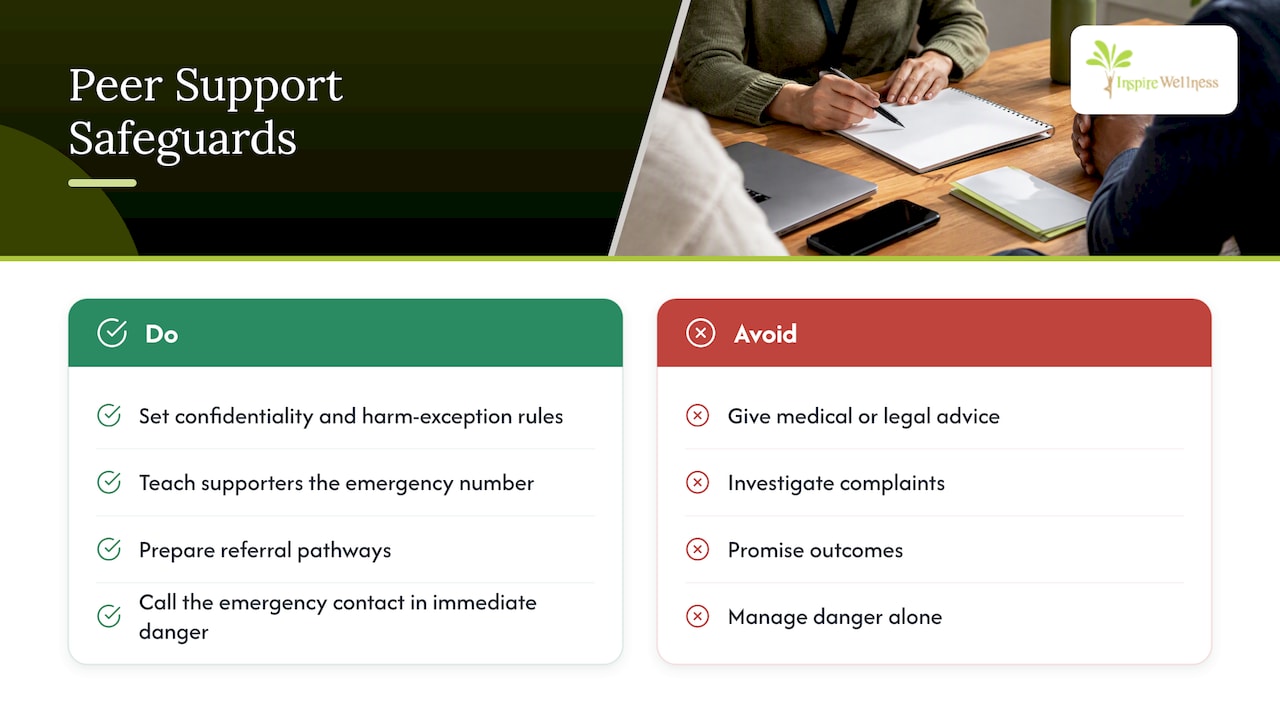
Confidentiality. Tell supporters and employees exactly what is private and when a supporter must involve someone else. The usual exceptions are risk of serious harm to the person or to others. Decide who the supporter contacts in that situation, and make sure every supporter knows the number by heart.
Boundaries. Supporters listen and signpost. They do not give medical or legal advice, investigate complaints or promise outcomes. They also do not take on a colleague’s workload or become a permanent substitute for professional care.
Referrals. Programs should offer referral pathways for complex cases. Prepare a one-page map: counseling through your health insurance or assistance provider, coaching, the HR contact and emergency services. If someone describes thoughts of self-harm or is in immediate danger, the supporter calls the emergency contact you have set up and does not manage the situation alone. The UAE national emergency number is 999.
If you are building this into a broader framework, our step-by-step guide to employee mental health for UAE HR teams shows where peer support sits next to screening, policy and manager training.
UAE compliance points to check
Two areas need attention before launch.
Personal data. UAE Federal Decree-Law No. 45 of 2021 generally prohibits processing personal data without consent, with an exception where processing is necessary for occupational or preventive medicine, including assessing an employee’s ability to work. For a peer program, the safe approach is to collect as little as possible. Do not keep notes on individual conversations in HR systems. Report anonymized usage counts only, and obtain explicit consent for anything beyond that. Our checklist for wellness program data privacy in the UAE walks through the steps.
Mental health policy and regulators. Peer support is stronger when it is written into your policy rather than running beside it. See our guides on complying with the UAE mental health law and on building a workplace mental health policy in 90 days. For a view across regulators, read how to map wellness compliance to UAE regulators. Have your legal counsel confirm the current requirements for your sector and free zone.
Evaluate and improve
Good programs plan evaluation from day one. Use both usage data and surveys to evaluate performance and improve continuously. Practical measures include:
- Number of conversations per quarter, by department, without identifying individuals
- Share of employees who know the program exists
- Employee confidence that they could ask for help without a penalty
- Supporter feedback on training, workload and supervision
- Referral uptake to counseling or coaching
- Trends in absence and turnover, read alongside other changes in the business
Australian academic work published in 2026 argues that peer support should be positioned as a formal behavioral health intervention, with clearer governance and better integration into management frameworks. That is a useful test for your own design: if peer support has an owner, a budget and a report to leadership, it is on solid ground.
Common design mistakes
- Launching with volunteers and no training. Goodwill is a start, not a program.
- Putting supervisors in the supporter role. It blurs authority and confidentiality.
- Treating the program as a stand-alone. Link it with counseling, coaching, manager training and policy.
- Forgetting the supporters. Rotate duties, schedule supervision and allow people to pause.
- Collecting too much data. Anonymous counts are enough, and they protect trust.
Our perspective
We see peer support as the human layer of a wellbeing strategy. It is the place where a colleague says “I am not coping” for the first time, and what happens next decides whether that person gets help early or carries on alone.
In our work with organizations in the UAE, we have found that peer support is most effective when it is connected to professional resources. Trained peers open the door, and wellbeing coaching, resilience training and structured programs give people somewhere meaningful to go. Our Wellness Pyramid framework is designed around this idea: foundations such as energy, stress management and emotional resilience first, then team culture and leadership behaviors that make support feel normal.
That is why we design programs around your culture, your workforce and your industry rather than offering a generic seminar. A finance team in Abu Dhabi, a luxury retail group and a regional multinational office each need different supporters, different language and different escalation routes.
Our aim is lasting, measurable change: supporters who feel confident, leaders who model openness, and employees who know where to turn.
Neelam
Build your program with Inspire Wellness
If you want peer support to sit inside a complete wellbeing strategy, we can help you design the supporter training, the coaching layer behind it and the workshops that build team-wide resilience. Our corporate wellness programs and workshops are customized to your organization, and our wellbeing coaching gives employees and leaders a professional route for deeper support.
For a defined starting point, our published packages are Reset & Recharge at AED 3,000 one-off, Transform & Thrive at AED 5,500 one-off, and Master Your Wellbeing at AED 10,000 one-off. You can compare them on our pricing and packages page, or get in touch to talk through a peer support rollout for your team. For other ideas to pair with it, see our list of 10 ways to support employee mental health at work.
FAQ
What are examples of peer support at work?
Common examples include wellbeing champions, employee resource groups and peer navigators who help colleagues find services. Some organizations also add peer circles for teams under sustained pressure, or activate peers after a difficult incident. The right format depends on your size, culture and goals.
What are the duties of a workplace peer supporter?
A supporter listens without judgment, offers encouragement and shares coping ideas, then helps the colleague find suitable next steps. They keep conversations confidential within the agreed limits and escalate risk through the defined route. They do not diagnose, treat or investigate complaints.
How is peer support different from an employee assistance service?
Peer support comes from a trained colleague who understands the daily realities of the job and is available informally. An employee assistance or counseling service is delivered by licensed professionals and can address clinical needs. The two work best together, with peers guiding colleagues toward professional help when it is needed.
How do I tell my boss I am struggling mentally?
Choose a private moment, describe what you are experiencing and how it affects your work, and say what would help, such as adjusted deadlines or time for an appointment. If that feels difficult, a peer supporter or HR contact can help you prepare. If you feel in danger or are thinking of harming yourself, contact emergency services on 999 or a doctor straight away.
Do we need consent to run a peer support program in the UAE?
UAE data protection law generally requires consent to process personal data, with narrow exceptions such as occupational medicine. Because the rules depend on what you collect and where you operate, keep records minimal and have legal counsel confirm your obligations before launch.
Sources
- Webinar 9: Building a Workplace Peer Support Program
- The TRUST second victim support program in Emirates Health Services
- Mental health peer support
- Guidelines for Peer Support in High-Risk Organizations
- Reframing workplace peer support: conceptual clarification and direction
- UAE Federal Decree-Law No. 45 of 2021 on personal data protection
- MoHAP launches Quality of Life and Mental Wellbeing programme
- Perceived workplace stressors and coping strategies of non-clinical staff