Energy management training teaches employees to build and protect their physical, emotional, mental and purpose-driven energy, so they perform well without burning out. It is different from the engineering courses of the same name, such as Certified Energy Manager or ISO 50001, which cover power consumption in buildings and plants. If you are an HR head or business owner in the UAE asking how to help people sustain their energy through demanding quarters, this guide covers what the training includes, what the evidence says, and how to choose and measure a workshop.
TL;DR
- Energy management training for employees is about human vitality (body, emotions, focus and purpose), not kilowatts. Many top search results cover the engineering version, so check the course description before you book.
- A peer-reviewed study of a 2.5-day program reported improvements in vitality and purpose that were still visible 18 months later, which suggests short, intensive formats can last when they are built well.
- Strategies tied to the work itself, such as learning, meaning and joy, are linked to better wellbeing and performance than passive breaks or avoidance.
- In the UAE, the National Wellbeing Strategy 2031 and sector rules such as the DoH policy favor programs that are structured, periodic and data-tracked.
- Start with a clear baseline, a defined cohort and a follow-up plan. Our pilot-style packages start at AED 3,000.
Table of Contents
- Two meanings of energy management, and which one this guide covers
- What energy management training for employees covers
- What the evidence says
- Why UAE employers are paying attention
- Designing a workshop that changes behavior
- Format: workshop, program or coaching?
- Our perspective
- How we can help
- Questions to ask before you sign
- FAQ
- Sources
Two meanings of energy management, and which one this guide covers
Search for this phrase in the UAE and you will see Certified Energy Manager courses in Dubai, ISO 50001 energy management systems training and university degrees in power and renewable engineering. They are valuable for facilities teams and sustainability officers. They teach audits, energy efficiency and systems for reducing consumption.
This article covers the other meaning, the one HR leaders use: helping people manage their personal energy at work. The idea is that time is a fixed resource, while energy is renewable if it is managed on purpose. A finance team closing the quarter, a retail team through the winter peak, or a client-facing luxury team working long hours has the same hours as anyone else. What differs is how much usable energy each person brings to those hours.
If you need an engineering certification for your building portfolio, look at accredited technical providers. If you need a workforce that stays sharp, calm and engaged, read on.
What energy management training for employees covers
Most well-designed programs work across four dimensions: physical, emotional, mental and purpose (sometimes called spiritual, in the sense of meaning rather than religion). A study of 522 employees used the same four-dimension view and reported that 74% of employees do not maintain optimal energy across them.
In practice, a good program turns each dimension into skills and routines:
- Physical energy: sleep habits, nutrition timing, movement across the workday, and recovery after peak periods.
- Emotional energy: noticing the early signs of frustration or anxiety, regulating them, and building the resilience to bounce back after setbacks. Our guide to emotional resilience at work goes deeper on this.
- Mental energy: focus management, reducing context switching, and structuring the day around the hours when thinking is sharpest.
- Purpose energy: connecting daily tasks to what matters to the person and the team, which is often the part that generic stress seminars leave out.
The skills matter less than the rituals that turn them into habits. A one-hour talk that people enjoy and forget by Friday does not change behavior. Training works when participants leave with specific, scheduled practices and a way to keep them going.
What the evidence says
HR budgets are rarely approved on enthusiasm, so here is what the research supports, and where its limits lie.
A 2.5-day program with an 18-month follow-up
The strongest finding we know of on this topic is a study in the American Journal of Health Promotion, published in 2019. It followed 163 employees across eight office-based worksites after a 2.5-day group program emphasizing vitality and purpose in life. The authors concluded that the intervention produced sustained improvement in quality of life, purpose and other wellbeing measures over 18 months.
The company press release summarizing the work reports a 17% increase in energy levels after the training, and 18% more participants reaching the highest vitality levels at 18 months. Two cautions apply. The sample was modest, and it was not a UAE workforce. Treat it as evidence that intensive formats can hold, not as a guarantee for any single organization.
Which energy strategies actually help
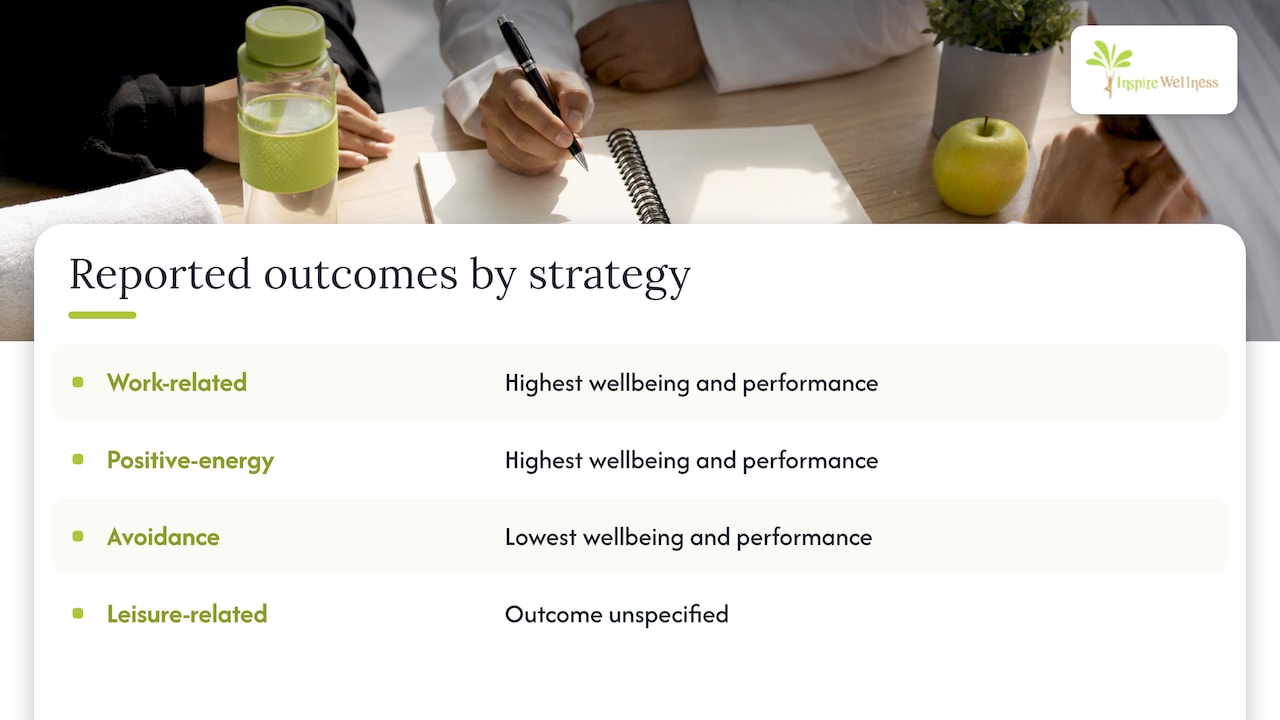
The 522-employee study identified four styles of managing energy at work: avoidance, work-related, leisure-related and positive-energy. Employees using work-related and positive-energy strategies reported the highest workplace wellbeing and performance, and those relying on avoidance reported the lowest.
That fits an earlier Michigan Ross paper, It’s the Little Things That Matter, which examines how individuals sustain their own energy at work. Its practical implication is that strategies woven into the work itself, such as learning something new, reflecting on why a task matters, or focusing on tasks that bring joy, can sustain vitality better than simply stepping away. Micro-breaks have a place. They are not a complete energy strategy on their own.
Stress, burnout and retention
Energy and stress are two sides of one problem. A 2024 study in Administrative Sciences of public sector organizations found that strong teamwork and organizational wellbeing policies together help buffer the effect of work stress on burnout. The sample is public sector and not UAE-specific, but the mechanism applies to any team: individual skills help more when the team environment supports them.
Why UAE employers are paying attention
The regulatory and cultural direction in the Emirates is clear. The National Wellbeing Strategy 2031 frames wellbeing as a national priority, and government guidance for employers already points to workshops on positivity and stress management as standard tools. The federal government’s employee wellbeing guidelines manual recommends training workshops on positivity and effective stress management.
Some sectors go further. Abu Dhabi’s Department of Health Healthcare Workforce Wellbeing Policy requires healthcare providers to design a comprehensive workforce wellbeing program, and includes training for managers to recognize signs of distress. If you are in healthcare, read that policy directly. If you are in finance, retail or luxury, you are not bound by it, but it shows what regulators consider a credible program: structured, periodic and measured.
The business case is also moving. As The National reported, GCC employers are prioritizing mental health in the workplace, and leaders there link internal programs to a more supportive culture and employee retention. For a deeper look at building a plan that stands up to scrutiny, see our piece on building a credible wellbeing strategy for UAE workplaces.
Designing a workshop that changes behavior
Here is the structure we recommend HR teams ask any provider to show them, ours included.
- Diagnose first. Start with a short baseline of energy, stress and engagement for the cohort, so you can compare later. Without a baseline, you cannot report results to leadership.
- Tailor to the work. A trading desk, a boutique sales floor and a compliance team drain energy in different ways. Examples and exercises should come from their real days, including seasonal peaks, client demands and, in the UAE, Ramadan schedules and long commutes.
- Teach across all four dimensions. Programs that stop at sleep tips and breathing exercises miss the purpose and mental-focus layers that the research links to lasting vitality.
- Make practices specific. Each participant should leave with two or three named rituals, a time and a trigger, for example a ten-minute planning block before email each morning.
- Build in reinforcement. Follow-up sessions, small-group check-ins or coaching keep rituals alive after the room empties. This is where one-off events usually fail.
- Involve managers. Employees cannot protect their energy if their manager sends messages at 11 pm. A short manager session pays for itself.
- Measure again. Repeat the baseline at a sensible interval and report it plainly, including where nothing moved.
Workload and inbox are energy issues too
Training cannot fix an unreasonable workload, and good facilitators say so. But some drains are within an individual’s control. Constant inbox pressure is a common one, and research-based tactics for email anxiety are a practical complement to a workshop, because they target a daily trigger of low mental energy and stress.
Format: workshop, program or coaching?
| Format | Best for | Strength | Limit |
|---|---|---|---|
| Single workshop | Awareness, kicking off a wellbeing calendar | Fast, reaches many people | Habits fade without follow-up |
| Multi-session program | Teams with a defined pressure point | Practice and reinforcement over weeks | Needs scheduling commitment |
| Group coaching | Intact teams who share a culture and workload | Peer accountability, shared language | Smaller cohorts |
| One-to-one coaching | Senior leaders and high-risk roles | Fully personal | Cost per person |
Most of our clients combine formats: a workshop to launch, coaching to sustain. If you are weighing options, our guides on the role of coaching in wellbeing and team resilience training lay out how the pieces fit.
Our perspective
We work with HR heads, business owners and senior leaders across the UAE, and the same pattern keeps appearing. Organizations buy a wellness day, people enjoy it, and three months later the numbers look the same. The cause is rarely the content. It is that the program was treated as an event rather than a change in how work runs.
We approach energy as a business input. It combines behavioral science, resilience training and emotional intelligence, and it is tailored to a company’s culture and the realities of each team. A finance team needs different rituals from a luxury retail floor, and a program that ignores that difference will feel generic to the people attending.
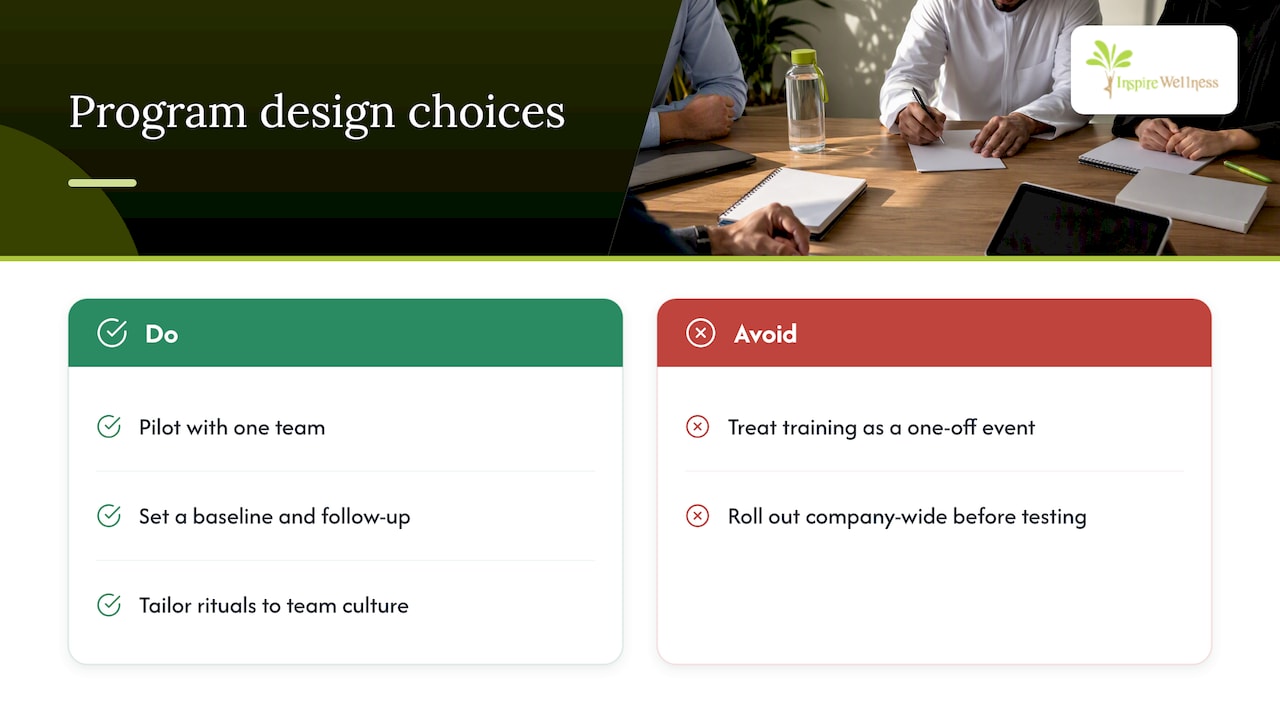
We also encourage leaders to start smaller than they think and measure more than they expect. A pilot with one team, a baseline and a follow-up gives you evidence you can take to your board. It also protects you from spending on a company-wide rollout before you know what fits your culture. We believe lasting change is possible, and we believe it should be shown with data rather than promised.
— Neelam
How we can help
Inspire Wellness is a Dubai-based provider of corporate wellbeing programs for organizations. Our energy and resilience work is delivered through corporate wellness programs and workshops, and can be extended with wellbeing coaching or group coaching for teams.
Our published packages give you a clear entry point:
- Reset & Recharge: AED 3,000, one-off
- Transform & Thrive: AED 5,500, one-off
- Master Your Wellbeing: AED 10,000, one-off
Corporate programs, workshops and coaching engagements are scoped to your team, so they carry no published price. Contact us through the corporate wellness programs page and we will propose a pilot that fits your cohort.
Questions to ask before you sign
Whatever provider you consider, these questions separate substance from polish:
- Which dimensions of energy does the program address, and how are they taught?
- How is the content adapted to our industry and team?
- What happens in the weeks after the session?
- What will we measure, when, and who sees the results?
- Does the provider train managers as well as staff?
- How does the program fit our obligations and the National Wellbeing Strategy 2031 direction?
A provider who answers these specifically has a method. One who answers with adjectives has a brochure. If your priorities lean toward stress, our personalized stress management service and our guide for UAE HR leaders on holistic wellbeing are good next reads.
FAQ
What is the difference between energy management training and stress management training?
Stress management focuses on how people respond to pressure. Energy management is broader: it covers how people build and renew physical, emotional, mental and purpose-driven energy so that pressure drains them less. The two work well together, and many programs combine them.
How long should an energy management workshop be?
The study behind the 18-month results used a 2.5-day format, so intensive formats can work. Shorter workshops can still be useful if they are paired with follow-up sessions or coaching. The key is reinforcement, not just hours in the room.
Is energy management training the same as an ISO 50001 or Certified Energy Manager course?
No. Those courses address energy consumption and efficiency in buildings and industrial systems. Energy management training for employees addresses human vitality, focus and wellbeing. Check the course outline before booking.
How do we measure whether the training worked?
Take a baseline of energy, stress and engagement before the program, then repeat it after a set interval with the same cohort. Add business indicators you already track, such as absence or turnover, but treat them as context rather than proof, since many factors affect them.
Do UAE employers have to provide this kind of training?
There is no general requirement we can point to for private companies, but some sectors have rules. The Abu Dhabi Department of Health policy sets wellbeing program requirements for healthcare providers. Other employers should check the rules that apply to their sector and emirate.
Sources
- Sustained Long-Term Effectiveness of an Energy Management Training Course on Employee Vitality and Purpose in Life
- New Findings Show Sustained Improvement in Employee Quality of Life 18 Months After Training
- Latent profile analysis of energy management strategies and employee work outcomes (Journal of Northeastern University)
- It’s the Little Things That Matter (University of Michigan)
- Stress, Teamwork, and Wellbeing Policies (Administrative Sciences)
- National Wellbeing Strategy 2031 (Emirates News Agency)
- Employees Wellbeing in the Federal Government Guidelines Manual
- Healthcare Workforce Wellbeing Policy (Department of Health Abu Dhabi)
- GCC countries start prioritising mental health in the workplace (The National)