
Federal Law No. 10 of 2023 is now in force across the UAE, and it changes what patients can expect and what employers must do. It replaced the country’s older 1981 framework, took effect on May 30, 2024, and now governs psychiatric patient rights, facility licensing, admission procedures, and the obligations businesses carry toward employees experiencing mental health conditions. Whether you run HR for a multinational or manage a single clinic, this law now shapes decisions you make every week.
TL;DR:
- Employers must now treat mental health conditions as workplace safety issues, requiring confidentiality, reasonable adjustments, and protection against discrimination.
- All mental health service providers need licensing according to strict standards, including detailed design plans, staffing credentials, and ongoing compliance checks.
- The law applies broadly across free zones and onshore entities, but jurisdictional differences require legal review to ensure policies align with specific regulators.
- Employers should update policies, establish referral pathways, train managers, verify vendor licensing, and maintain detailed documentation to ensure compliance.
- Non-compliance risks legal penalties and reputational damage, so proactive preparation and vendor verification are essential before any incidents occur.
Table of Contents
- What the mental health law UAE covers: scope, objectives, and key definitions
- Patient rights and how admission actually works
- Employer obligations and workplace implications
- Licensing, facility standards, and the 2025 executive regulations
- Free zones, DIFC, ADGM, and cross-jurisdiction compliance
- A practical employer checklist for compliance
- What this law means for UAE employers and HR leaders
- How Inspire Wellness helps you meet these obligations
- Where to verify the official law and guidance
- Sources
What the mental health law UAE covers: scope, objectives, and key definitions
Federal Law No. 10 of 2023 applies broadly. It reaches psychiatric patients, licensed mental health facilities, care homes, and service providers, and its language extends into free zones as well as onshore entities. That breadth is deliberate: lawmakers wanted one coherent standard rather than a patchwork of emirate-level rules.
The law works from a handful of core definitions you will see repeated throughout its articles:
- Psychiatric patient: someone diagnosed with a mental disorder requiring assessment, treatment, or care under the law’s provisions.
- Mental health services: diagnosis, treatment, rehabilitation, and follow-up care delivered by licensed professionals or facilities.
- Care home: a residential facility providing ongoing psychiatric or rehabilitative support outside a hospital setting.
Three objectives run through the entire statute: protecting patient rights, regulating the relationships between patients and the parties around them (families, employers, providers), and setting enforceable standards of care. Earlier UAE health regulations rarely addressed workplace mental health regulations directly. This law does, which is exactly why UAE workplace health regulations now intersect with mental health policy in a way they didn’t before 2023.
Patient rights and how admission actually works
Patients under this law keep meaningful control over their own treatment, and the statute is specific about it. Three principles anchor the rights section:
- Consent and informed decisions. Patients admitted voluntarily retain the right to understand their diagnosis, treatment options, and the right to leave a facility once they no longer consent to care.
- Compulsory admission requires layered oversight. A patient can only be admitted against their will when two psychiatrists independently determine it’s necessary, and the facility must notify authorities promptly. Private facilities need court or Public Prosecution approval before compulsory admission proceeds.
- Restraint and treatment safeguards. Even in compulsory cases, the law limits how and when restraint is used, and it requires documented justification rather than discretionary judgment calls.
Compulsory outpatient therapeutic care exists as a middle path, letting patients receive mandated treatment without full facility admission. This structure reduces the risk of arbitrary detention, a criticism that dogged mental health systems in plenty of jurisdictions before frameworks like this one built in judicial checkpoints.
Employer obligations and workplace implications
This is the section most HR leaders search for, and for good reason: the law reshapes UAE workplace health regulations in ways that touch hiring, accommodation, and confidentiality all at once.
The statute recognizes rights that carry direct employment consequences:
- Nondiscrimination. Employers cannot penalize or dismiss employees solely because of a diagnosed mental health condition.
- Confidentiality. Medical information about an employee’s mental health status must be protected with the same rigor as other sensitive health data.
- Reasonable adjustments. Where a condition affects someone’s ability to perform specific duties, employers are expected to consider adjustments rather than default to termination.
Mental health becomes a workplace health and safety issue the moment it affects someone’s capacity to work safely, whether that’s a manager operating machinery or an employee experiencing acute distress at their desk. Legal commentary from DLA Piper points out that non-compliance carries real penalty exposure, not just reputational risk.
Practically, this means updating HR policy language, training managers to recognize when a referral (not a performance conversation) is the right first move, and building confidentiality procedures that hold up if a case ever gets scrutinized.

Pro Tip: Don’t wait for an incident to write your mental health accommodation policy. Draft it now, get legal sign off, and circulate it before you need it. Reactive policies almost always contain gaps a proactive one would have caught.
Licensing, facility standards, and the 2025 executive regulations
Every psychiatric service provider in the UAE needs a license, and Cabinet Resolution No. 213 of 2025 spells out exactly what that license requires. This executive regulation operationalizes Federal Law No. 10, turning broad legal principles into inspection-ready checklists.
Key licensing requirements include:
- Submission of detailed engineering design plans before a facility opens.
- Documented staffing qualifications for psychiatrists, nurses, and support personnel.
- Defined fee structures and renewal timelines set by the relevant health authority.
- Ongoing operational controls covering everything from patient records to emergency protocols.
Oversight doesn’t stop at licensing approval. Each emirate maintains a follow-up committee tasked with monitoring facility compliance, and health authorities retain inspection powers throughout a facility’s operating life. If you’re an employer contracting with a mental health vendor, this is exactly where you should be asking for paperwork, not taking a provider’s word for it.
Free zones, DIFC, ADGM, and cross-jurisdiction compliance
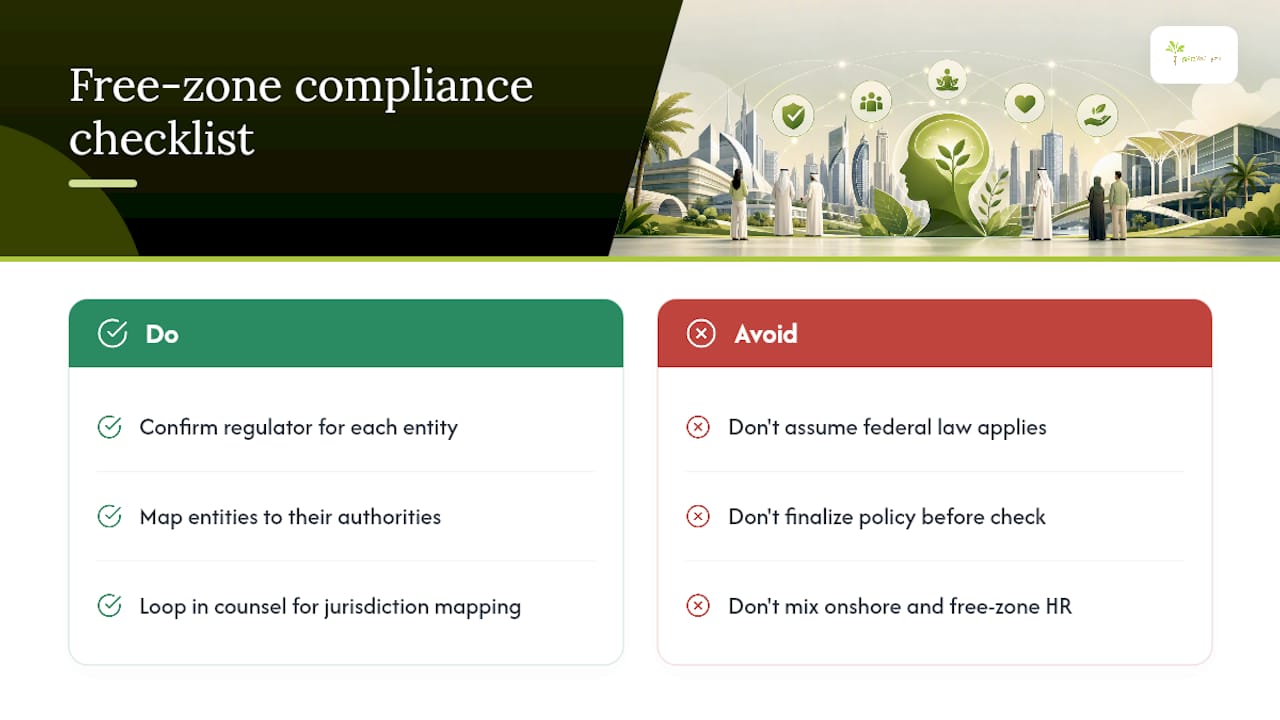
Federal law applies broadly across the UAE, but free zones complicate the picture. DIFC and ADGM operate under distinct regulatory frameworks in several areas, and mental health legislation UAE employers rely on may interact differently depending on where an entity is registered.
The practical rule is simple: confirm which regulator actually governs your entity before assuming federal provisions apply wholesale. A briefing from Morgan Lewis flags this diligence gap as one employers frequently miss, especially multinationals running both onshore and free-zone operations under one HR umbrella. If your business spans jurisdictions, loop in legal counsel to map which entity answers to which authority before finalizing policy language.
A practical employer checklist for compliance
Turning legal text into daily practice takes a few concrete moves. Here’s where to start:
- Update policy documents. Rewrite confidentiality clauses, reasonable adjustment procedures, and mental health leave processes to reflect the law’s language.
- Build referral pathways. Designate an internal single point of contact for mental health concerns, and make sure managers know who that person is.
- Train managers. Frontline supervisors need to recognize warning signs and understand when to refer rather than manage a situation themselves.
- Vet your vendors. Before referring an employee to any provider, verify facility licensing and staff credentials against Cabinet Resolution 213’s requirements.
- Document everything. Keep records of policy rollouts, training sessions, and referral outcomes. Routine audits protect you if compliance is ever questioned.
Our UAE HR guide walks through each of these steps with more operational detail.
Pro Tip: Treat your vendor checklist as a living document. Licensing renews, staff turn over, and a provider that was compliant last year needs re-verification, not assumed continuity.
What this law means for UAE employers and HR leaders
This law raises the bar on employer responsibility, and that’s a genuinely good thing. Mental health now sits inside occupational health and safety, not off in a separate HR silo where it’s easy to deprioritize. The employers who get ahead of this won’t be the ones scrambling to write policy after a complaint lands. They’ll be the ones who already built prevention and early support into how they operate, often through structured partnerships with licensed workplace wellbeing providers.
— Neelam
How Inspire Wellness helps you meet these obligations
Inspire-wellness gives UAE employers a faster path to compliance than building a mental health program from scratch. Rather than assembling policy templates, vendor lists, and manager training independently, you get an in-market partner that already understands Federal Law No. 10’s requirements and the executive regulation’s licensing standards.
Our offerings include policy advisory support, manager training on recognizing and responding to mental health concerns, employee wellbeing coaching, and vendor selection guidance that checks against the licensing standards Cabinet Resolution 213 requires. The Wellness Pyramid framework structures these pieces into one program rather than scattered initiatives, which matters when legal or compliance stakeholders ask how your mental health strategy actually holds together.
If your organization needs a compliance-aligned wellbeing assessment, get started with Inspire Wellness’s corporate wellness programs and find out where your current policies stand against the new law.
Where to verify the official law and guidance
- Federal Law No. (10) of 2023 On Mental Health — full legislative text
- Cabinet Resolution No. (213) of 2025 — executive regulations
- UAE Government mental health guidance and MOHAP national policy
This article is general information, not a substitute for advice from a qualified lawyer. Consult a qualified legal professional about your own circumstances before acting on anything here.
Sources
- Federal Law No. (10) of 2023 On Mental Health
- Cabinet Resolution No. (213) of 2025 Regarding the Executive Regulation of Federal Law No. (10) of 2023 Regarding Mental Health
- The UAE’s new Mental Health Law comes into effect – DLA Piper