The most effective wellness incentives reward participation and process, not health outcomes, and offer employees a real choice in how they’re recognized. Cash bonuses, points systems, extra time off, and subsidized services all work when they’re tied to clear program goals and open to every employee regardless of health status. The idea list, budget tiers, and design checklist below show you how to build that structure.
TL;DR:
- Incentives should reward participation and process, such as workshop attendance or engagement, rather than health outcomes like weight loss or cholesterol reduction.
- Program success depends on setting measurable goals, offering reward choices, protecting confidentiality, and engaging leadership from the start.
- Participation rates typically double with incentives, reaching around 40%, but focus on equitable reach and sustained engagement over time.
- Tailored programs that combine incentives with organizational changes and environmental supports outperform generic perks and improve overall engagement.
- Pilot programs with visible leadership support, clear communication, and flexible reward options to avoid common pitfalls and ensure long-term success.
Table of Contents
- How Do Wellness Incentives for Employees Actually Work?
- Which Incentive Type Fits Your Budget?
- Aligning Incentives With Program Goals: A Design Checklist
- What Metrics Actually Prove Your Program Is Working?
- Why Tailored, Evidence-Based Programs Outperform Generic Perks
- Your Launch Checklist and the Mistakes to Avoid
- What 30 Days of Running These Programs Taught Me
- How Inspire-wellness Helps You Build a Program That Sticks
- Sources
How Do Wellness Incentives for Employees Actually Work?
Wellness incentives for employees are rewards, monetary or otherwise, that organizations offer to encourage staff to engage with health-related programs, from mental health coaching to fitness challenges to financial wellness workshops. The industry term you’ll see in HR circles is “incentivized wellness programming,” and it covers everything from a $20 gift card for completing a health assessment to a full points-based recognition platform tied to annual performance reviews.
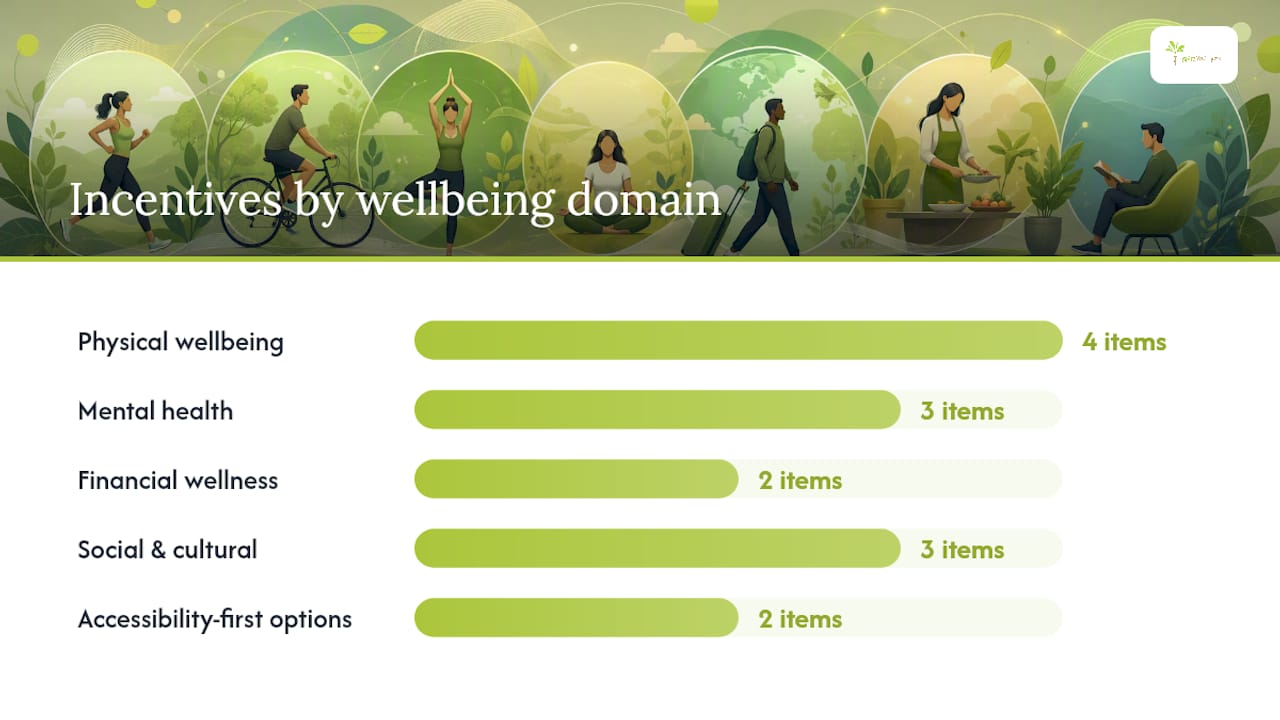
Here are 14 incentive ideas organized by wellbeing domain, ranked roughly by ease of implementation.
Physical wellbeing:
- Subsidized gym memberships or fitness class credits — best for younger, health-active staff; mid budget tier; template: “Attend 8 classes this quarter → earn a $50 credit.”
- Standing desk or ergonomic equipment stipend — best for desk-based teams; low to mid budget; roll out during onboarding for maximum uptake.
- Walking challenge with team leaderboards — best for distributed or hybrid teams; no-cost to low budget; pairs well with a workplace fitness initiative built into the office layout itself.
- On-site health screenings with a small thank-you gift — best for larger campuses; low budget; template: “Complete your screening → earn a wellness kit.”
Mental health:
5. Points for completing a resilience or stress-management workshop — best for high-pressure teams like finance or client-facing roles; no-cost if led internally; template: “Complete this workshop → earn 100 points.”
6. Subsidized therapy or coaching sessions — best for any workforce with elevated burnout risk; mid to premium budget.
7. Mental health days that don’t require a doctor’s note — best for all segments; no direct cost beyond productivity planning.
Financial wellness:
8. Financial literacy workshop attendance rewards — best for early-career or hourly staff; no-cost to low budget.
9. 401(k) or retirement-match boosts tied to participation in a budgeting course — best for mid-career employees; premium budget.

Social and cultural:
10. Peer recognition programs with redeemable points — best for team-based cultures; low budget; scalable with any HR platform.
11. Volunteer day stipends — best for mission-driven organizations; low to mid budget.
12. Team wellness challenges with shared rewards — best for competitive cultures; no-cost to low budget.

Accessibility-first options:
13. Flexible reward menus (choose cash, gift card, or extra PTO) — best for diverse or multigenerational workforces; low to mid budget.
14. Quiet-hour accommodations paired with a recognition badge — best for neurodiverse employees; no cost.
Process-based incentives consistently reduce unintended harms compared with outcome-based rewards like “lose 10 pounds” or “lower your cholesterol,” because they don’t penalize employees managing chronic conditions or disabilities. Reward the workshop attendance, not the weigh-in.
Which Incentive Type Fits Your Budget?
Wellness incentives generally fall into five categories: monetary rewards, non-monetary recognition, time-off credits, subsidized services, and insurance-linked perks. Each comes with its own budget footprint, and most organizations blend two or three types rather than committing to just one.
Here’s how the tiers typically break down:
- No-cost: Peer recognition shoutouts, flexible scheduling, quiet-hour accommodations, internally led workshops.
- Low tier (under $100 per employee): Gift cards, wellness kits, walking challenge prizes, financial literacy sessions run by a partner bank.
- Mid tier ($100 to $300 per employee): Gym membership subsidies, coaching session bundles, ergonomic equipment stipends.
- Premium tier ($300 and up): Ongoing therapy subsidies, retirement-match boosts, comprehensive coaching engagements, or a full coaching program built around measurable outcomes.
Cash incentives and gift cards are usually taxable as income in most jurisdictions, while some wellness-specific benefits (like on-site fitness facilities) may carry different tax treatment. Payroll implications vary by country and even by state or emirate, so verify the rules with your local tax authority or payroll provider before finalizing any monetary incentive structure. Don’t assume what worked at a previous employer transfers directly.
Aligning Incentives With Program Goals: A Design Checklist
Every incentive should trace back to a specific, measurable program goal. Guessing at what employees want wastes budget and erodes trust when the rewards miss the mark.
- Run a workplace health assessment first. Survey employees anonymously about stress levels, financial concerns, and physical health priorities before designing anything.
- Set one measurable goal per incentive. “Increase workshop attendance by 25%” is actionable; “improve wellbeing” is not.
- Reward process over outcome. Attendance, participation, and completion are fair; weight loss or blood pressure targets are not, per Volpp et al.’s incentive design research.
- Build in reward choice. Offer at least two redemption options so employees with disabilities or cultural constraints can participate equitably.
- Protect confidentiality. Never link individual health data to incentive eligibility in a way that’s visible to managers.
- Set a communication cadence. Announce the program, remind mid-cycle, and celebrate completions.
- Assign governance. One owner (usually HR) should track eligibility, budget, and vendor performance.
When vetting a wellness vendor, ask directly: How do you measure engagement versus outcomes? What data do you share with employers, and how is it anonymized? Can rewards be customized by segment?
Pro Tip: Pilot a single incentive with two reward formats, points versus a small cash bonus, before rolling it out company-wide. You’ll learn which format your workforce actually responds to in weeks, not quarters.
What Metrics Actually Prove Your Program Is Working?
Participation rate is the metric most HR teams track first, and for good reason: it’s the leading indicator that predicts everything else. Track it alongside sustained engagement (do employees return after month one?), reach (what percentage of eligible staff enrolled?), and satisfaction scores from a short post-program survey.
- Participation rate: enrolled employees divided by eligible employees, tracked monthly.
- Sustained engagement: percentage of participants still active after 90 days.
- Reach across segments: compare participation by department, tenure, and role level to catch equity gaps.
- Satisfaction and self-reported confidence: a two-question pulse survey after each program cycle.
Employer surveys show incentives roughly double participation, with median rates near 40% when incentives are offered versus around 20% without. But watch for selection effects: randomized controlled trial evidence shows healthier and higher-paid employees participate more readily, which can skew your results and mask whether the program is reaching the people who need it most. Review metrics quarterly, and treat any short-term cost-savings claim with caution since the evidence on medical cost reductions remains mixed.
Why Tailored, Evidence-Based Programs Outperform Generic Perks
A gym discount blasted to the entire company rarely moves the needle the way a tailored program does. The CDC’s workplace health model makes the case clearly: individual incentives only work when paired with organizational supports, policies, benefits, and physical environment changes that make healthy choices the easy default.
Programs that combine incentives with environmental and policy supports, rather than incentives alone, consistently show stronger and more equitable engagement across the workforce.
Inspire-wellness built its Wellness Pyramid framework around this exact principle, layering physical, mental, emotional, and financial supports rather than relying on a single perk. Three ways to adapt this to your workforce: segment incentives by department risk profile, pair every reward with a policy change (flexible hours, quiet spaces), and revisit your reward menu every six months as workforce needs shift.
Your Launch Checklist and the Mistakes to Avoid
Launch with a pilot, not a full rollout. Secure visible leadership sponsorship, publish a communications schedule, issue a clear data privacy notice, and lock in vendor contracts before day one.
- Pilot with one department for 4 to 6 weeks.
- Get a senior leader to personally announce the program.
- Publish a privacy notice explaining exactly what data is collected.
- Build a reward calendar so employees know when redemptions happen.
- Review vendor contracts for renewal terms and data-handling clauses.
The most common pitfalls: leaning entirely on cash rewards (it excludes tax-sensitive employees and burns budget fast), surprising staff with health data requests they didn’t expect, and applying one incentive structure to every department. If early enrollment stalls, don’t scrap the program. Survey the non-participants directly and adjust the reward menu before month two ends.
What 30 Days of Running These Programs Taught Me
Two lessons stick out from watching incentive programs launch and stall. First, the programs that survive are the ones leadership visibly champions from week one, not just funds. Second, reward menus that offer real choice consistently outperform single-option cash rewards, even when the cash value is higher.
If you’re starting from scratch, run a two-week pilot with a points-based reward and a short leadership announcement. Measure enrollment before you commit further budget.
— Neelam
How Inspire-wellness Helps You Build a Program That Sticks
Inspire-wellness gives you what most in-house teams can’t build alone: a tested framework instead of a guessing game. Where generic wellness vendors sell one-size-fits-all perks, Inspire-wellness designs coaching, resilience training, and incentive structures around your workforce’s actual risk profile, using the Wellness Pyramid to layer physical, mental, financial, and social supports into one coherent strategy.
Our coaching engagements and tailored program design work precisely because they start with your organization’s data, not a template pulled from a competitor’s playbook. If you’re ready to move past scattered perks toward a structured, evidence-informed rollout, the workplace wellbeing improvement guide walks HR teams through the exact planning steps, from baseline assessment to reward calendar. Download it, then schedule a discovery call with our team to map out a pilot for your organization.
Sources
- Volpp KG et al. — Incentives and health behavior: the role of outcomes vs. participation
- CDC — Building Blocks of Workplace Health