Building a wellbeing culture means making employee wellbeing part of daily work and leadership behavior, not an add on program. Start this week with three moves: secure visible executive commitment, run a short pulse survey, and choose one pilot team to test changes before you scale them.
Here’s what that looks like in practice:
- Get a leader on record. Ask your CEO or a senior leader to state, in writing or in a town hall, that wellbeing is a business priority tied to specific behaviors (protecting focus time, modeling boundaries). This is the single highest-leverage action you can take, because leader behavior change is the multiplier for everything that follows.
- Run a 3-question pulse survey. Ask about workload, psychological safety, and manager support. Keep it under two minutes to complete.
- Pick one pilot team. Choose a team with an engaged manager, not necessarily your highest performing one.
Within a short time frame you should have a baseline pulse score, a documented leader commitment statement, and a pilot engagement rate you can report back to the executive team.
Key Takeaways
A wellbeing culture takes hold when leaders model specific behaviors, HR measures those behaviors consistently, and policy changes reinforce daily work rather than sitting beside it.
| Point | Details |
|---|---|
| Start with leadership, not perks | Secure a visible executive commitment statement before launching any program. |
| Pilot before you scale | Test policy or program changes with one team over 90 days with pre and post pulse data. |
| Measure behavior, not sentiment | Track manager scorecards on check-in frequency and boundary setting, not just survey mood. |
| Embed wellbeing into core HR processes | Add workload questions to hiring, onboarding, and performance reviews so gains don’t depend on a side program. |
| Work with a structured partner | Inspire Wellness builds an assessment-to-pilot pathway with measurable dashboards rather than a one-off perk catalog. |
Table of Contents
- Why Build a Wellbeing Culture: The Benefits HR Should Measure
- What Core Principles Should Guide a Wellbeing Culture?
- What Does Wellbeing Leadership Actually Look Like Day To Day?
- How Should HR Design Policies That Reinforce Culture, Not Perks?
- How Do You Measure a Wellbeing Culture?
- How Do You Embed Wellbeing Into HR Processes?
- How Does a Wellness Provider Operationalize This Pathway?
- Prioritizing Action Over Perfection: A 12-Month Roadmap
- Ready to Move From Pulse Survey to Pilot Program?
- Where to Go Deeper on Wellbeing Culture Research
- Sources
Why Build a Wellbeing Culture: The Benefits HR Should Measure
Culture, not perks, is what moves the needle on burnout and retention. Peer reviewed research on organizational change shows that culture-led wellbeing improvements require multidisciplinary engagement and leadership commitment, not a wellness app rolled out to everyone at once. Teams that get sustained leader attention on wellbeing see measurable gains in engagement and lower turnover intent, while teams that only receive one-off perks rarely show the same durability.
Wellbeing is a leadership competence, not a benefit. The Harvard Business Review has argued that framing wellness around individual self-care undermines its impact, because it puts the burden on employees to fix a problem that workload design and management practice actually created. Reframe wellbeing internally as a skill leaders practice daily, the same way you’d treat budget management or performance coaching.
Four outcomes HR can realistically tie to a wellbeing culture investment include lower voluntary turnover in pilot teams compared to the company average, improved absenteeism trends following manager coaching rollouts, higher psychological safety scores on repeated pulse surveys, and faster time to productivity for new hires who go through a wellbeing-integrated onboarding process.
Pro Tip: When you present this business case to leadership, lead with the retention and absenteeism numbers specific to your organization’s pilot, not industry averages. A number your CFO recognizes from your own payroll data lands harder than a benchmark from someone else’s company.
What Core Principles Should Guide a Wellbeing Culture?
Six focus areas show up consistently across workplace research, and HR needs a working definition and a diagnostic signal for each one.
- Psychological safety. People can raise concerns or admit mistakes without fear of punishment. Signal to watch: how often employees speak up in team meetings versus stay silent until a one-on-one.
- Belonging and connection. Employees feel part of a team, not just present on an org chart. Distributed and hybrid teams need connection designed deliberately rather than assumed from proximity.
- Workload design. Work is distributed realistically across a team, with recovery time built in. Signal: consistent after-hours message volume or unused vacation days.
- Flexibility. Employees have real control over when and how they work, within clear boundaries. Signal: whether flexible policies exist on paper but get quietly penalized in practice.
- Recognition. Contributions get acknowledged specifically and often, not just at annual reviews. Signal: whether recognition mentions concrete actions or stays generic.
- Physical health support. Movement, ergonomics, and preventive health are built into the workday, not left to personal time.
The HERO Culture of Health framework identifies 24 such elements, most of them tied to shared values, communication, measurement, and reward alignment rather than standalone programs.
Pro Tip: If your budget only covers one or two focus areas this year, prioritize workload design and manager capability first. Both produce visible behavior change across a whole team fast, without requiring an enterprise-wide rollout.
What Does Wellbeing Leadership Actually Look Like Day To Day?
Leadership is where a wellbeing culture either takes root or quietly dies, regardless of what your policy documents say. CCL’s research maps wellbeing leadership to six observable components: purpose, growth, health, agency, connection, and resilience. Each one has a plain behavioral test.

A leader modeling purpose connects daily tasks to a larger reason the work matters, out loud, in team meetings. A leader modeling agency gives people real choices in how they complete work, rather than dictating method alongside deadline. Resilience shows up as a leader who names their own setbacks openly instead of projecting constant composure.
Three habits change team norms faster than a formal training module:
- Boundary setting. A leader who stops sending emails after 7 PM signals more than any wellness policy memo.
- Walk-and-talks. Moving one-on-ones outdoors or away from a desk changes the tone of the conversation and normalizes movement during the workday.
- Structured check-ins. A consistent opening question like “what’s one thing taking more energy than it should this week?” surfaces workload issues before they become resignations.
To make these habits stick, pair them with a short leadership development sequence: a workshop introducing the six components, followed by monthly coaching check-ins and a simple manager scorecard tracking adoption of one or two behaviors per quarter. Our guide to workplace wellbeing tips for managers breaks down check-in templates you can adapt directly.
Pro Tip: Score leaders on behavior frequency, not intention. “Did this manager hold four structured check-ins this quarter?” is measurable. “Does this manager care about wellbeing?” is not.
How Should HR Design Policies That Reinforce Culture, Not Perks?
Programs fail when they sit on top of an unchanged operating rhythm. A resilience workshop scheduled during an unmanageable sprint tells employees the company doesn’t believe its own material.
Start with structural changes to how work actually happens:
- Meeting norms. Default to 25 or 50 minute meetings and require an agenda before anyone can book a slot.
- Focused work windows. Block two to three hours daily as no-meeting time, protected at the calendar level.
- Asynchronous collaboration rules. Define which decisions require a live conversation and which can move through written updates, cutting unnecessary real-time demands.
Once those norms exist, layer in a program mix built around what each format is actually good for. Manager coaching builds daily behavior change and fits any budget size. Resilience training helps teams facing sustained pressure, like finance close periods or product launches. An employee assistance program provides confidential, clinical-grade support for individuals in crisis. Wellbeing coaching supports leaders and high-potential employees working through specific personal or professional friction. Our 10 ways to support employee mental health at work walks through how to sequence these for a first-year rollout.
A wellness program is tokenistic when it exists to generate a press release, not to change a Tuesday afternoon for the people who use it. If a benefit gets announced once and never mentioned by a manager again, employees notice the silence faster than they noticed the launch.
Red flags include a wellness offering with near-zero usage after month one, or a program that leadership never references outside of open enrollment. If you spot either, pull the relevant manager into a short conversation about whether the offering solves a problem their team actually has.
How Do You Measure a Wellbeing Culture?
You cannot manage what you don’t track, and a wellbeing culture without measurement drifts back into whatever the loudest manager prefers. WorkSafe Victoria’s WorkWell toolkit recommends employee surveys, focus groups, and leadership development as the core measurement steps, paired with repeated assessment rather than a single annual check.
Build your measurement stack in three layers:
- A 3 to 5 question pulse, run monthly, covering workload, psychological safety, and manager support.
- An annual culture assessment, going deeper into belonging, flexibility, and recognition across the full workforce.
- Manager scorecards, tracking behavior adoption (check-in frequency, boundary modeling) rather than sentiment alone.
| Instrument | Cadence | Primary metric |
|---|---|---|
| Team pulse survey | Monthly | Psychological safety score |
| Annual culture assessment | Yearly | Belonging and flexibility index |
| Manager scorecard | Quarterly | Behavior adoption rate |
| HR retention dashboard | Quarterly | Voluntary turnover, absenteeism trend |
Review results on a quarterly cycle and turn every review into an action plan with named owners, not just a slide deck that gets archived. Our guide to corporate wellbeing metrics walks through target-setting for each KPI in more depth.
How Do You Embed Wellbeing Into HR Processes?
A wellbeing culture only lasts if it lives inside the processes HR already runs, not beside them as a parallel initiative that competes for attention.
- Hiring: Add one interview question that surfaces how candidates handle workload conflict, and have hiring managers describe workload realistically rather than selling an idealized version of the role.
- Onboarding: Introduce a new hire’s manager check-in rhythm and flexibility norms in week one, not buried in a policy handbook nobody reads.
- Performance conversations: Include a standing question about workload sustainability alongside output review, so managers can’t separate results from how they were achieved.
- Recognition criteria: Reward behaviors that support team wellbeing (delegation, mentoring, sustainable pacing) alongside individual output metrics.
- Pilot testing: Run these process changes with one department for one quarter before rolling them out company-wide, and compare pulse scores before and after.
This sequencing matters more than the individual changes. A 90 day pilot with pre and post pulse measurement and manager coaching gives you defensible evidence before you ask leadership to fund a wider rollout.
How Does a Wellness Provider Operationalize This Pathway?
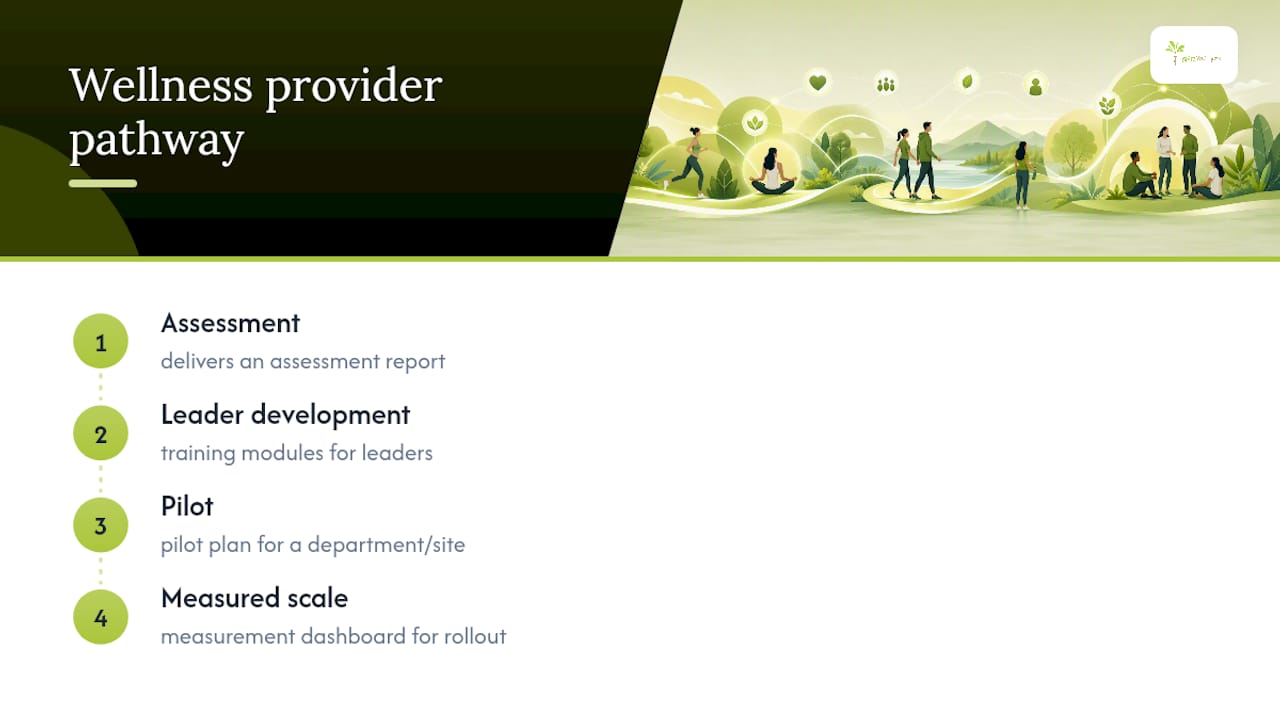
Inspire Wellness structures this work as assessment, leader development, pilot, and measured scale, delivering an assessment report, leader training modules, a pilot plan, and a measurement dashboard. When evaluating any provider, ask for clear deliverables, access to your own pulse data, and a realistic timeframe. The pathway suits organizations from single-department pilots to multi-site rollouts.
Prioritizing Action Over Perfection: A 12-Month Roadmap
Month one is about visibility: get a leader commitment on record, run your first pulse, and pick a pilot team. Month three is about proof: coach pilot managers, measure the shift, and adjust one or two policies based on what the data shows. By month twelve, scale what worked into performance and rewards processes, and publish the results internally so the case for continued investment makes itself.
— Neelam
Ready to Move From Pulse Survey to Pilot Program?
Most HR teams don’t lack ideas for building a wellbeing culture. They lack a structured way to test one before committing budget to it company-wide. Inspire Wellness runs a short diagnostic against your existing culture data, then builds a pilot proposal around behavioral science principles and the leadership components covered above, rather than handing you a generic wellness catalog.
A typical diagnostic runs two to three weeks and produces a baseline report, a recommended pilot design, and a measurement plan tied to KPIs your executive team will actually recognize. That matters because a program without measurable outputs is the exact tokenism trap this article warned against. If you’re preparing an RFP or internal brief, ask any provider you’re considering how they measure behavior adoption, not just satisfaction. Explore Inspire Wellness’s corporate wellness programs to see how the assessment-to-pilot pathway is structured, and request a diagnostic conversation to see what your own baseline data would show.
Where to Go Deeper on Wellbeing Culture Research
- HERO’s Culture of Health framework lists 24 elements for designing culture around shared values and measurement.
- CCL’s wellbeing leadership resources detail the six leader behaviors linked to team engagement gains.
- WorkSafe Victoria’s WorkWell toolkit offers assessment steps for building a mentally healthy workplace.
- Building a thriving workplace covers additional practitioner strategies for sustaining culture change over time.
Sources
- Create better culture: the keys to wellbeing and leadership | CCL
- Culture of Health definition and elements | HERO
- What builds a wellbeing culture — and what gets in the way | PMC
- WorkWell toolkit: culture and its role supporting a mentally healthy workplace | WorkSafe Victoria